What Are the Different Types of Statistical Studies?
TL;DR
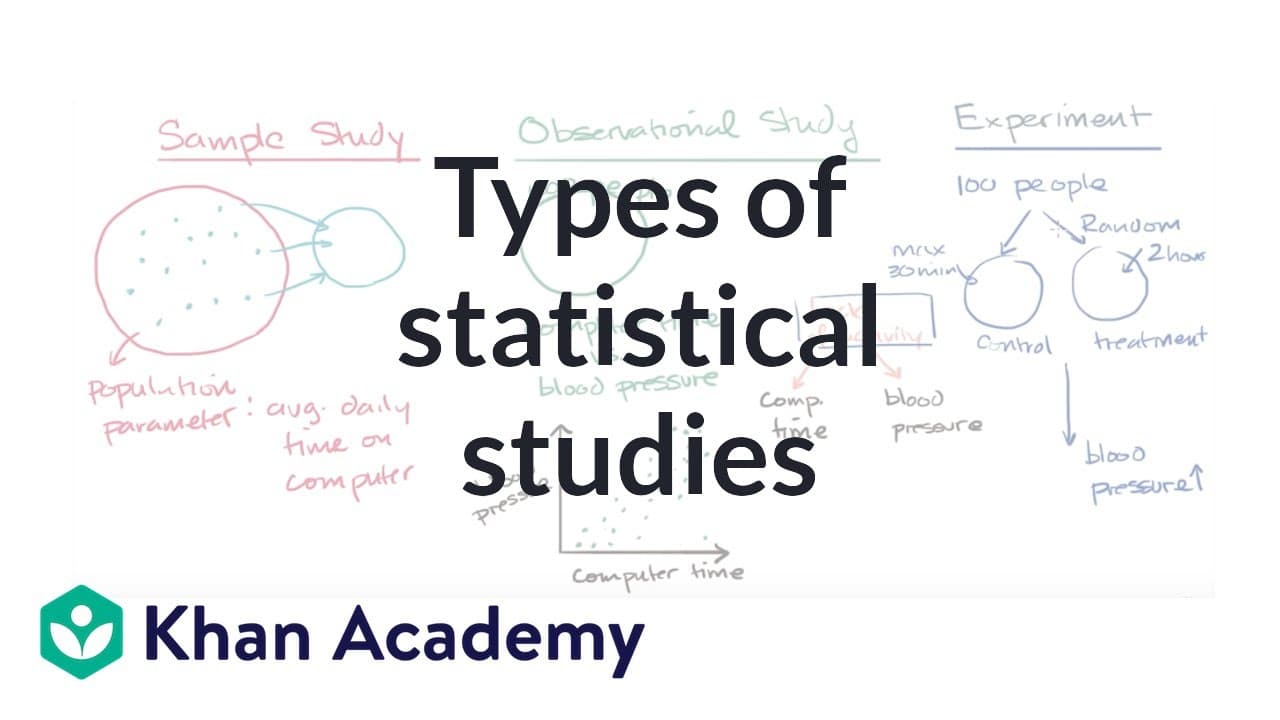
There are three main types of statistical studies: sample studies, observational studies, and experiments. Sample studies estimate population parameters through random sampling, observational studies examine correlations without establishing causality, and experiments seek to prove causation by manipulating variables in controlled environments. Understanding these concepts is crucial for effective statistical analysis.
Transcript
- [Instructor] Talk about the main types of statistical studies. So you can have a sample study and we've already talked about this in several videos but we'll go over it again in this one. You can have an observational study, observational study. Or you can have an experiment, experiment. So let's go through each of these and always pause this vid... Read More
Key Insights
- ❓ Sample studies estimate population parameters by randomly sampling individuals and determining the average for the sample.
- ❓ Observational studies explore correlations between variables but cannot establish causality.
- 😖 Confounding variables can influence the relationship between variables in observational studies.
- 👥 Experiments are used to establish causality by manipulating variables and observing their effects in control and treatment groups.
- 😖 Random assignment is crucial in experiments to avoid confounding variables.
- 👨🔬 Observational studies and experiments serve different purposes in statistical research.
- ❓ Correlations observed in observational studies should not be interpreted as causation.
Install to Summarize YouTube Videos and Get Transcripts
Explore YouTube Video Summarizer or Get YouTube Transcript Extractor
Questions & Answers
Q: What is the main goal of a sample study?
The main goal of a sample study is to estimate the value of a population parameter by randomly sampling individuals and determining the average for the sample, which serves as an estimate for the population parameter.
Q: How are observational studies different from sample studies?
While sample studies aim to estimate a parameter, observational studies focus on exploring correlations or relationships between two variables in a population without establishing causality.
Q: Why is it important not to conclude causality in observational studies?
Observational studies cannot establish causality because there may be confounding variables that drive both variables being studied. Correlations observed in the data may not imply causation.
Q: How do experiments help establish causality?
Experiments involve randomly assigning individuals to control and treatment groups, manipulating a variable in the treatment group, and observing the effects on another variable. By controlling for confounding factors, experiments provide evidence for causality.
Summary & Key Takeaways
-
Sample study: In a sample study, researchers estimate the value of a parameter for a population by randomly sampling individuals and determining the average for the sample, which serves as an estimate for the population parameter.
-
Observational study: Observational studies aim to understand how two parameters in a population might move together or not. Researchers collect data from individuals in a population and look for correlations or relationships between variables.
-
Experiment: Experiments are used to establish causality. Researchers randomly assign individuals to control and treatment groups, manipulate a variable in the treatment group, and observe the effects on another variable.
Read in Other Languages (beta)
Share This Summary 📚
Summarize YouTube Videos and Get Video Transcripts with 1-Click
Try YouTube Summary with ChatGPT & Claude or YouTube Transcript Generator
Explore More Summaries from Khan Academy 📚



Summarize YouTube Videos and Get Video Transcripts with 1-Click
Try YouTube Summary with ChatGPT & Claude or YouTube Transcript Generator