Concept of Stress Part 1
TL;DR
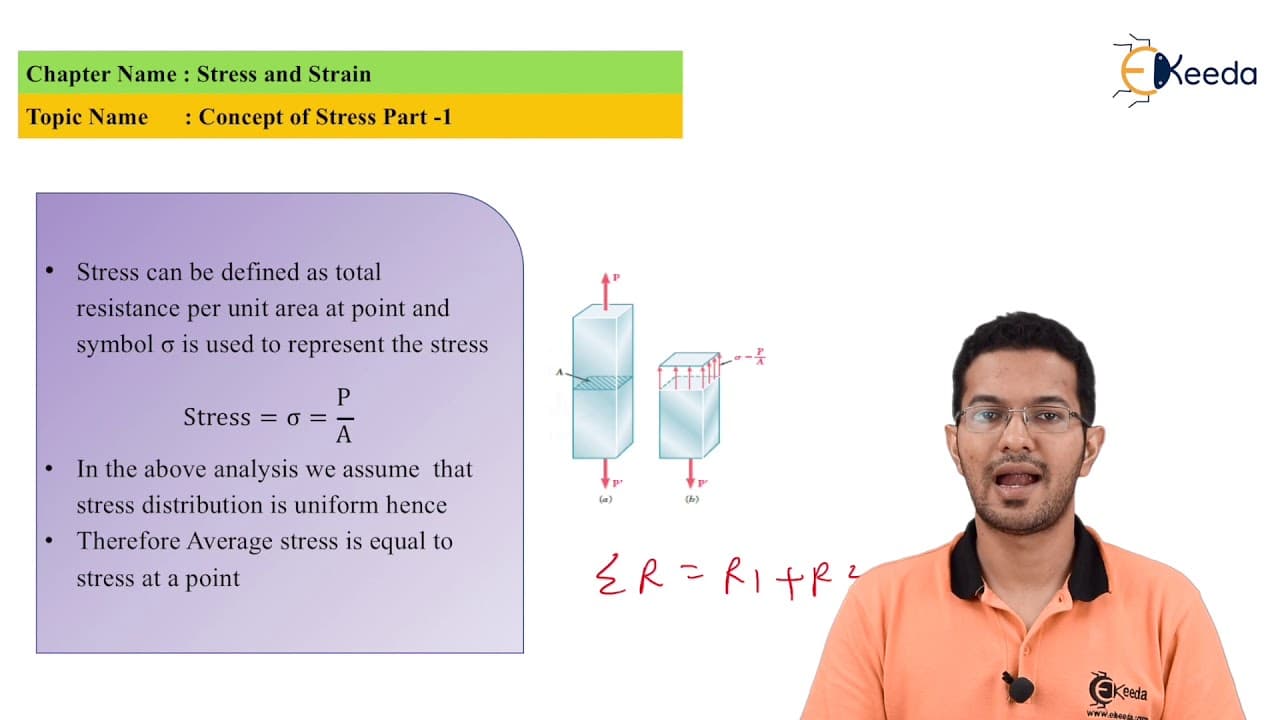
Stress is the total resistance per unit area in a deformable body and is determined by the applied load and cross-sectional area.
Transcript
let's start with the concept of stress we know that when we apply an external load on a deformable body there is some deformation in the body and it doesn't matter how small it is but still there is some amount of deformation let's take a bar which is subjected to a load P as shown in the figure a due to this load there is a deformation in the bar ... Read More
Key Insights
- 🇦🇪 Stress is the total resistance per unit area experienced by a deformable body when an external load is applied.
- ⚖️ The internal resistance force must be balanced with the applied load for static equilibrium to be achieved.
- 😵 Stress is not directly measurable but can be calculated by dividing the applied load by the cross-sectional area.
- 😵 Stress is dependent on the applied load and the cross-sectional area of the body.
- 0️⃣ If the resistance force is zero, the stress will be zero.
- ❓ Stress is not a measurable quantity but can be calculated using experimental techniques to measure strain.
- ❓ Stress is not a property but a result of the existence of resistance in a deformable body.
Install to Summarize YouTube Videos and Get Transcripts
Explore YouTube Video Summarizer or Get YouTube Transcript Extractor
Questions & Answers
Q: What is stress and how is it related to deformable bodies?
Stress is the total resistance per unit area in a deformable body when an external load is applied. It is directly related to the deformation caused by the applied load.
Q: How can stress be measured in a deformable body?
Stress cannot be directly measured, but it can be calculated by balancing the internal resistance force with the applied load using force balancing equations.
Q: What are the three conditions for total internal resistance force to be balanced with an applied load?
The three conditions are: 1) When the total internal resistance force is greater than the applied load, 2) When the total internal resistance force is less than the applied load, and 3) When the total internal resistance force is equal to the applied load, which represents static equilibrium.
Q: How is stress defined and calculated?
Stress is defined as the total resistance per unit area at a point. It can be calculated by dividing the applied load (P) by the cross-sectional area (A), which gives the stress (σ = P/A).
Summary & Key Takeaways
-
Stress is the resistance experienced by a deformable body when an external load is applied, causing deformation.
-
To measure stress, the internal resistance force must be balanced with the applied load using force balancing equations.
-
Stress can be defined as the total resistance per unit area at a point, denoted by the symbol Sigma (σ).
Read in Other Languages (beta)
Share This Summary 📚
Summarize YouTube Videos and Get Video Transcripts with 1-Click
Try YouTube Summary with ChatGPT & Claude or YouTube Transcript Generator
Explore More Summaries from Ekeeda 📚

Summarize YouTube Videos and Get Video Transcripts with 1-Click
Try YouTube Summary with ChatGPT & Claude or YouTube Transcript Generator