Benford's law explanation (sequel to mysteries of Benford's law) | Algebra II | Khan Academy
TL;DR
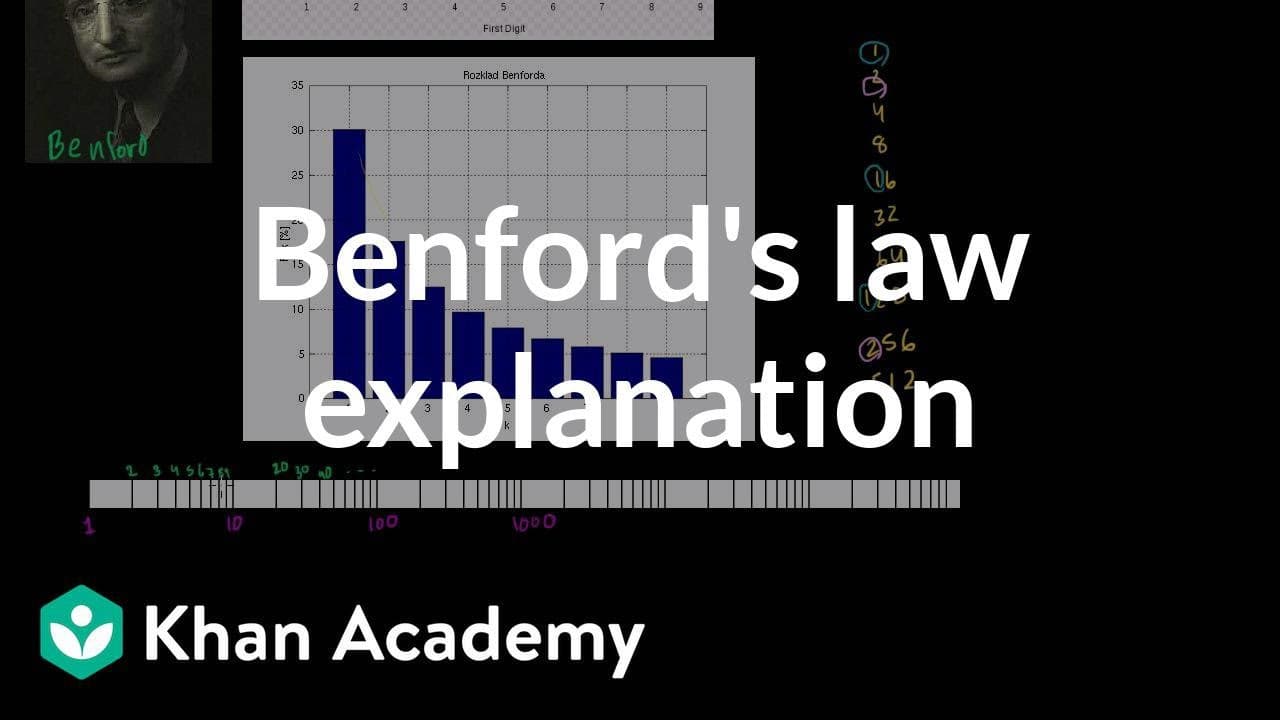
Benford's Law is a mathematical phenomenon where the most significant digit follows a specific distribution, often seen in exponential growth scenarios.
Transcript
SAL: So where we left off in the last video, Vi and myself had posed a mystery to you. We had talked about Benford's law. VI: And we asked, what is up with Benford's law? SAL: This idea that, if you took just random countries and took their population and took the most significant digit in their population and plotted the numbers of countries that ... Read More
Key Insights
- #️⃣ Benford's Law is a statistical phenomenon that explains the distribution of the most significant digit in numbers.
- 👮 The law is commonly observed in exponential growth scenarios, such as population sizes and financial data.
- ✊ Plotting powers of 2 on a logarithmic scale reveals a distribution pattern that aligns with Benford's Law.
- ❓ The occurrence of Benford's Law in physical constants is still not entirely clear and requires further study.
- 🕵️ Benford's Law provides a useful tool for analyzing data and detecting potential anomalies or inconsistencies.
- 🏑 The distribution pattern of Benford's Law can be applied to various fields, including forensic accounting and fraud detection.
- 🌥️ Understanding Benford's Law can help researchers and analysts identify trends and patterns in large datasets.
Install to Summarize YouTube Videos and Get Transcripts
Explore YouTube Video Summarizer or Get YouTube Transcript Extractor
Questions & Answers
Q: What is Benford's Law?
Benford's Law is a mathematical principle that states the most significant digit in numbers is more likely to be 1, followed by 2, 3, and so on, based on a specific distribution pattern.
Q: In what scenarios does Benford's Law apply?
Benford's Law can be observed in exponential growth scenarios, such as population sizes, Fibonacci sequences, powers of 2, and financial data.
Q: Why do the powers of 2 exhibit the same distribution as Benford's Law?
When plotting powers of 2 on a logarithmic scale, the digits are equally spaced apart, creating a distribution pattern that aligns with Benford's Law.
Q: What are some possible explanations for the occurrence of Benford's Law in physical constants?
The connection between Benford's Law and physical constants is still not fully understood, but it is hypothesized that factors such as the units used or various underlying dependencies contribute to this phenomenon.
Summary & Key Takeaways
-
Benford's Law describes the distribution of the most significant digit in numbers, showing that the number 1 is more likely to occur than any other digit.
-
This distribution can be observed in various phenomena, such as population sizes, powers of 2, and financial data.
-
When plotting powers of 2 on a logarithmic scale, the digits are equally spaced apart, providing insight into the distribution pattern.
Read in Other Languages (beta)
Share This Summary 📚
Summarize YouTube Videos and Get Video Transcripts with 1-Click
Try YouTube Summary with ChatGPT & Claude or YouTube Transcript Generator
Explore More Summaries from Khan Academy 📚



Summarize YouTube Videos and Get Video Transcripts with 1-Click
Try YouTube Summary with ChatGPT & Claude or YouTube Transcript Generator