SN1 Carbocation Rearrangements - Hydride Shift & Methyl Shift
TL;DR
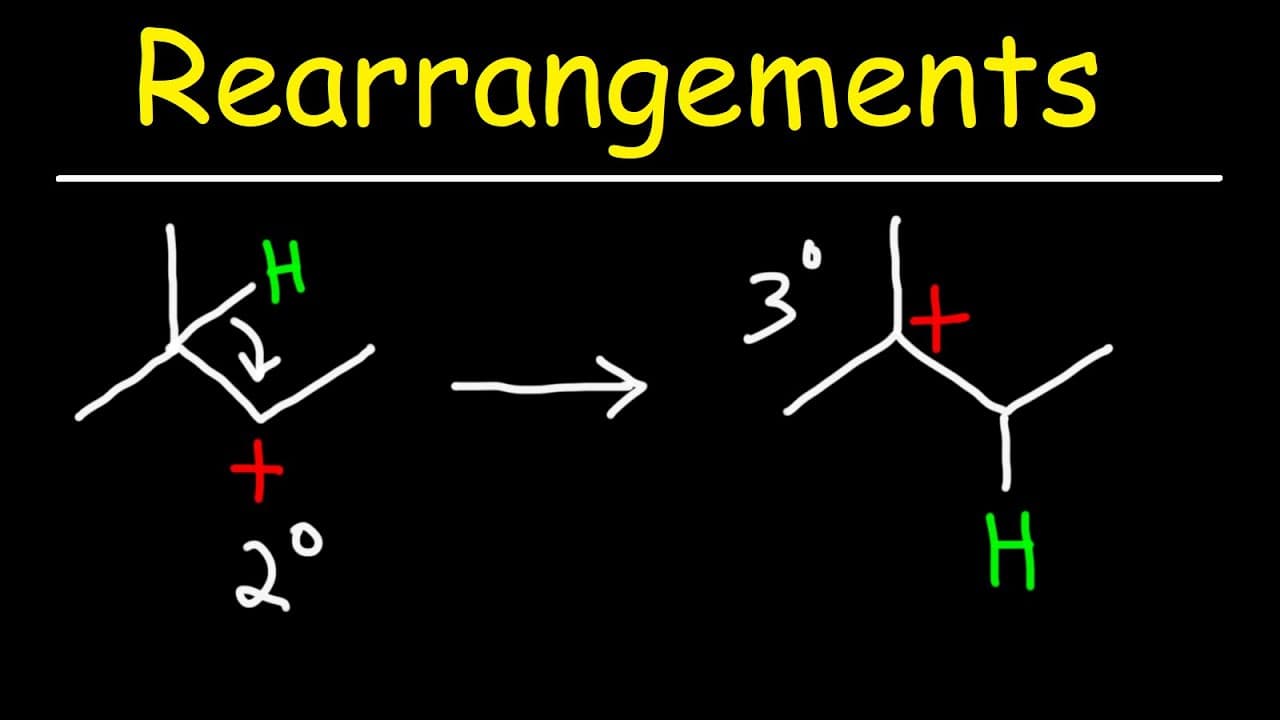
Carbocation rearrangements, specifically hydride shifts and methyl shifts, occur during SM1 reactions to increase stability.
Transcript
in this video we're going to cover sm1 reactions particularly those associated with carbocation rearrangements we're going to talk about the hydride shift and the methyl shift so let's consider this reaction we have a secondary alkyl halide the carbon that bears the bromine is attached to two other carbon atoms so that's why it's secondary and we h... Read More
Key Insights
- ❓ Carbocation rearrangements occur during SM1 reactions to increase stability.
- ❓ Hydride shifts involve the movement of a hydrogen from a tertiary carbon to the carbocation.
- 👥 Methyl shifts involve the movement of a methyl group from a coronary carbon to the carbocation.
- 🧑🏭 Solvolysis reactions occur when the solvent acts as a nucleophile and reacts with the carbocation.
- ❓ Secondary carbocations adjacent to tertiary or coronary carbons are more likely to undergo rearrangements.
- ❓ Tertiary carbocations are more stable than secondary carbocations due to hypoconjugation and the inductive effect.
- ❓ The major product of an SM1 reaction can be affected by carbocation rearrangements.
Install to Summarize YouTube Videos and Get Transcripts
Explore YouTube Video Summarizer or Get YouTube Transcript Extractor
Questions & Answers
Q: What is the driving force for carbocation rearrangements?
The driving force for carbocation rearrangements is stability. If a carbocation can restructure itself to form a more stable state, it will do so.
Q: What is a hydride shift?
A hydride shift occurs when a hydrogen from a tertiary carbon moves to the carbocation, resulting in a more stable carbocation.
Q: What is a methyl shift?
A methyl shift occurs when a methyl group from a coronary carbon moves to the carbocation, leading to a rearrangement of the entire carbon structure.
Q: How does the solvent behave in a solvolysis reaction?
In a solvolysis reaction, the solvent acts as a nucleophile and combines with the carbocation, resulting in the formation of an oxonium ion or an ether.
Summary & Key Takeaways
-
SM1 reactions involve protic solvents and result in first-order nucleophilic substitution.
-
Carbocation rearrangements occur when a more stable state can be formed by rearranging adjacent atoms.
-
A hydride shift occurs when a hydrogen from a tertiary carbon moves to the carbocation, increasing stability.
-
A methyl shift occurs when a methyl group from a coronary carbon moves to the carbocation.
Read in Other Languages (beta)
Share This Summary 📚
Summarize YouTube Videos and Get Video Transcripts with 1-Click
Try YouTube Summary with ChatGPT & Claude or YouTube Transcript Generator
Explore More Summaries from The Organic Chemistry Tutor 📚





Summarize YouTube Videos and Get Video Transcripts with 1-Click
Try YouTube Summary with ChatGPT & Claude or YouTube Transcript Generator