Abstract Class
TL;DR
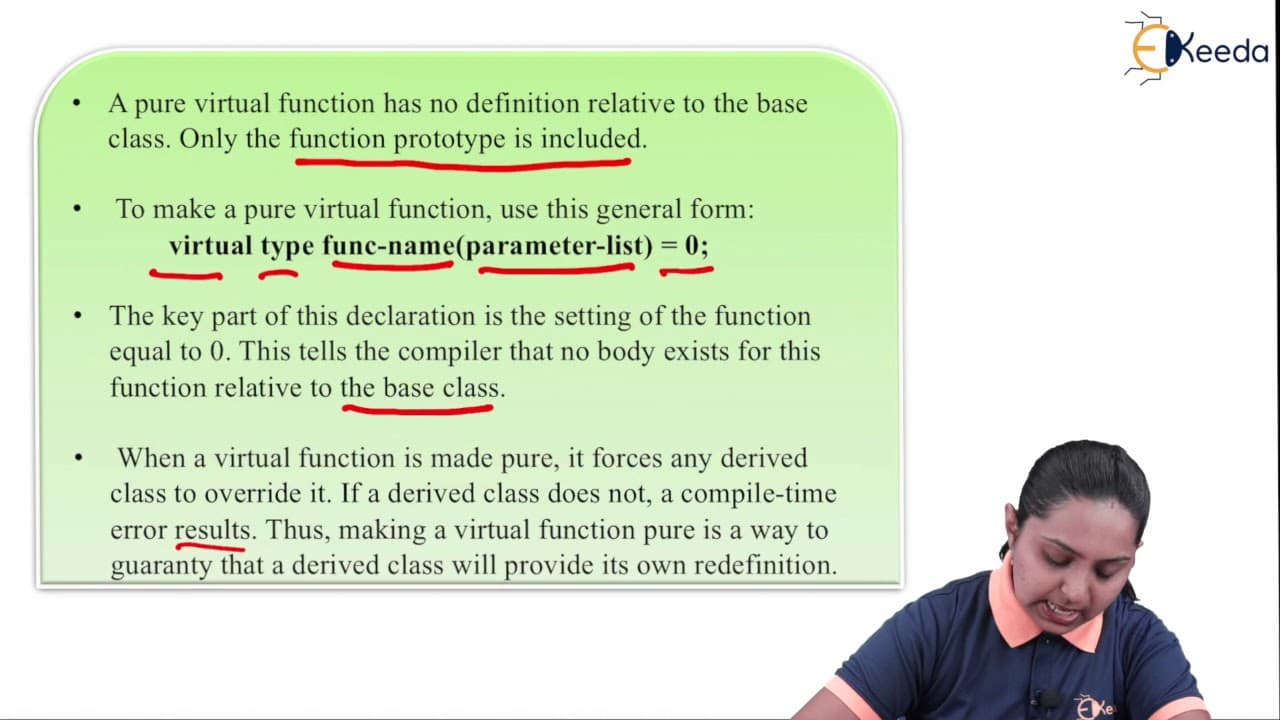
Abstract classes in C++ are classes that contain pure virtual functions, which must be overridden by derived classes. They cannot be instantiated but can be used through pointers or references.
Transcript
hello friends when we are walking with a virtual function for chill function if it is defined purely in the base class without giving the definition in the base class that means we are not providing the implementation part of any virtual function in the base class that type of function is provided in the class is called as a abstract class animal f... Read More
Key Insights
- 🏛️ Abstract classes in C++ are used to create a base class with at least one pure virtual function that must be overridden by derived classes.
- 😒 The use of pure virtual functions ensures that derived classes provide their own implementation.
- 🏛️ Abstract classes cannot be instantiated as objects, but pointers or references to abstract classes can be used for polymorphism.
- 🏛️ Abstract classes are often used to provide a common interface for a set of related classes.
- 🏛️ Creating an abstract class allows for better code organization and enforceability of certain methods across derived classes.
- 🏛️ When a class contains one or more pure virtual functions, it is considered an abstract class.
- 🏛️ The presence of pure virtual functions makes a class an incomplete type, and no object of that class can be created.
Install to Summarize YouTube Videos and Get Transcripts
Explore YouTube Video Summarizer or Get YouTube Transcript Extractor
Questions & Answers
Q: What is an abstract class?
An abstract class in C++ is a class that includes at least one pure virtual function, which means it does not have a definition in the base class. An abstract class cannot be instantiated.
Q: How are pure virtual functions overridden?
Derived classes must override pure virtual functions to provide their own implementation. This ensures that every derived class that inherits from the abstract class must provide a definition for the pure virtual function.
Q: What happens if a derived class does not override a pure virtual function?
If a derived class does not override a pure virtual function, a compile-time error will occur. This is because the base class has declared the function as pure virtual, indicating that it must be overridden by derived classes.
Q: Can abstract classes be used through pointers or references?
Yes, abstract classes can be used through pointers or references. Although objects of abstract classes cannot be created, pointers or references to abstract classes can be created, allowing polymorphic behavior and usage of member functions and variables.
Summary & Key Takeaways
-
An abstract class in C++ is a class that includes at least one pure virtual function, which does not have a definition in the base class.
-
Derived classes must override pure virtual functions to provide their own implementation.
-
Abstract classes cannot be instantiated, but pointers or references to abstract classes can be created and used for runtime polymorphism.
Read in Other Languages (beta)
Share This Summary 📚
Summarize YouTube Videos and Get Video Transcripts with 1-Click
Try YouTube Summary with ChatGPT & Claude or YouTube Transcript Generator
Explore More Summaries from Ekeeda 📚





Summarize YouTube Videos and Get Video Transcripts with 1-Click
Try YouTube Summary with ChatGPT & Claude or YouTube Transcript Generator