Resistors In Parallel - The Easy Way!
TL;DR
Learn how to solve DC circuits with parallel resistors by calculating current, power, and total resistance.
Transcript
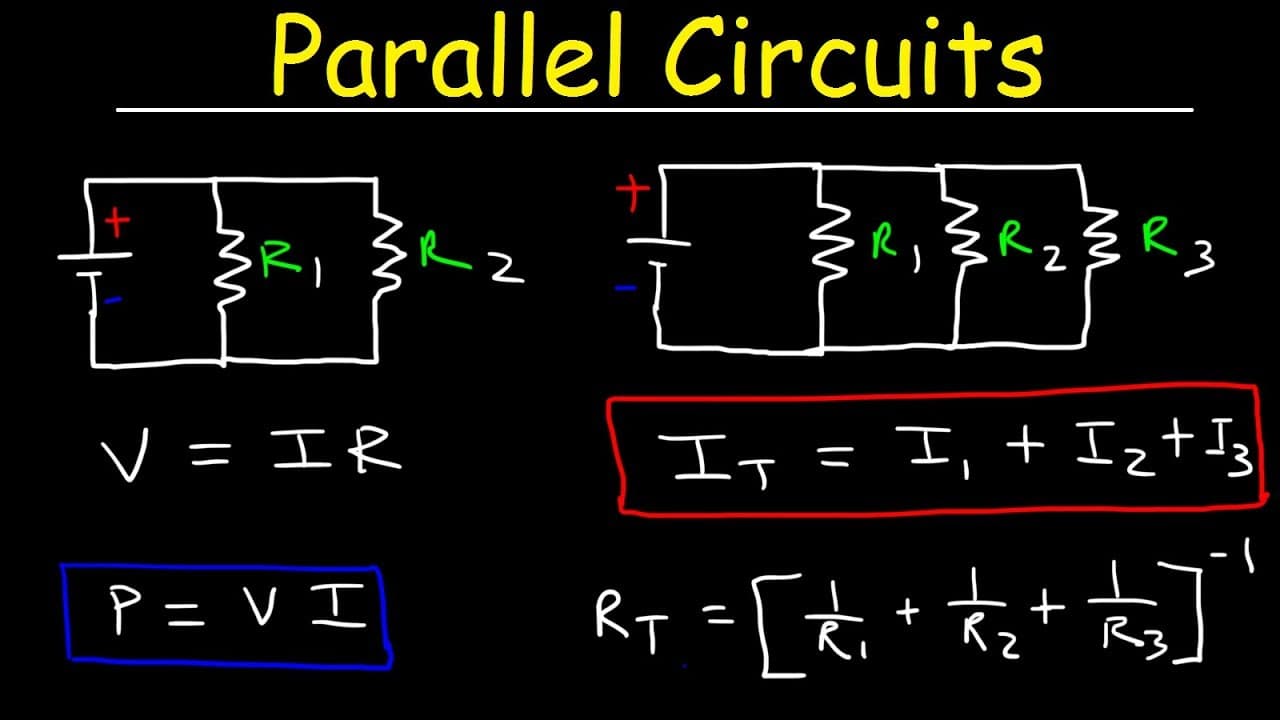
this video is all about how to solve dc circuits with parallel resistors so consider the circuit shown below calculate the current flowing through each resistor so let's call this resistor 1 and resistor 2. how can we determine how much current flows through the resistor well we can use ohm's law v is equal to ir so the voltage of the battery which... Read More
Key Insights
- ♍ Ohm's Law (V = IR) is a fundamental equation used to calculate current and resistance in DC circuits.
- 🥡 The total resistance in a parallel circuit can be calculated by taking the inverse of the sum of the inverses of each resistor's resistance.
- ✊ The power consumed by a resistor in a parallel circuit is determined by multiplying the current flowing through it by its resistance.
- 🔋 The power delivered by the battery in a parallel circuit is equal to the total power absorbed by all the resistors.
- 🍹 Kirchhoff's Current Law states that the sum of currents entering a junction is equal to the sum of currents leaving the junction in a circuit.
- 🪜 Adding resistors in parallel decreases the total resistance of a circuit, while adding them in series increases the total resistance.
- ⚡ Two methods can be used to calculate the total resistance in a parallel circuit: dividing the voltage by the total current or using the formula with the inverses of resistances.
Install to Summarize YouTube Videos and Get Transcripts
Explore YouTube Video Summarizer or Get YouTube Transcript Extractor
Questions & Answers
Q: How can Ohm's Law be used to calculate the current flowing through a resistor in a parallel circuit?
Ohm's Law states that voltage (V) is equal to current (I) multiplied by resistance (R). By rearranging the equation, we can calculate current (I) by dividing voltage (V) by resistance (R).
Q: What is the relationship between the current released by the battery and the sum of the currents flowing through each resistor in a parallel circuit?
According to Kirchhoff's Current Law, the current released by the battery is equal to the sum of the currents flowing through each resistor in a parallel circuit. This law ensures the conservation of energy in the circuit.
Q: How can the power consumed by a resistor in a parallel circuit be calculated?
The power consumed by a resistor in a parallel circuit can be calculated using the formula P = I^2 * R, where P is power, I is current, and R is resistance. By substituting the values, the power consumed by each resistor can be determined.
Q: Why is the power delivered by the battery equal to the total power absorbed by all the resistors in a parallel circuit?
According to the Law of Conservation of Energy, the rate at which energy is transferred from the battery is equal to the rate at which the resistors absorb that energy. Therefore, the power delivered by the battery must be equal to the total power absorbed by all the resistors.
Summary & Key Takeaways
-
The video explains how to calculate the current flowing through each resistor in a DC circuit with parallel resistors using Ohm's Law.
-
It demonstrates how to determine the power consumed by each resistor and the power delivered by the battery in the circuit.
-
The video also illustrates the concept of total resistance in a parallel circuit and provides two methods to calculate it.
Read in Other Languages (beta)
Share This Summary 📚
Summarize YouTube Videos and Get Video Transcripts with 1-Click
Try YouTube Summary with ChatGPT & Claude or YouTube Transcript Generator
Explore More Summaries from The Organic Chemistry Tutor 📚



Summarize YouTube Videos and Get Video Transcripts with 1-Click
Try YouTube Summary with ChatGPT & Claude or YouTube Transcript Generator