Stanford CS330: Deep Multi-Task & Meta Learning I 2021 I Lecture 4
TL;DR
Optimization-based metal learning is a powerful approach for predicting land cover from satellite images, allowing for quick adaptation to different regions of the world.
Transcript
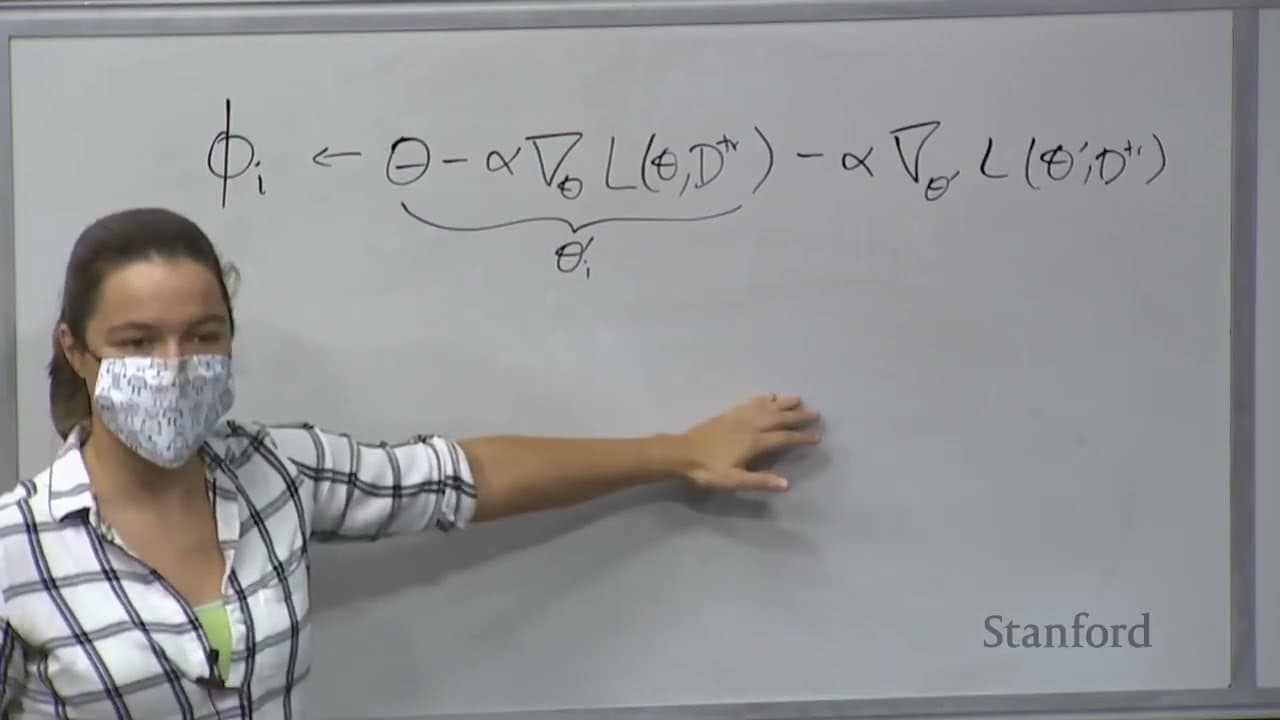
hi everyone welcome to the fourth lecture today we'll be talking about optimization-based Metal learning um before that a couple reminders um homework one is due on Wednesday so a week from today uh we're also going to post some project ideas suggestions later today um this won't be enough like we'll hopefully have around 10 to 20 project suggestio... Read More
Key Insights
- 🤘 Optimization-based metal learning allows for quick adaptation to new tasks by embedding an optimization process into the metal learning procedure.
- 😑 It outperforms other methods, such as random training or pre-training, especially in out-of-distribution tasks.
- 😃 Challenges of optimization-based metal learning include bi-level optimization and computational/memory intensity, but these can be mitigated with various techniques.
Install to Summarize YouTube Videos and Get Transcripts
Explore YouTube Video Summarizer or Get YouTube Transcript Extractor
Questions & Answers
Q: How does optimization-based metal learning differ from black box approaches?
Optimization-based metal learning uses an embedded optimization process, such as gradient descent, to update parameters based on a small training data set, allowing for quick adaptation to new tasks. In contrast, black box approaches pass the entire training data set into a neural network for prediction.
Q: What are some challenges of optimization-based metal learning?
One challenge is the bi-level optimization problem, which can lead to instabilities. To address this, learning the inner learning rate and optimizing only a subset of parameters can improve stability. Another challenge is computational and memory intensity, especially with multiple inner gradient steps. Approximations and optimizations can be used to mitigate this.
Q: Can optimization-based metal learning be applied to other tasks besides land cover prediction?
Yes, optimization-based metal learning is a general approach and can be applied to various tasks and domains. It has been successfully applied in image classification, reinforcement learning, and even non-parametric methods. It is a flexible approach that can work well with different architectures and learning procedures.
Q: How does optimization-based metal learning compare to first-order methods?
Optimization-based metal learning can be viewed as a more advanced version of first-order methods. While first-order methods can work well in simple scenarios, optimization-based metal learning leverages the structure of fine-tuning and can better adapt to out-of-distribution tasks, leading to improved performance.
Summary & Key Takeaways
-
Optimization-based metal learning is a technique that aims to quickly learn a new task given previous task experiences, such as predicting land cover from satellite images.
-
By embedding an optimization process into the metal learning procedure, fine-tuning can be performed at test time, leading to better generalization on out-of-distribution tasks.
-
A case study on land cover prediction from satellite images showed that optimization-based metal learning outperformed other methods, such as random training or pre-training, especially in regions that differed from the training data.
Read in Other Languages (beta)
Share This Summary 📚
Summarize YouTube Videos and Get Video Transcripts with 1-Click
Try YouTube Summary with ChatGPT & Claude or YouTube Transcript Generator
Explore More Summaries from Stanford Online 📚

Summarize YouTube Videos and Get Video Transcripts with 1-Click
Try YouTube Summary with ChatGPT & Claude or YouTube Transcript Generator