What is Reinforcement Learning from Human Feedback?
TL;DR
Reinforcement Learning from Human Feedback (RLHF) optimizes language models by aligning them with human preferences through a reward system. This technique leverages human ratings on model outputs to maximize their expected rewards, enhancing the model's ability to perform tasks according to user intent.
Transcript
okay awesome um we're going to get started so uh my name is Jesse moo I'm a PhD student in the Cs Department here uh working with the NLP group and really excited to be talking about the topic of today's lecture which is on prompting instruction fine-tuning and rlhf so this is all stuff that has been you know um super hot recently because of all th... Read More
Key Insights
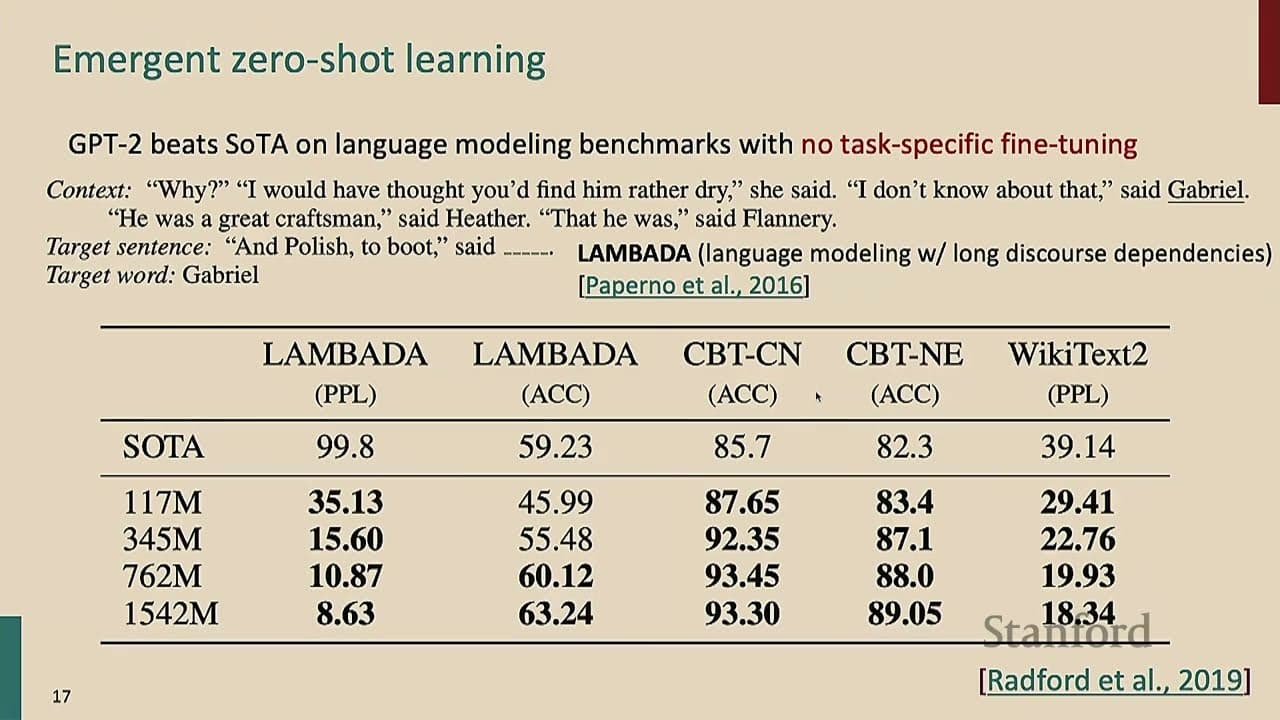
- 🛀 Large language models like GPT-2 and GPT-3 have shown impressive capabilities in zero-shot and few-shot learning, performing tasks without task-specific fine-tuning.
- ⛓️ Chain of Thought prompting can enhance language model performance by providing explicit reasoning steps in the prompt.
- 👻 Instruction Fine-tuning allows language models to be trained on specific instructions and desired outputs, improving their alignment with human intent.
- 😒 Reinforcement Learning from Human Feedback (RLHF) combines the use of reward models and policy gradient methods to optimize language models based on human preferences.
Install to Summarize YouTube Videos and Get Transcripts
Explore YouTube Video Summarizer or Get YouTube Transcript Extractor
Questions & Answers
Q: What is the difference between zero-shot and few-shot learning?
Zero-shot learning involves using a language model to complete tasks it hasn't been explicitly trained on, by structuring the prompt in a certain way. Few-shot learning, on the other hand, involves providing a small number of examples of a task to the language model and fine-tuning it to improve performance.
Q: How do large language models like GPT-2 and GPT-3 perform on different tasks without task-specific fine-tuning?
GPT-2 and GPT-3 have shown the ability to perform zero-shot and few-shot learning by generating prompts based on the task requirements. They are able to generalize their language modeling capabilities to a wide range of tasks without explicit fine-tuning.
Q: What is Chain of Thought prompting and how does it improve language model performance?
Chain of Thought prompting involves providing reasoning steps in the prompt to guide the language model's response. By including these steps, the language model can generate more accurate and relevant answers, particularly for complex tasks that require logical reasoning.
Q: How does Instruction Fine-tuning improve language model performance?
Instruction Fine-tuning involves collecting human-labeled examples and fine-tuning the language model based on these examples. By training the language model on specific instructions and desired outputs, it can generate more accurate responses that align with user intent.
Summary & Key Takeaways
-
The lecture introduces the concept of training large language models and the increase in model size over the years.
-
It explores the idea that language models essentially act as rudimentary world models due to their ability to predict the next word in text and learn about agents, human beliefs, and common knowledge.
-
The lecture delves into different techniques for training language models, including zero-shot and few-shot learning, instruction fine-tuning, and reinforcement learning from human feedback.
Read in Other Languages (beta)
Share This Summary 📚
Summarize YouTube Videos and Get Video Transcripts with 1-Click
Try YouTube Summary with ChatGPT & Claude or YouTube Transcript Generator
Explore More Summaries from Stanford Online 📚

Summarize YouTube Videos and Get Video Transcripts with 1-Click
Try YouTube Summary with ChatGPT & Claude or YouTube Transcript Generator