Keto-enol tautomerization (by Sal) | Alpha Carbon Chemistry | Organic chemistry | Khan Academy
TL;DR
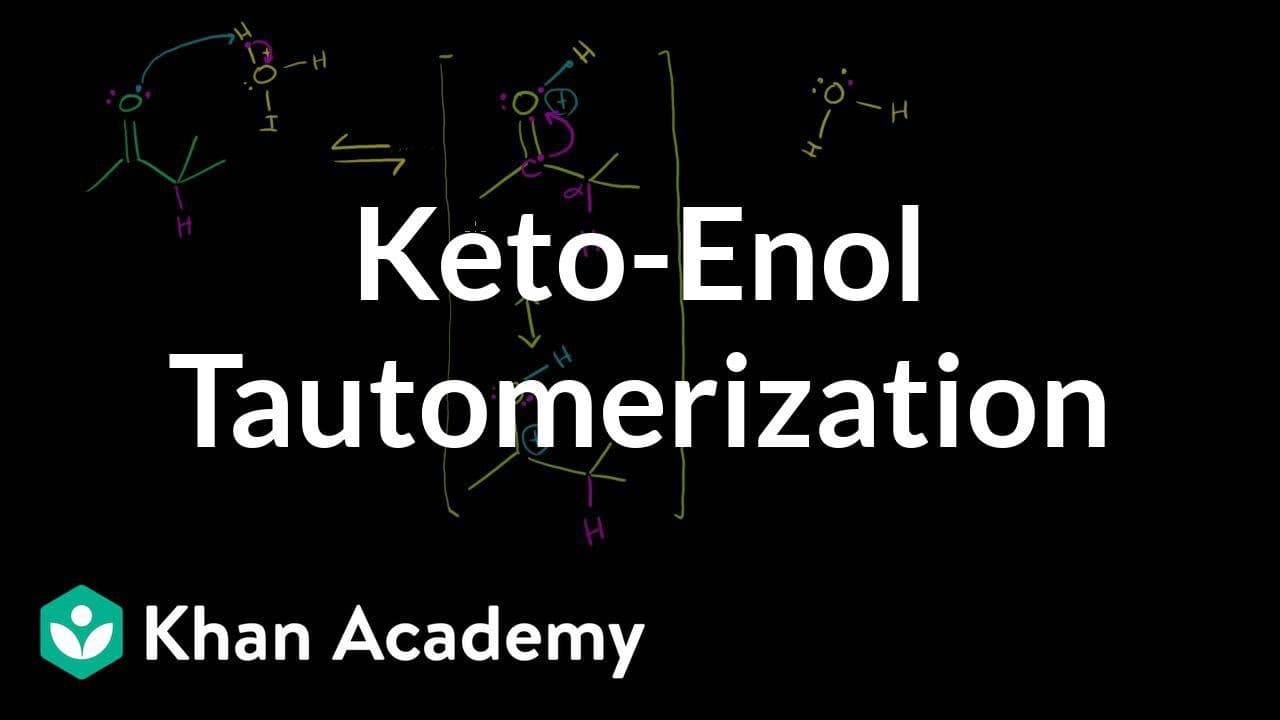
Ketones can undergo tautomerization, converting into enol forms, through a mechanism involving proton transfer and electron movement.
Transcript
Let's explore another mechanism that we can have with the ketone. And actually, an aldehyde can undergo a very similar or actually the same type of reaction. So let's say that I had a ketone that looked like this. Let me draw my carbonyl group, just like that, and then it is bonded to a carbon that is bonded to two other CH3 groups. And just to mak... Read More
Key Insights
- ❓ Tautomerization is a mechanism that can occur with both ketones and aldehydes.
- ❓ The transfer of a proton and movement of electrons are involved in the tautomerization process.
- 💁 The enol form, resulting from tautomerization, is an alkene with an attached alcohol group.
- 💁 Tautomers are two isomeric forms of a molecule that can interconvert through equilibrium.
- 💁 The keto form is typically more stable than the enol form in a solution.
- 🈸 Tautomerization has practical applications in organic chemistry and is relevant to biological systems.
Install to Summarize YouTube Videos and Get Transcripts
Explore YouTube Video Summarizer or Get YouTube Transcript Extractor
Questions & Answers
Q: What is tautomerization?
Tautomerization is a chemical reaction where a molecule switches between two isomeric forms, known as tautomers, through the movement of protons and electrons.
Q: How does tautomerization occur in ketones?
Tautomerization in ketones involves the transfer of a proton from a hydronium molecule to the ketone, resulting in the formation of an enol form. The process also includes the movement of electrons to form a double bond.
Q: What is the difference between the keto and enol forms?
The keto form refers to the original ketone structure, while the enol form is an alkene with an alcohol group attached to one of the carbon atoms involved in the double bond.
Q: Are tautomers stable?
In a solution, the keto form is generally more stable than the enol form. However, tautomeric equilibrium allows for the existence and interconversion of both forms.
Summary & Key Takeaways
-
Ketones can undergo a reaction called tautomerization, where they convert into enol forms, which are alkenes with an attached alcohol group.
-
The tautomerization process involves the transfer of a proton from a hydronium molecule to the ketone, followed by the movement of electrons to form a double bond.
-
The keto form (ketone) is more stable than the enol form (alkenol), but the equilibrium between the two forms allows for the occurrence of tautomerization.
Read in Other Languages (beta)
Share This Summary 📚
Summarize YouTube Videos and Get Video Transcripts with 1-Click
Try YouTube Summary with ChatGPT & Claude or YouTube Transcript Generator
Explore More Summaries from Khan Academy 📚



Summarize YouTube Videos and Get Video Transcripts with 1-Click
Try YouTube Summary with ChatGPT & Claude or YouTube Transcript Generator