Finding projection onto subspace with orthonormal basis example | Linear Algebra | Khan Academy
TL;DR
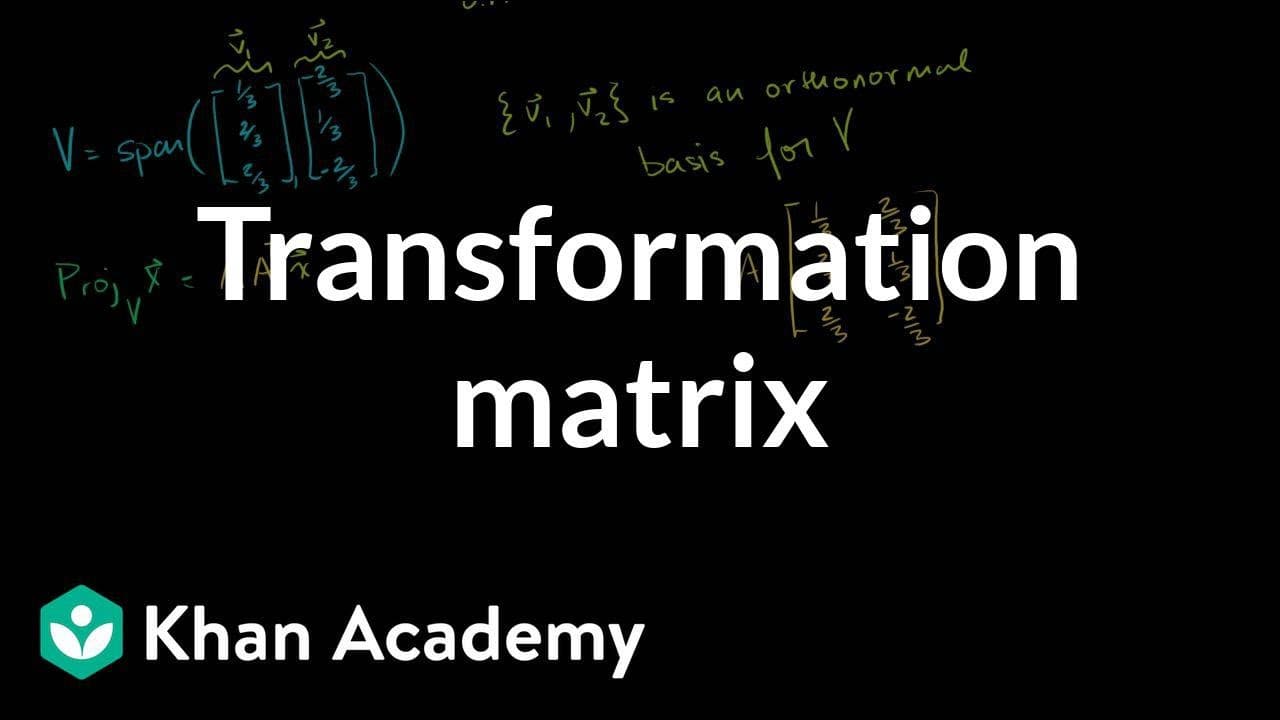
Find the transformation matrix for the projection of a vector onto a subspace using orthonormal basis vectors.
Transcript
We saw on the last video that if I have some sort of orthonormal basis, I should have a shorthand for this-- if I have an orthonormal basis, then to find for a subspace V, and if I want to find the projection of some vector x in Rn onto V, the transformation matrix simplifies to A times A transpose times x. Where A is equal to essentially, or exact... Read More
Key Insights
- ❓ Orthonormal basis vectors simplify the transformation matrix for finding the projection of a vector onto a subspace.
- ❓ Linear independence and orthogonality are crucial properties of the basis vectors.
- ✈️ The subspace being a plane in R3 results in a 3x3 transformation matrix.
- ✖️ The projection matrix can be obtained by multiplying the basis matrix with its transpose.
- ❓ The projection transformation is a mapping from R3 to R3.
- 🫥 The dot product of basis vectors helps in calculating the elements of the transformation matrix.
- ❓ Orthonormal bases make projection calculations less complex compared to other methods.
Install to Summarize YouTube Videos and Get Transcripts
Explore YouTube Video Summarizer or Get YouTube Transcript Extractor
Questions & Answers
Q: What is the advantage of using an orthonormal basis for finding the projection of a vector onto a subspace?
An orthonormal basis simplifies the transformation matrix and makes the calculation of the projection easier and faster. It reduces the need for computing inverses.
Q: How can we determine if two vectors are linearly independent and orthogonal to each other?
To check if two vectors are linearly independent, we can see if no scalar multiples of one vector can sum up to equal the other vector. To check for orthogonality, we can calculate the dot product of the two vectors and see if it equals zero.
Q: What is the significance of the subspace being a plane in R3?
The subspace being a plane means that the projection of any vector onto the subspace will result in a vector that is contained within that plane. It represents the closest member of the subspace to the original vector.
Q: What is the purpose of the transformation matrix for the projection?
The transformation matrix represents the linear transformation from R3 to R3, where it takes a vector in R3 and outputs a vector in the subspace V. It maps vectors to their projections onto the subspace.
Summary & Key Takeaways
-
An orthonormal basis simplifies the transformation matrix for finding the projection of a vector onto a subspace.
-
The subspace V is represented by the span of two linearly independent vectors that are orthogonal to each other.
-
To find the transformation matrix, construct a matrix A with the basis vectors as columns and multiply it by its transpose.
Read in Other Languages (beta)
Share This Summary 📚
Summarize YouTube Videos and Get Video Transcripts with 1-Click
Try YouTube Summary with ChatGPT & Claude or YouTube Transcript Generator
Explore More Summaries from Khan Academy 📚



Summarize YouTube Videos and Get Video Transcripts with 1-Click
Try YouTube Summary with ChatGPT & Claude or YouTube Transcript Generator