Testing of Lime 1
TL;DR
Learn about different tests for lime testing, including visual inspection, field tests, impurity tests, heat tests, hydraulic acid tests, physical tests, fineness tests, and determination of residue on slacking of quicklime.
Transcript
hello students in this lesson let us discuss about the testing of limes so basically the first five tests we will be discussing here the first test is the visual inspection so the name itself is indicating that we just see the lime and do the inspection for examining its color and for lumps okay so if the color is white that indicates that it is a ... Read More
Key Insights
- 🆘 Visual inspection helps determine the purity and burning process of lime.
- 💁 Field tests provide valuable information on lime classification and quality.
- ❓ Quicklime and hydrated lime require different sample sizes for testing.
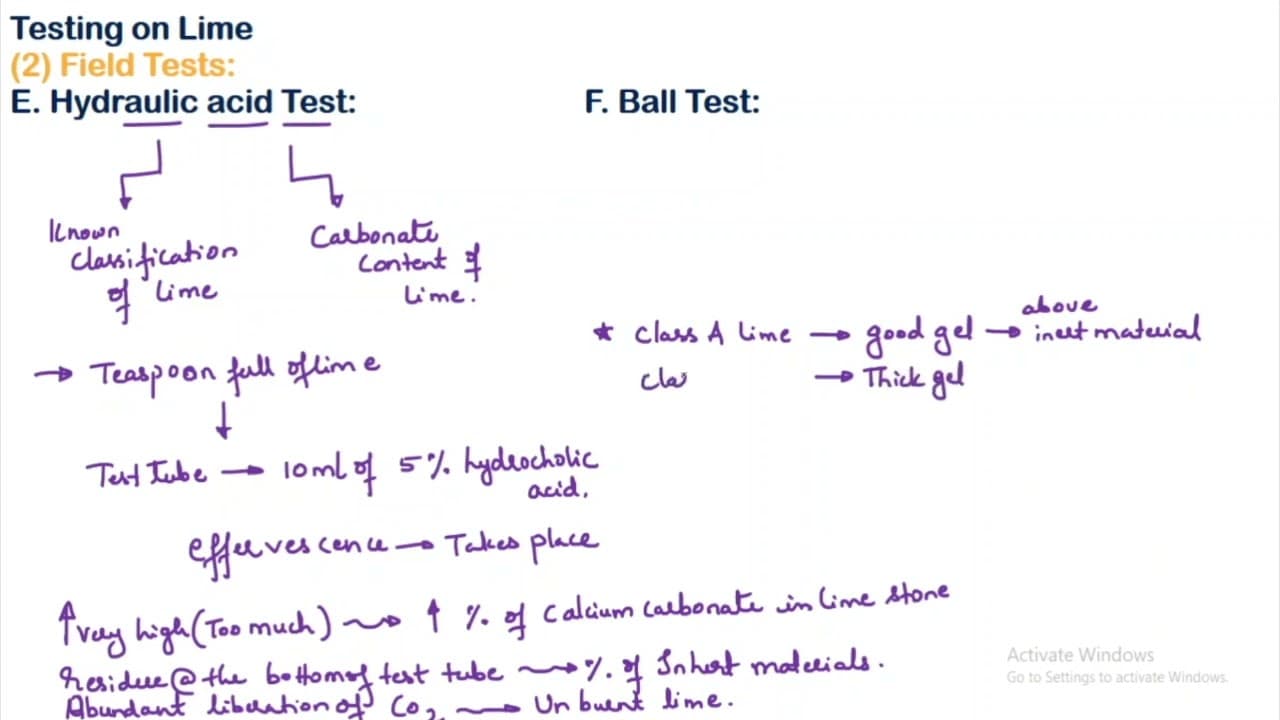
- 🏆 The hydraulic acid test is used to determine the classification and carbonate content of lime.
- 🏆 The fineness test measures the particle size of hydrated lime.
- 🆘 Determination of residue on slacking of quicklime helps assess the performance of the lime.
- 🏆 Lime samples should be tested as quickly as possible to prevent deterioration.
Install to Summarize YouTube Videos and Get Transcripts
Explore YouTube Video Summarizer or Get YouTube Transcript Extractor
Questions & Answers
Q: How can visual inspection determine the quality of lime?
In visual inspection, the color of lime indicates its purity; white is pure or fat lime, while lumps suggest quick lime or unburnt lime.
Q: How can the impurity of lime be tested?
To test impurity, a known weight of lime is mixed with water, and the residue is dried and weighed. If it is less than 10% of the initial weight, the lime is considered good quality.
Q: What is the purpose of the hydraulic acid test?
The hydraulic acid test helps determine the classification and carbonate content of the lime. It involves mixing lime with hydrochloric acid and observing efflorescence and liberation of CO2.
Q: How is fineness of lime determined?
The fineness test involves sieving hydrated lime and measuring the residue on each sieve. The results are expressed as a percentage of the total mass of hydrated lime taken.
Summary & Key Takeaways
-
Visual inspection: Color and lumps indicate the purity and burning process of the lime.
-
Field tests: Physical properties, workability, impurity test, heat test, hydraulic acid test, and ball test help determine lime classification and quality.
-
Physical Test: Sampling should be done quickly to prevent deterioration, and different sample sizes are recommended for quicklime and hydrated lime.
Read in Other Languages (beta)
Share This Summary 📚
Summarize YouTube Videos and Get Video Transcripts with 1-Click
Try YouTube Summary with ChatGPT & Claude or YouTube Transcript Generator
Explore More Summaries from Ekeeda 📚






Summarize YouTube Videos and Get Video Transcripts with 1-Click
Try YouTube Summary with ChatGPT & Claude or YouTube Transcript Generator