How Do Chameleons Change Color?
TL;DR
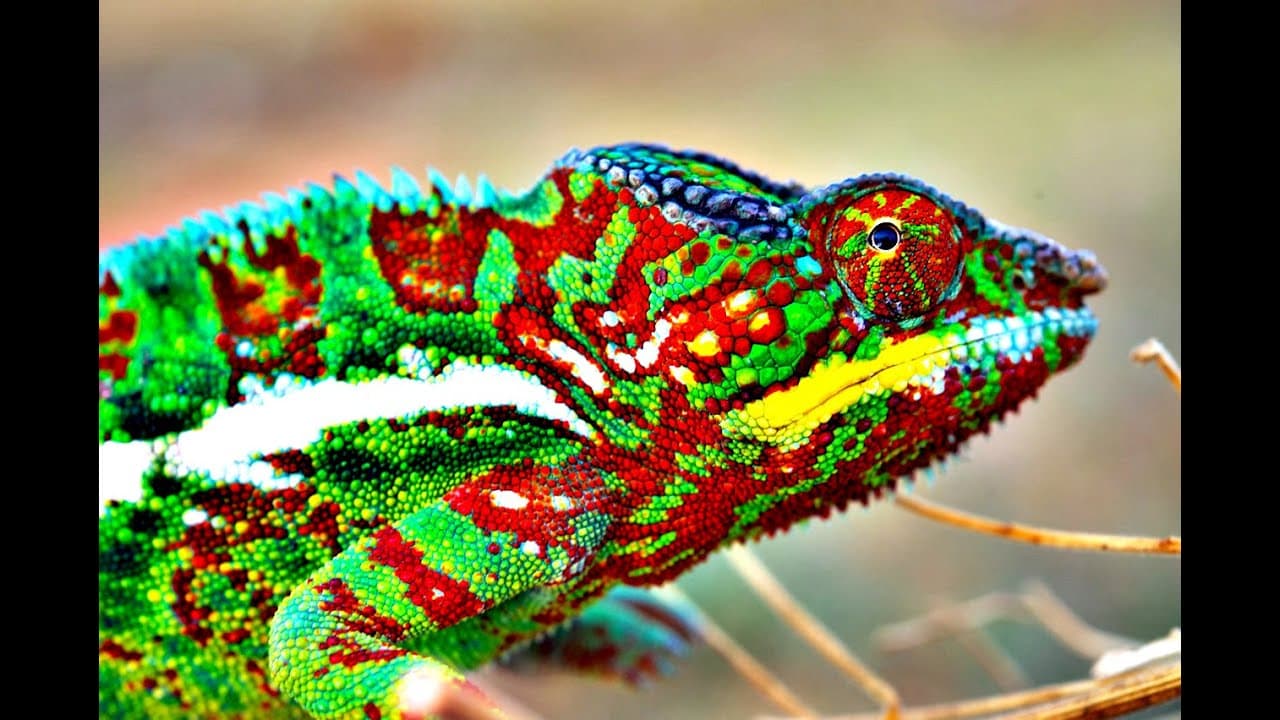
Chameleons change their color not to blend in, but to attract mates or intimidate rivals. They achieve this color change through the spacing of nanoscale crystals in their skin.
Transcript
There is a misconception about chameleons that they change their color in order to blend in with their environment. That is actually not the case. When a chameleon is calm it is green and so it naturally blends in with its leafy surroundings. But male chameleons change color when they become excited in the presence of a female or a rival male, as s... Read More
Key Insights
- 🧉 Chameleons do not change their color to blend in with their environment but to attract mates or intimidate rivals.
- 🔮 The color change in chameleons is achieved by altering the spacing between nanoscale crystals in their skin.
- 🙂 Chameleons can reflect different wavelengths of light by compressing or expanding the crystals in their skin.
- 🩵 The green color of a chameleon is a combination of yellow pigment and blue light reflected off the crystal structure beneath the pigment.
- 🔮 Chameleons actively tune the spacing between the crystals to create structural colors across the visible spectrum.
- 🌥️ The structure of a chameleon's skin includes an additional layer of cells with larger crystals, reflecting longer wavelengths in the infrared part of the spectrum.
- 💱 Collaboration between physicists and biologists was necessary to uncover the true mechanism behind chameleon color change.
Install to Summarize YouTube Videos and Get Transcripts
Explore YouTube Video Summarizer or Get YouTube Transcript Extractor
Questions & Answers
Q: Why do chameleons change their color?
Chameleons change their color to attract mates or intimidate rivals. When they become excited, their color changes from green to yellow, orange, and red.
Q: How do chameleons change their color?
Chameleons change their color by altering the spacing between nanoscale crystals in their skin. By increasing or decreasing this spacing, they can selectively reflect different wavelengths of light and change their color.
Q: What was previously thought to be the mechanism for chameleon color change?
It was previously believed that chameleons changed color by dispersing pigments in their skin. However, new research shows that it is the nanoscale crystals underneath their skin that are responsible for the color change.
Q: What is the function of the crystals in the chameleon's skin?
The crystals in the chameleon's skin reflect and diffract light, creating structural colors. They can be compressed or expanded to reflect different wavelengths of light, allowing the chameleon to change its color.
Summary & Key Takeaways
-
Chameleons change colors when they become excited in the presence of a female or a rival male.
-
Previous understanding of chameleon color change was based on the assumption that pigments in their skin were dispersed. However, new research shows that it is the spacing of nanoscale crystals underneath the skin that changes, reflecting different colors.
-
The crystals in chameleon skin can be compressed or expanded, allowing the chameleon to selectively reflect different wavelengths of light and change its color.
Read in Other Languages (beta)
Share This Summary 📚
Summarize YouTube Videos and Get Video Transcripts with 1-Click
Try YouTube Summary with ChatGPT & Claude or YouTube Transcript Generator
Explore More Summaries from Veritasium 📚






Summarize YouTube Videos and Get Video Transcripts with 1-Click
Try YouTube Summary with ChatGPT & Claude or YouTube Transcript Generator