Leetcode 1770. Maximum Score from Performing Multiplication Operations
TL;DR
Analyzing a dynamic programming problem involving multipliers and maximum scores from arrays.
Transcript
hey there everyone welcome back to lead coding i am your host faraz and today we are doing the contest number 229 this is the problem number three of the contest so you must have read the problem statement we are given two arrays nums and multipliers of size n and m respectively n is given greater than equal to m the arrays are one indexed um you a... Read More
Key Insights
- 🤗 The problem at hand involves maximizing a score through strategic decisions made with elements from two arrays.
- 😘 A greedy choice can lead to lower scores, reinforcing the need to consider future options when selecting multipliers.
- ❓ By using a recursive function with dynamic programming, the solution effectively explores all possible scoring paths.
- ⌛ Memoization saves computed states, significantly enhancing efficiency and reducing execution time for overlapping subproblems.
- ❤️🩹 The problem emphasizes the exploration of both ends of an array to leverage the maximum potential of selected values.
- ⏮️ Understanding the implications of previous choices is crucial for optimal decision-making in dynamic programming problems.
- 👨💻 A structured and systematic approach to coding problems can result in successful solutions, especially in competitive programming scenarios.
Install to Summarize YouTube Videos and Get Transcripts
Explore YouTube Video Summarizer or Get YouTube Transcript Extractor
Questions & Answers
Q: What are the main elements involved in the problem presented?
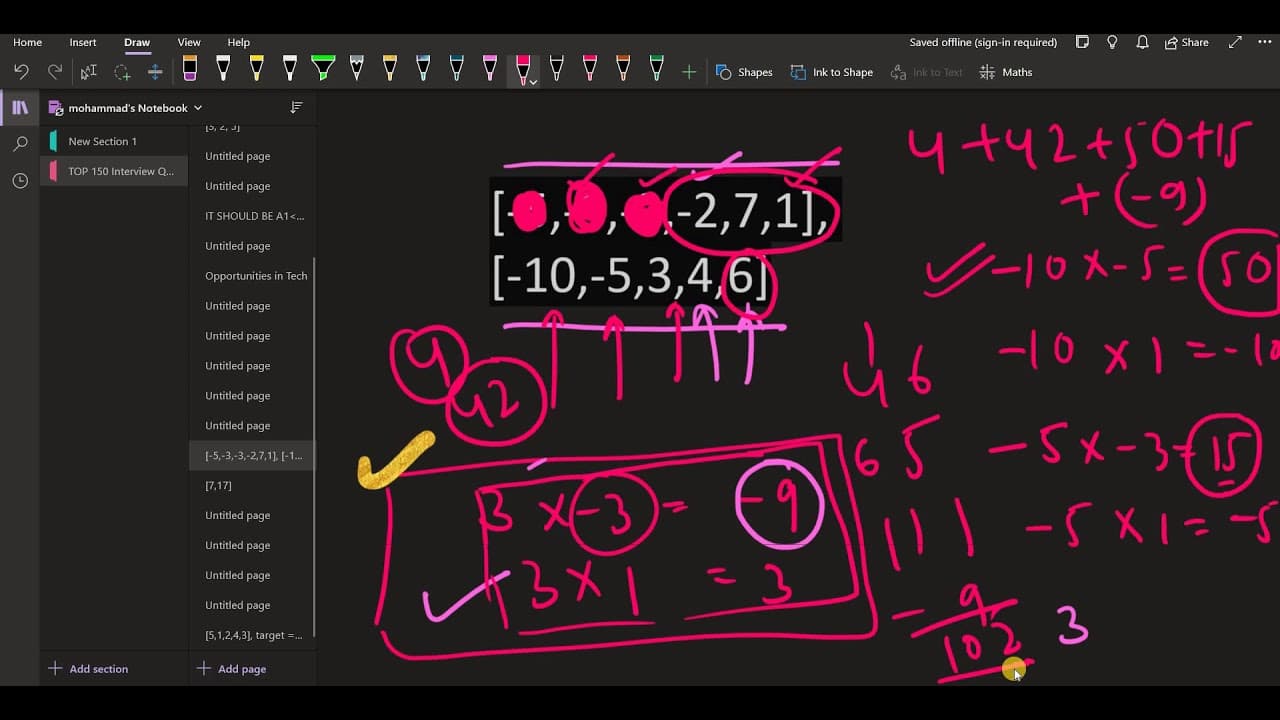
The problem involves two arrays: nums, which holds integers, and multipliers, which are used to adjust the scoring as the program progresses. The aim is to maximize the total score through strategic multiplication of elements selected from both arrays.
Q: Why should we avoid a greedy approach in this problem?
A greedy approach tends to make local optimum choices that might not lead to the global optimum score, as seen when initially selecting multipliers. The content illustrates how carefully considering future implications of choices leads to a higher overall score.
Q: Can you describe the recursive approach to solving this problem?
The recursive approach evaluates all possibilities by multiplying the current multiplier with either the first or last element of nums, subsequently adjusting the range of nums. Each recursive call explores further multipliers until the end of the array is reached.
Q: How does memoization optimize the solution?
Memoization reduces redundant calculations by storing previously computed results in a DP (dynamic programming) table. This prevents the algorithm from recalculating the scores for the same indices and allows for a more efficient resolution of overlapping subproblems.
Q: What is the time complexity of the final solution?
The optimized solution has a time complexity of O(m^2), where m is the number of multipliers. This is due to the structured filling of the dynamic programming table that confirms all possible states without redundancy.
Q: How does the content suggest tackling dynamic programming issues for beginners?
The presenter recommends exploring a playlist dedicated to recursion and dynamic programming concepts on their channel. This resource helps build foundational understanding and problem-solving strategies for coding interviews.
Q: What is the significance of exploring both ends of the nums array?
Exploring both ends of the nums array ensures that the solution is gathering the best possible score by considering both extremes for each multiplier. This is key to making informed decisions that benefit future multiplier selections.
Q: What final score did the best approach yield?
The optimized approach yielded a final score of 102, demonstrating that careful consideration of multiplier choices and their implications leads to better overall outcomes compared to a naive greedy method.
Summary & Key Takeaways
-
The content details a coding problem from a contest that involves two arrays, nums and multipliers, and aims to maximize the score through strategic multiplication.
-
The greedy approach to solving the problem can lead to suboptimal results, emphasizing the need for exploring all possibilities using dynamic programming techniques.
-
The presenter explains the recursive solution and how to optimize it with memoization to reduce time complexity, demonstrating the final implementation for accuracy.
Read in Other Languages (beta)
Share This Summary 📚
Summarize YouTube Videos and Get Video Transcripts with 1-Click
Try YouTube Summary with ChatGPT & Claude or YouTube Transcript Generator
Explore More Summaries from Fraz 📚


Summarize YouTube Videos and Get Video Transcripts with 1-Click
Try YouTube Summary with ChatGPT & Claude or YouTube Transcript Generator