How to Build a Deep Q Network Using TensorFlow 2
TL;DR
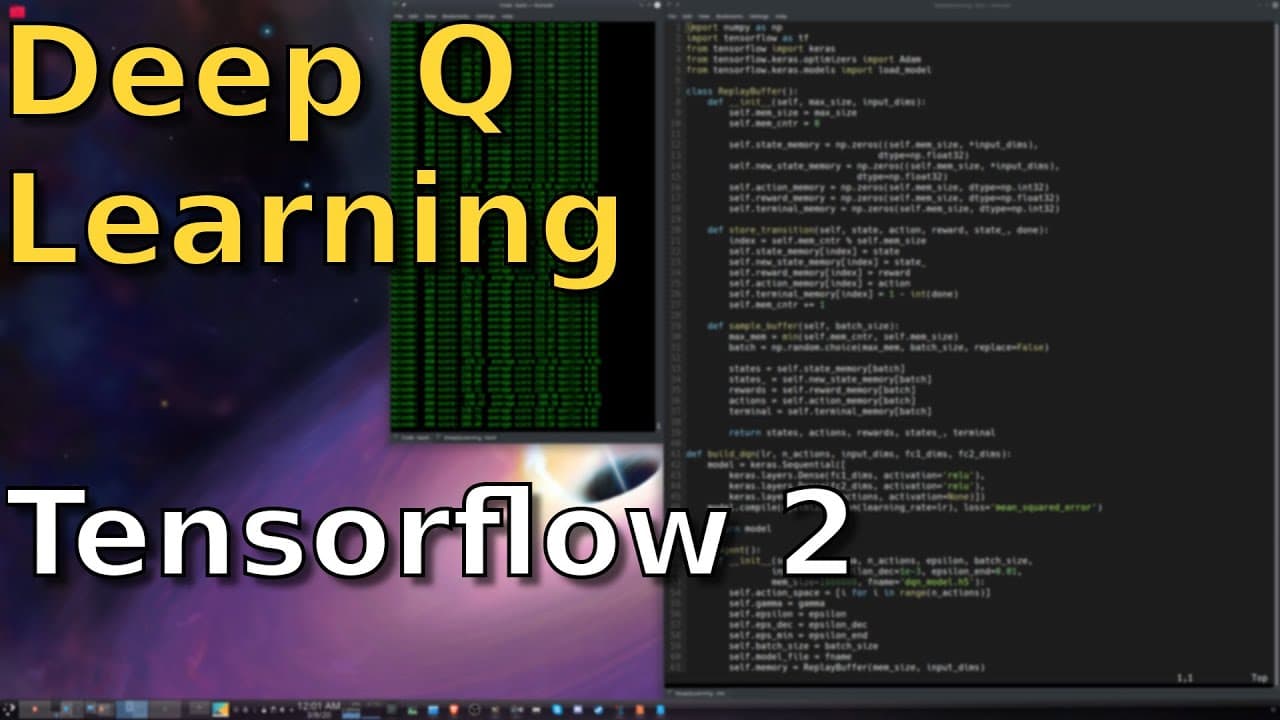
To build a Deep Q Network (DQN) with TensorFlow 2, set up a replay buffer to store transitions, create a sequential DQN model, and implement the agent's functions for choosing actions and learning. The epsilon-greedy strategy is crucial for balancing exploration and exploitation, while the TensorFlow 2 implementation may experience slower performance during predictions.
Transcript
in this video you're going out of code a deep Q network intensive load - from scratch no prior experience needed you don't need to know anything about reinforcement learning you just have to follow along let's get started so before we begin a couple of announcements first of all I put out a tweet on Twitter yesterday one of the rare times I actuall... Read More
Key Insights
- 🦮 Deep Q Learning utilizes a replay buffer to store past experiences and a target value to guide learning.
- 🎮 The video emphasizes the importance of epsilon-greedy exploration to balance exploration and exploitation during training.
- 🐢 TensorFlow 2 implementation of the DQN's predict function is slower than expected, highlighting potential performance issues.
- 🎯 The agent's learning improves as it accumulates more experiences and adjusts its action-value estimates towards the target.
Install to Summarize YouTube Videos and Get Transcripts
Explore YouTube Video Summarizer or Get YouTube Transcript Extractor
Questions & Answers
Q: What is the purpose of the replay buffer in a Deep Q Network?
The replay buffer stores the agent's experiences, including states, actions, rewards, new states, and done flags. It allows the agent to learn from past experiences by randomly sampling transitions during training.
Q: What is the significance of the target value in DQN training?
The target value guides the learning process by providing a desired goal for the agent's action-value estimates. It is calculated based on the rewards and estimated values of the next states, helping the agent update its estimates towards the target.
Q: How does the agent choose actions during exploration and exploitation?
The agent chooses random actions based on a certain exploration rate (epsilon) during exploration to gather diverse experiences. As training progresses, the agent gradually shifts towards taking greedy actions based on its learned action-value estimates during exploitation.
Q: Why is TensorFlow 2 implementation slower compared to TensorFlow 1 and PyTorch?
The video mentions that the TensorFlow 2 implementation of the DQN's predict function is unexpectedly slow, making it slower even compared to TensorFlow 1 and PyTorch. The reason behind this is not clear, but it suggests that TensorFlow 2's eager execution might be the cause.
Summary & Key Takeaways
-
The video teaches how to build a DQN using TensorFlow, starting with importing necessary libraries and setting up the replay buffer.
-
The video explains the functions for adding transitions to the replay buffer and sampling from the memory buffer.
-
The video also covers building the DQN model, compiling it, and implementing the agent class with functions for choosing actions, learning, saving, and loading models.
Read in Other Languages (beta)
Share This Summary 📚
Summarize YouTube Videos and Get Video Transcripts with 1-Click
Try YouTube Summary with ChatGPT & Claude or YouTube Transcript Generator
Explore More Summaries from Machine Learning with Phil 📚


Summarize YouTube Videos and Get Video Transcripts with 1-Click
Try YouTube Summary with ChatGPT & Claude or YouTube Transcript Generator