Why Is Understanding Concurrency in Go Essential?
TL;DR
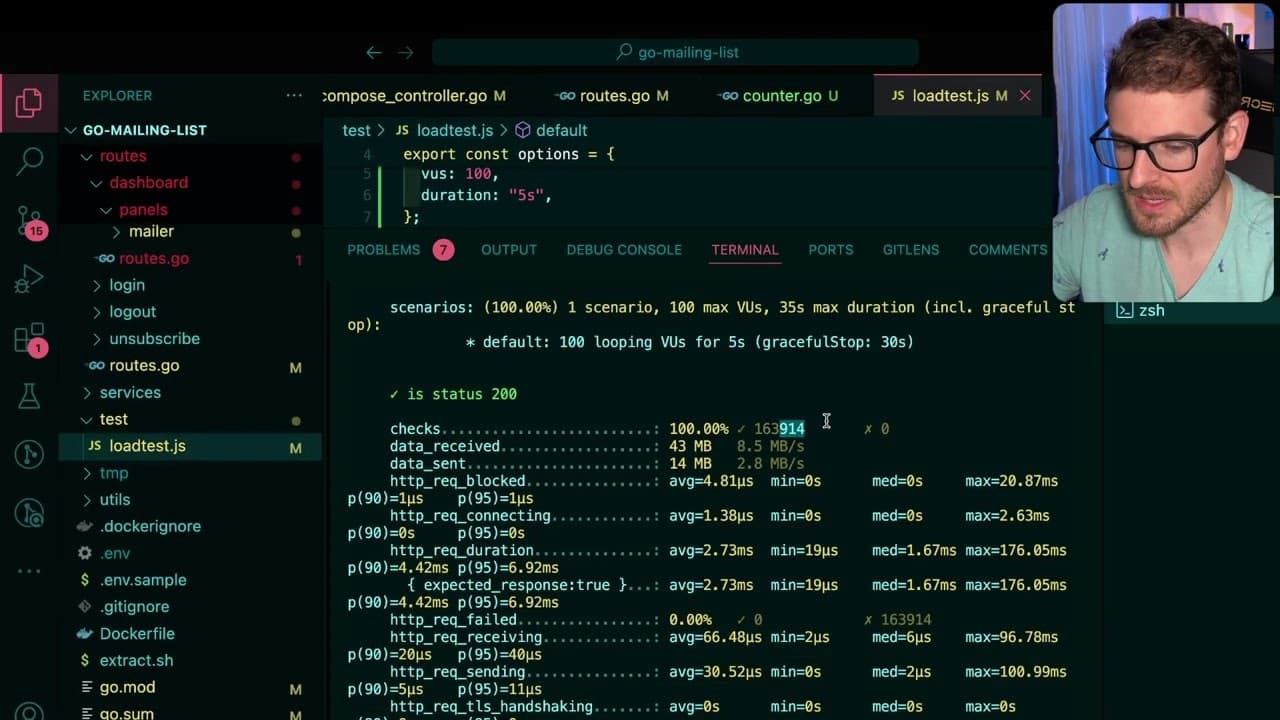
Understanding concurrency in Go is essential because it can lead to race conditions when multiple goroutines access shared variables. To prevent these issues, developers should use mutex locks to ensure safe modifications to shared state. Load testing can help identify concurrency problems, making it crucial for managing application stability.
Transcript
so now that I'm a professional go developer I do want to share one of the biggest foot guns that I've run into When developing go rest apis or just go programs in general and that is a round concurrency so most of the go HTTP libraries you're going to use such as fiber or like Chi or Echo when a request comes in typically that request is processed ... Read More
Key Insights
- 👻 Go's concurrency model allows efficient request handling but requires vigilance against race conditions when accessing shared state.
- ⏰ Implementing a mutex lock is a practical solution to manage shared variable access and can mitigate the risks associated with concurrent operations.
- 👍 Load testing is critical in exposing concurrency problems, proving that multiple goroutines can interfere with each other's operations if not properly synchronized.
- 😄 The ease of writing concurrent code in Go can lead to oversights for developers transitioning from single-threaded paradigms, necessitating a clearer understanding of goroutines and their interactions.
- 🐎 Race conditions can manifest subtle bugs that may not be apparent without extensive testing and monitoring, highlighting the need for disciplined development practices.
- 😒 Developers should embrace the use of Go's built-in race detection tools to ensure comprehensive testing and debugging of concurrent operations.
- 🈸 The management of shared resources via proper synchronization techniques like mutexes is crucial in maintaining application stability in heavily concurrent applications.
Install to Summarize YouTube Videos and Get Transcripts
Explore YouTube Video Summarizer or Get YouTube Transcript Extractor
Questions & Answers
Q: What are goroutines, and how do they work in Go?
Goroutines are lightweight threads managed by Go's built-in scheduler, allowing concurrent execution of functions. They enable efficient processing by utilizing a pool of threads for several goroutines instead of creating separate threads for each function call, optimizing performance in web applications.
Q: What is a race condition, and why is it a problem in Go?
A race condition occurs when two or more goroutines attempt to read and write shared data simultaneously, leading to unpredictable results. In Go, race conditions can cause subtle bugs, especially with primitive types like integers, where modifications can occur before the value is safely updated.
Q: How can developers detect race conditions in Go code?
Developers can detect race conditions in Go using the built-in race detector by running tests with the go test --race command. This requires writing test cases around functions that manipulate shared data, enabling Go to flag potential race conditions during testing.
Q: What is the purpose of using a mutex in Go?
A mutex (mutual exclusion) is a synchronization primitive that allows only one goroutine to access a shared resource at a time. By locking a mutex while modifying shared state, developers can ensure that other goroutines wait until the lock is released, preventing race conditions and ensuring data integrity.
Q: How did the load test demonstrate the concurrency issue?
The load test simulated multiple requests hitting the increment counter endpoint simultaneously, which resulted in an inaccurate total due to race conditions. The initial count from concurrent increments led to discrepancies in expected and actual values, highlighting the importance of synchronizing access to shared variables.
Q: How can mutexes impact performance in a Go application?
While mutexes are essential for preventing race conditions, they can also introduce overhead since they block other goroutines from accessing the shared variable until the mutex is unlocked. This can lead to reduced performance if contention for the mutex is high, so it's crucial to manage their use carefully.
Q: What are the key differences between Go and Node.js in handling concurrency?
Go uses goroutines to manage concurrency with a multi-threaded approach, needing careful attention to shared variables and potential race conditions. In contrast, Node.js operates on a single thread and uses an event-driven model, avoiding race conditions since all operations are handled sequentially within the same thread.
Q: Why does the speaker refer to concurrency issues as a "foot gun"?
The term "foot gun" refers to a potentially self-inflicted problem that can cause unexpected errors. In this context, concurrency issues in Go can silently lead to bugs if developers are not cautious, particularly if they apply their knowledge from single-threaded environments, such as Node.js, without understanding Go's concurrency model.
Summary & Key Takeaways
-
Concurrency in Go allows requests to be processed in separate goroutines, improving efficiency; however, it introduces the risk of race conditions when accessing shared variables.
-
The video demonstrates a simple load test on a Go web server and explains how the absence of synchronization leads to inconsistent counts due to concurrent goroutines modifying a shared counter.
-
To resolve concurrency issues, the use of mutex locks is recommended, ensuring that modifications to shared state are safe and do not lead to incorrect behavior.
Read in Other Languages (beta)
Share This Summary 📚
Summarize YouTube Videos and Get Video Transcripts with 1-Click
Try YouTube Summary with ChatGPT & Claude or YouTube Transcript Generator
Explore More Summaries from Web Dev Cody 📚

Summarize YouTube Videos and Get Video Transcripts with 1-Click
Try YouTube Summary with ChatGPT & Claude or YouTube Transcript Generator