Euler's method program code | First order differential equations | Khan Academy
TL;DR
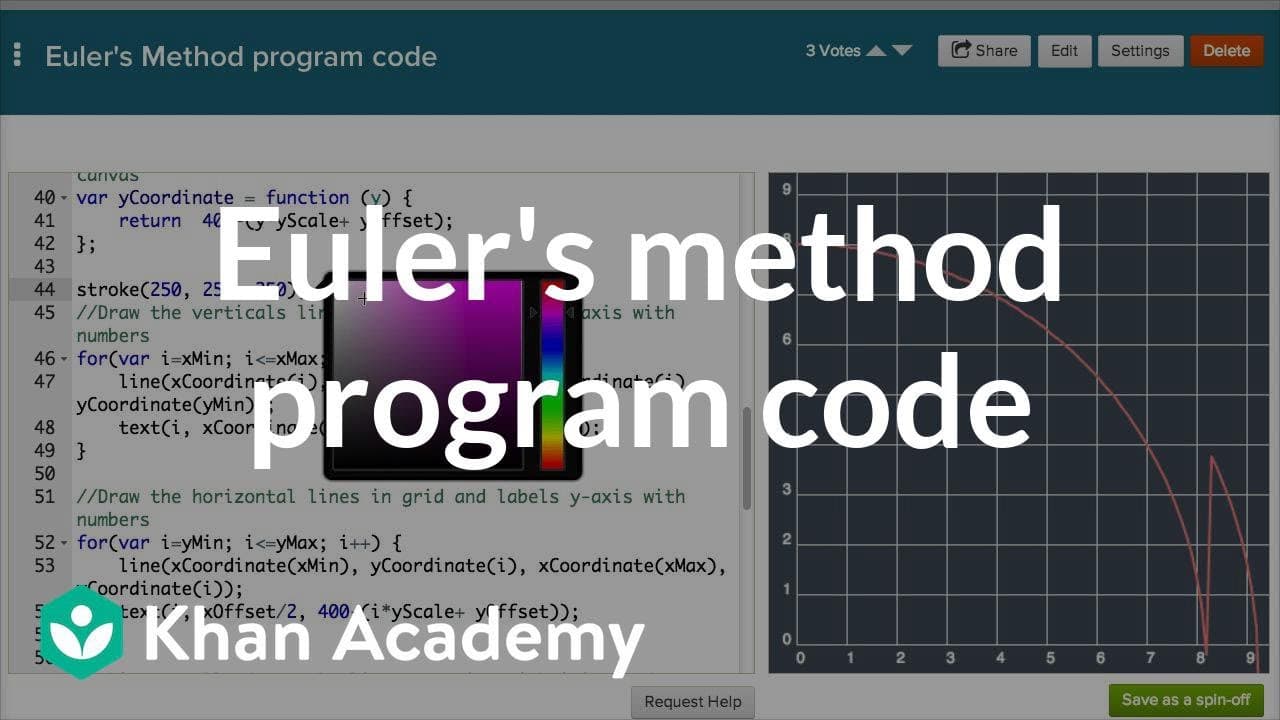
This video explains how to use a computer program to implement Euler's Method for approximating solutions to differential equations.
Transcript
- [Voiceover] In the first video on Euler's Method we walked through an example where we were trying to approximate the solution to y prime is equal to y using the initial condition, start when x is equal to zero y equals one. And you're probably thinking to yourself, well, it's very nice that Sal was doing that by hand and it felt very home-brewed... Read More
Key Insights
- ❓ Euler's Method is a numerical technique used to approximate solutions to differential equations.
- ❓ Adjusting the step size in Euler's Method can greatly impact the accuracy of the approximation.
- 👻 The program demonstrated in the video allows users to experiment with different functions and initial conditions.
- ❓ The program's output becomes more accurate as the step size decreases.
- 🔨 Euler's Method is a useful tool for approximating solutions when analytic methods are not feasible or too complex.
- 🎮 The video highlights the importance of understanding and tweaking the program to achieve accurate results.
- 💄 The program provides a visual representation of the approximation, making it easier to understand the concepts.
Install to Summarize YouTube Videos and Get Transcripts
Explore YouTube Video Summarizer or Get YouTube Transcript Extractor
Questions & Answers
Q: What is Euler's Method?
Euler's Method is a numerical approach for approximating solutions to differential equations by breaking down the problem into small intervals and using the derivative at each point to calculate the next point.
Q: How do you adjust the step size in the program?
In the program, the variable xStep determines the step size. You can modify it to any value, such as 0.1 or 0.001, to get a more precise approximation.
Q: What are the initial conditions in the program?
The initial conditions refer to the starting x and y values for the function. You can change these values to define the starting point for the approximation.
Q: Can you use Euler's Method with different differential equations?
Yes, you can modify the program to work with different functions. By changing the function definition in the program, you can approximate solutions to various differential equations.
Summary & Key Takeaways
-
The video introduces a computer program that implements Euler's Method for approximating solutions to differential equations.
-
It explains how to use the program, including adjusting the step size and initial conditions.
-
The video demonstrates various examples of using the program to approximate different functions and shows how the accuracy improves with smaller step sizes.
Read in Other Languages (beta)
Share This Summary 📚
Summarize YouTube Videos and Get Video Transcripts with 1-Click
Try YouTube Summary with ChatGPT & Claude or YouTube Transcript Generator
Explore More Summaries from Khan Academy 📚



Summarize YouTube Videos and Get Video Transcripts with 1-Click
Try YouTube Summary with ChatGPT & Claude or YouTube Transcript Generator