Seasons aren't dictated by closeness to sun | Cosmology & Astronomy | Khan Academy
TL;DR
Earth's distance from the sun does not determine the seasons, as demonstrated by the fact that the seasons vary between the Northern and Southern Hemispheres.
Transcript
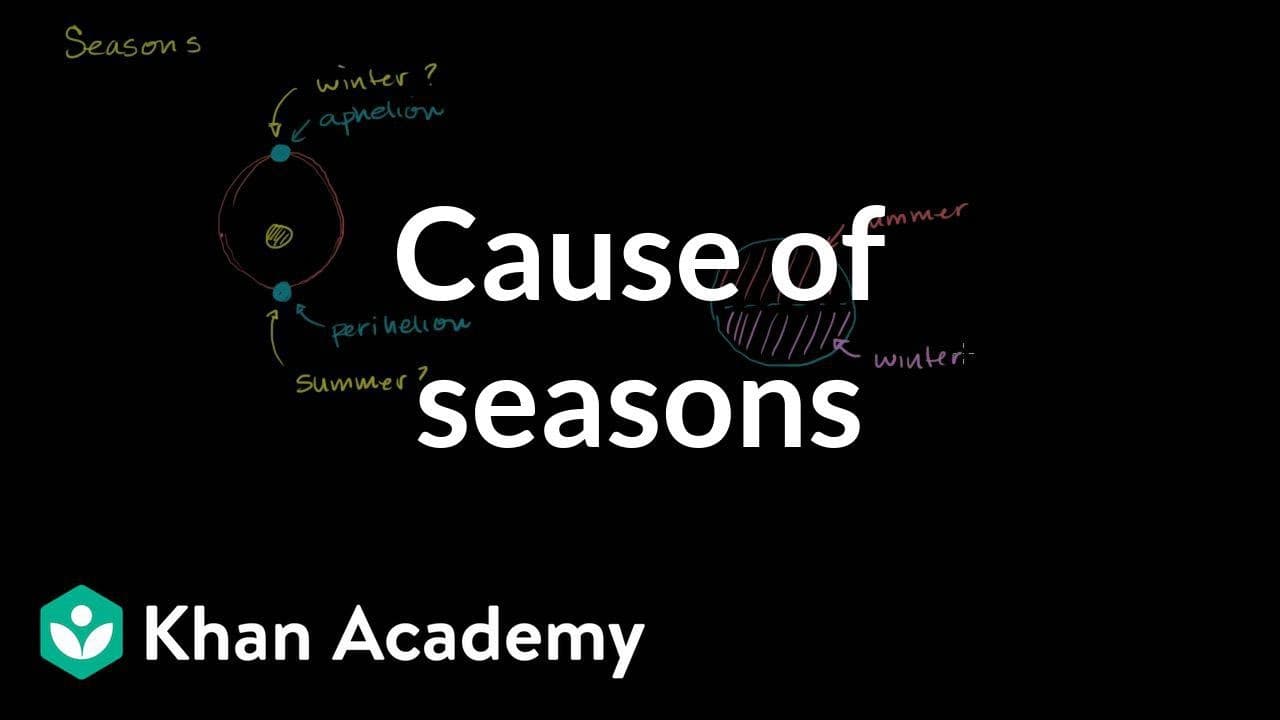
If you were to ask some people why we have seasons, they might say that maybe it's due to how far we are from the sun at different points in the year, different points in Earth's orbit. And what I want to do in this video is show you why that isn't the case. So the line of reasoning would go something like this. This is the sun at the center of our... Read More
Key Insights
- 🙂 Earth's orbit is slightly elliptical, resulting in variations in distance from the sun.
- 😎 Despite these variations, Earth's distance from the sun does not determine the seasons.
- 🧑🏭 The fact that different hemispheres experience opposite seasons simultaneously is evidence against the distance-based explanation.
- 🌞 In the Northern Hemisphere, perihelion occurs during winter, debunking the idea that closer proximity to the sun corresponds to summer.
- 🧑🏭 The tilt of Earth's axis is the primary factor determining seasons, as explained in the next video segment.
- 😎 Earth's elliptical orbit results in a mere 3% difference in distance from the sun, which is not significant enough to account for seasonal variations.
- 🤔 The misconception that distance from the sun determines seasons highlights the importance of scientific education and critical thinking.
Install to Summarize YouTube Videos and Get Transcripts
Explore YouTube Video Summarizer or Get YouTube Transcript Extractor
Questions & Answers
Q: Why do some people believe that Earth's distance from the sun determines the seasons?
Some people believe this because Earth's distance from the sun varies throughout its orbit, leading them to assume that closer proximity to the sun means warmer seasons.
Q: What is perihelion and aphelion?
Perihelion is the closest point in Earth's orbit to the sun, while aphelion is the furthest point. Earth's elliptical orbit leads to variations in distance from the sun.
Q: How does the fact that opposite hemispheres experience opposite seasons challenge the belief that distance from the sun determines seasons?
If distance from the sun were the sole determining factor, both hemispheres would experience the same season simultaneously. However, the fact that one hemisphere experiences winter while the other experiences summer clearly indicates that other factors are involved.
Q: When does perihelion occur in the Northern Hemisphere?
Perihelion in the Northern Hemisphere currently occurs during the winter, which contradicts the belief that closer proximity to the sun corresponds to summer.
Summary & Key Takeaways
-
Earth's distance from the sun varies throughout its elliptical orbit, with perihelion being the closest point and aphelion being the furthest point.
-
Contrary to popular belief, the seasons on Earth are not determined by its distance from the sun.
-
The fact that different hemispheres experience opposite seasons at the same time is a clear indication that Earth's distance from the sun is not the sole factor affecting seasons.
Read in Other Languages (beta)
Share This Summary 📚
Summarize YouTube Videos and Get Video Transcripts with 1-Click
Try YouTube Summary with ChatGPT & Claude or YouTube Transcript Generator
Explore More Summaries from Khan Academy 📚



Summarize YouTube Videos and Get Video Transcripts with 1-Click
Try YouTube Summary with ChatGPT & Claude or YouTube Transcript Generator