Citizenship in the US territories and District of Columbia | High school civics | Khan Academy
TL;DR
The content discusses the citizenship and voting rights of residents in US territories, highlighting the differences and similarities with citizens of the states.
Transcript
- [Presenter] Did you know that there are more than 4 million people who live in American territories that aren't part of the 50 US states? In fact, the US claims 16 territories outside of the continental United States, although a few of those are in dispute with other countries and only five of them are permanently inhabited. So where are these te... Read More
Key Insights
- 🇮🇴 There are 4 million people living in US territories, with only five territories having permanent inhabitants.
- 🇵🇷 Puerto Rico is the most populous territory, with a population greater than 19 US states.
- 🇦🇸 Residents of territories have varying citizenship statuses, with American Samoa currently being US nationals and others being US citizens.
- 🇮🇴 Voting rights in territories differ, with Washington DC having more voting representation than other territories.
- 🖤 Territories' residents have most of the same civil and political rights as citizens of states, but lack voting representation in Congress.
- 💼 There is an ongoing court case seeking US citizenship for American Samoans.
- 🇮🇴 Territories' residents have obligations to pay federal taxes and defend the country.
Install to Summarize YouTube Videos and Get Transcripts
Explore YouTube Video Summarizer or Get YouTube Transcript Extractor
Questions & Answers
Q: How did residents of American territories gain US citizenship?
Citizenship was granted through legislation and congressional orders, starting with Puerto Rico in 1917, US Virgin Islands in 1927, Guam in 1952, and Northern Mariana Islands in 1976.
Q: Are residents of American Samoa US citizens?
No, they are currently US nationals, which grants them travel and living rights in the US but not the right to vote. A court case seeking US citizenship for American Samoans is ongoing.
Q: Do residents of territories have the same civil and political rights as citizens of states?
Yes, residents of territories have most of the same rights and responsibilities as citizens of the states, such as the right to move freely within the US and obligations to pay federal taxes and defend the country.
Q: Do residents of territories have voting representation in Congress?
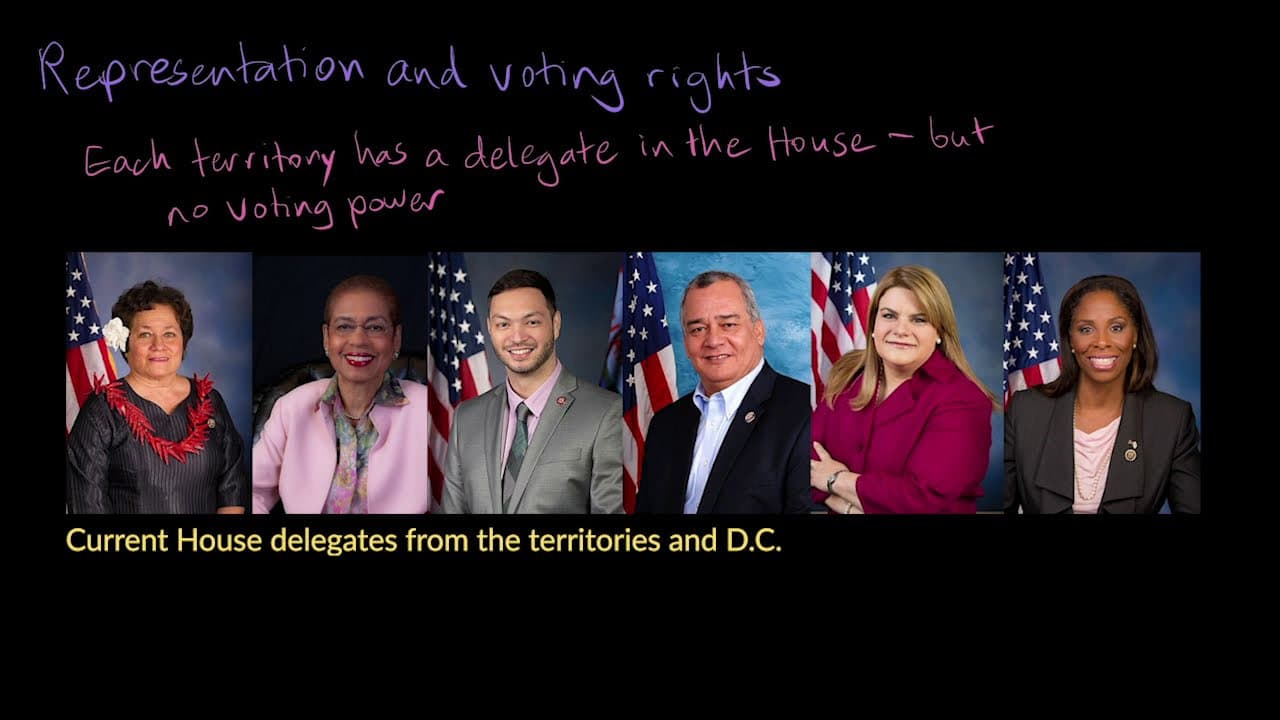
No, although territories have delegates in the House of Representatives, they cannot cast votes. Puerto Rico, Guam, US Virgin Islands, Northern Mariana Islands, and Washington DC residents have limited voting rights in other elections.
Summary & Key Takeaways
-
There are 16 territories outside of the US states, with only five of them being permanently inhabited.
-
Guam, the Northern Mariana Islands, American Samoa, the US Virgin Islands, and Puerto Rico are the main inhabited territories.
-
Residents of territories have varying citizenship statuses and voting rights, with American Samoa currently being US nationals without the right to vote.
Read in Other Languages (beta)
Share This Summary 📚
Summarize YouTube Videos and Get Video Transcripts with 1-Click
Try YouTube Summary with ChatGPT & Claude or YouTube Transcript Generator
Explore More Summaries from Khan Academy 📚



Summarize YouTube Videos and Get Video Transcripts with 1-Click
Try YouTube Summary with ChatGPT & Claude or YouTube Transcript Generator