2015 AP Chemistry free response 3d | Chemistry | Khan Academy
TL;DR
The pH at the half-equivalence point is equal to the pK-a, which can be calculated using the given dissociation constant (K-a) of sorbic acid.
Transcript
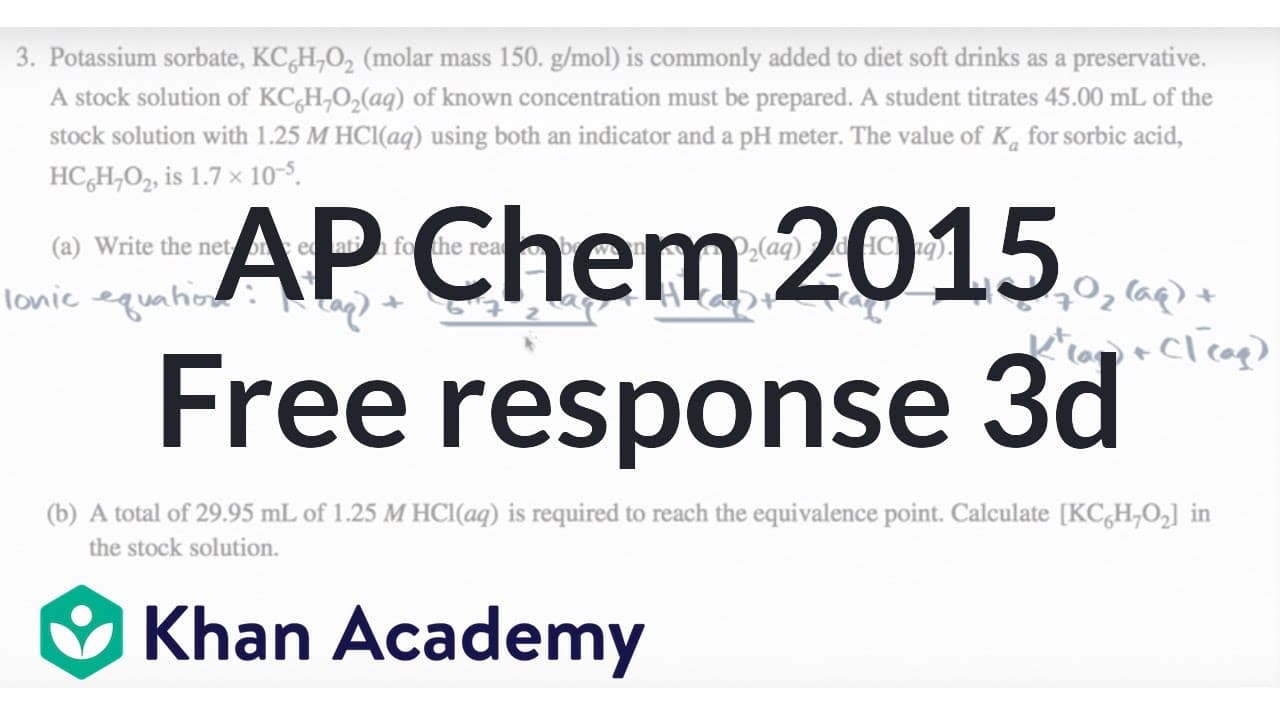
- [Voiceover] Calculate the pH at the half-equivalence point. So, let's just remind ourselves what the half-equivalence point even is. The equivalence point is when the titrant, in this case the hydrochloric acid, completely reacts with the potassium sorbate, the thing that we are titrating. Now the half-equivalence point is the point at which half... Read More
Key Insights
- 😥 The half-equivalence point is when half of the substance being titrated has been converted.
- 😥 At the half-equivalence point, the pH is equal to the pK-a.
- 👌 The pK-a can be calculated by taking the negative log (base ten) of the dissociation constant (K-a) of the acid.
Install to Summarize YouTube Videos and Get Transcripts
Explore YouTube Video Summarizer or Get YouTube Transcript Extractor
Questions & Answers
Q: What is the half-equivalence point?
The half-equivalence point is the point at which half of the substance being titrated has been converted or reacted with the titrant.
Q: How does the pH at the half-equivalence point relate to the pK-a?
At the half-equivalence point, the pH is equal to the pK-a. This means that the concentration of the acid and its conjugate base are equal, as indicated by the Henderson-Hasselbalch equation.
Q: How is the pK-a calculated?
The pK-a can be calculated by taking the negative log (base ten) of the dissociation constant (K-a) of the acid. In this case, the K-a of sorbic acid is used.
Q: Why is the Henderson-Hasselbalch equation relevant in this context?
The Henderson-Hasselbalch equation connects the pH, pK-a, and the concentrations of an acid and its conjugate base. It allows for the determination of pH at the half-equivalence point.
Summary & Key Takeaways
-
The equivalence point is when the titrant completely reacts with the substance being titrated, while the half-equivalence point is when half of the substance has been converted.
-
The pH at the half-equivalence point is equal to the pK-a.
-
The pK-a can be calculated by taking the negative log (base ten) of the dissociation constant (K-a) of sorbic acid.
Read in Other Languages (beta)
Share This Summary 📚
Summarize YouTube Videos and Get Video Transcripts with 1-Click
Try YouTube Summary with ChatGPT & Claude or YouTube Transcript Generator
Explore More Summaries from Khan Academy 📚



Summarize YouTube Videos and Get Video Transcripts with 1-Click
Try YouTube Summary with ChatGPT & Claude or YouTube Transcript Generator