Worked example: Determining an empirical formula from combustion data | AP Chemistry | Khan Academy
TL;DR
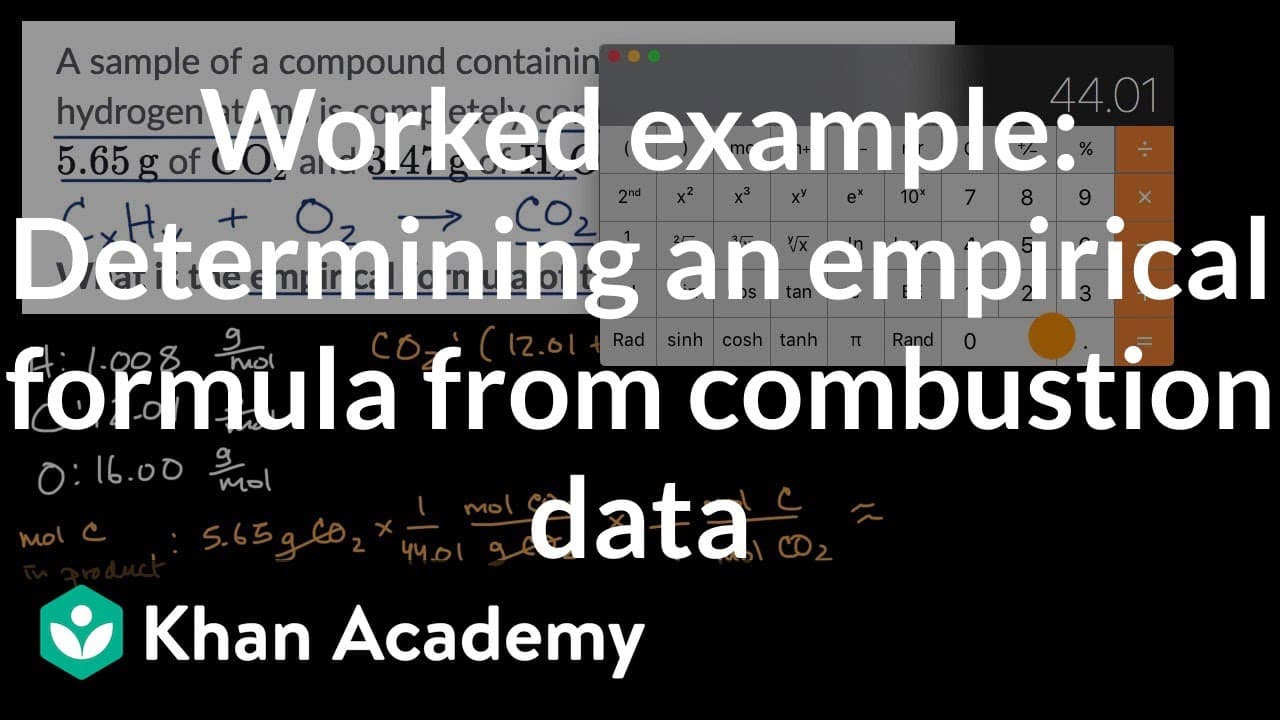
This video explains how to calculate the empirical formula of a compound based on the combustion reaction by determining the moles of carbon and hydrogen from the given mass of carbon dioxide and water.
Transcript
- [Instructor] We are told that a sample of a compound containing only carbon and hydrogen atoms is completely combusted, producing 5.65 grams of carbon dioxide and 3.47 grams of H2O or water. What is the empirical formula of the compound? So pause this video and see if you can work through that. All right, now let's just try to make sure we unders... Read More
Key Insights
- ❓ Combustion reactions involving carbon and hydrogen can be used to determine the empirical formula of a compound.
- 💆 Molar masses of elements are essential for converting between mass and moles.
- 🥳 The ratio of moles of reactants and products in a chemical reaction can be used to determine the empirical formula of a compound.
- 🥳 The empirical formula provides information about the simplest whole number ratio of atoms in a compound.
- 🆘 Calculating the empirical formula helps in identifying the composition and structure of a compound.
- 🏛️ The empirical formula represents the fundamental building blocks of a compound.
- ⚖️ Balancing the chemical equation is not necessary for determining the empirical formula.
Install to Summarize YouTube Videos and Get Transcripts
Explore YouTube Video Summarizer or Get YouTube Transcript Extractor
Questions & Answers
Q: What is the purpose of calculating the empirical formula in this context?
Calculating the empirical formula allows us to determine the ratio of carbon to hydrogen atoms in the compound, providing insight into the compound's composition and structure.
Q: How is the number of moles of carbon dioxide calculated?
The number of moles of carbon dioxide is determined by dividing the given mass of carbon dioxide (5.65 grams) by the molar mass of carbon dioxide (44.01 grams/mole).
Q: How is the number of moles of carbon calculated from the moles of carbon dioxide?
Since every carbon dioxide molecule contains one carbon atom, the number of moles of carbon is equal to the number of moles of carbon dioxide.
Q: Why is the mass of water divided by the molar mass of water to calculate the moles of water?
Dividing the mass of water (3.47 grams) by the molar mass of water (18.016 grams/mole) gives the number of moles of water because the molar mass represents the mass of one mole of water.
Q: How is the ratio of hydrogen to carbon atoms in the compound determined?
The ratio is found by dividing the moles of hydrogen (0.385 moles) by the moles of carbon (0.128 moles).
Summary & Key Takeaways
-
The video discusses a combustion reaction in which a compound containing only carbon and hydrogen atoms is completely combusted to produce carbon dioxide and water.
-
The mass of carbon dioxide produced is given as 5.65 grams, and the mass of water produced is given as 3.47 grams.
-
By calculating the moles of carbon and hydrogen from the given masses, the empirical formula of the compound (CH3) can be determined.
Read in Other Languages (beta)
Share This Summary 📚
Summarize YouTube Videos and Get Video Transcripts with 1-Click
Try YouTube Summary with ChatGPT & Claude or YouTube Transcript Generator
Explore More Summaries from Khan Academy 📚



Summarize YouTube Videos and Get Video Transcripts with 1-Click
Try YouTube Summary with ChatGPT & Claude or YouTube Transcript Generator