Motion problems: when a particle is speeding up | AP Calculus AB | Khan Academy
TL;DR
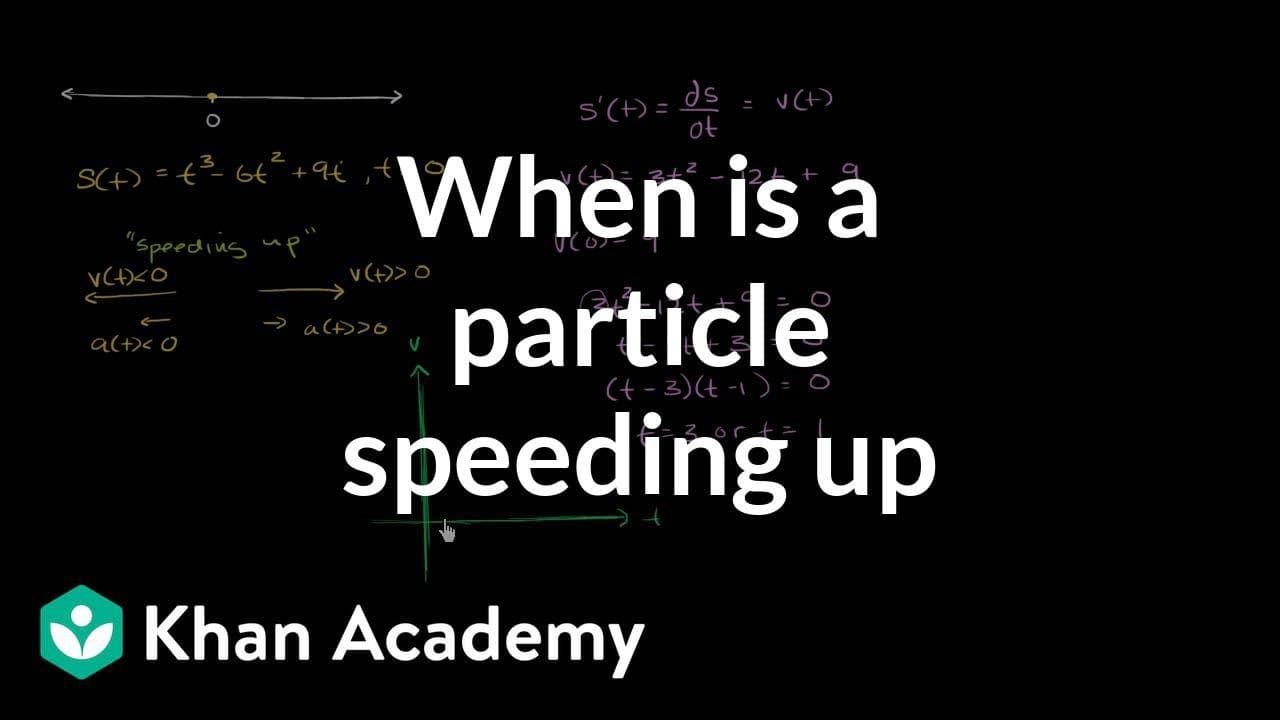
This content explains how to determine when a particle is speeding up based on its position, velocity, and acceleration functions.
Transcript
Let's say that we have some particle that's moving along the number line. So let me draw a number line right over here. So that's our number line right over there. And let's say it starts right over here at 0. And then as time passes, this little point is going to move around. Maybe it moves to the right, slows down, speeds up. Maybe it moves to th... Read More
Key Insights
- 🐎 Speeding up refers to an increase in velocity over time.
- 🧘 The velocity of a particle can be obtained by finding the derivative of its position function.
- 🫡 The acceleration of a particle is equal to the rate of change of its velocity with respect to time.
- 🤘 For a particle to be speeding up, the velocity and acceleration should have the same sign.
- 🫱 When the velocity is positive and the acceleration is positive, the particle is speeding up in the rightward direction.
- ❎ When the velocity is negative and the acceleration is negative, the particle is speeding up in the leftward direction.
- 🐎 The graph of velocity as a function of time helps visualize when the particle is speeding up.
Install to Summarize YouTube Videos and Get Transcripts
Explore YouTube Video Summarizer or Get YouTube Transcript Extractor
Questions & Answers
Q: What does it mean for a particle to speed up?
A particle is considered to be speeding up when it is either moving in the rightward direction and both its velocity and acceleration are positive, or moving in the leftward direction with negative velocity and negative acceleration.
Q: How can we determine when a particle is speeding up?
By analyzing the functions of position, velocity, and acceleration with respect to time, we can identify intervals where the conditions for speeding up are met. We check if the velocity is positive and the acceleration is either positive for rightward motion or negative for leftward motion.
Q: Are there any specific intervals where a particle is guaranteed to be speeding up?
Yes, the particle is guaranteed to be speeding up between the first and second seconds and after the third second, as long as the velocity and acceleration conditions are met.
Q: How can we determine the velocity and acceleration of a particle given its position function?
To find the velocity function, we take the derivative of the position function with respect to time. Similarly, to find the acceleration function, we take the derivative of the velocity function with respect to time.
Summary & Key Takeaways
-
The content discusses how to describe the motion of a particle using its position as a function of time.
-
When a particle is moving in the rightward direction and its velocity and acceleration are both greater than 0, it is speeding up.
-
If the particle is moving in the leftward direction, its velocity should be negative and its acceleration should also be negative for it to be speeding up.
Read in Other Languages (beta)
Share This Summary 📚
Summarize YouTube Videos and Get Video Transcripts with 1-Click
Try YouTube Summary with ChatGPT & Claude or YouTube Transcript Generator
Explore More Summaries from Khan Academy 📚



Summarize YouTube Videos and Get Video Transcripts with 1-Click
Try YouTube Summary with ChatGPT & Claude or YouTube Transcript Generator