Introduction to kNN: k Nearest Neighbors Classification and Regression in Python Using scikit-learn
TL;DR
Learn how to implement and understand the basics of the K nearest neighbors algorithm using Python for machine learning applications.
Transcript
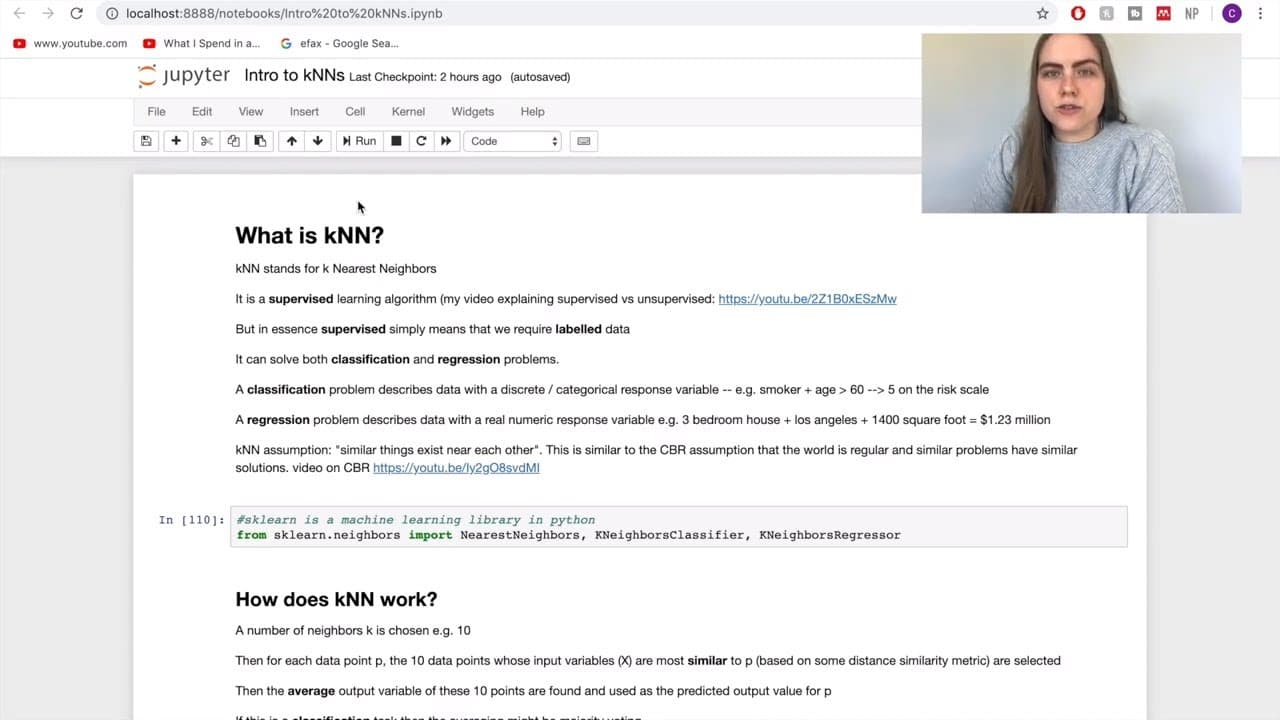
hey everyone and welcome back to my channel today we're going to do more of a practical sort of programming video about K nearest neighbors and it's going to be in Python so this is something that has been requested in a sense to start doing more videos about my research on my work so I think this is a good place to start because as I mentioned in ... Read More
Key Insights
- ⚾ KNN is a practical algorithm for implementing case-based reasoning and finding similar solutions for similar problems.
- 🏷️ Supervised learning algorithms like KNN require labeled data with input variables and output variables.
- 🔢 Scaling the input variables and selecting the appropriate number of neighbors (K) can significantly impact the performance of KNN.
- ❎ Evaluating KNN models involves assessing mean squared error, correlation (R-squared), and analyzing residuals.
Install to Summarize YouTube Videos and Get Transcripts
Explore YouTube Video Summarizer or Get YouTube Transcript Extractor
Questions & Answers
Q: What is K nearest neighbors (KNN)?
KNN is a supervised learning algorithm used for classification or regression problems. It relies on finding the nearest neighbors based on input variables to make predictions.
Q: How does KNN work in Python?
In Python, the scikit-learn library is commonly used for implementing KNN. The algorithm finds the K nearest neighbors for each data point, based on distance metrics like Euclidean or Manhattan distance. The output variables of the nearest neighbors are used to estimate the variable of interest.
Q: What is the difference between classification and regression problems in KNN?
In classification problems, the output variable is discrete, such as yes or no, and KNN uses majority voting to determine the predicted class. In regression problems, the output variable is continuous, and KNN uses techniques like mean or median to estimate the variable of interest.
Q: How can overfitting and underfitting be addressed in KNN?
Overfitting, where the model performs well on training data but poorly on new data, can be addressed by using techniques like cross-validation or splitting the data into training and testing sets. Underfitting, where the model fails to capture the underlying features, can be mitigated by using more data and adjusting model parameters.
Summary & Key Takeaways
-
K nearest neighbors (KNN) is a supervised learning algorithm that uses similar data points to make predictions.
-
KNN can be used for classification problems, where the output is discrete, or regression problems, where the output is continuous.
-
Implementing KNN in Python using the scikit-learn library involves finding the nearest neighbors, using distance metrics, and using their output variables to estimate the variable of interest.
Read in Other Languages (beta)
Share This Summary 📚
Summarize YouTube Videos and Get Video Transcripts with 1-Click
Try YouTube Summary with ChatGPT & Claude or YouTube Transcript Generator
Explore More Summaries from PhD and Productivity 📚





Summarize YouTube Videos and Get Video Transcripts with 1-Click
Try YouTube Summary with ChatGPT & Claude or YouTube Transcript Generator