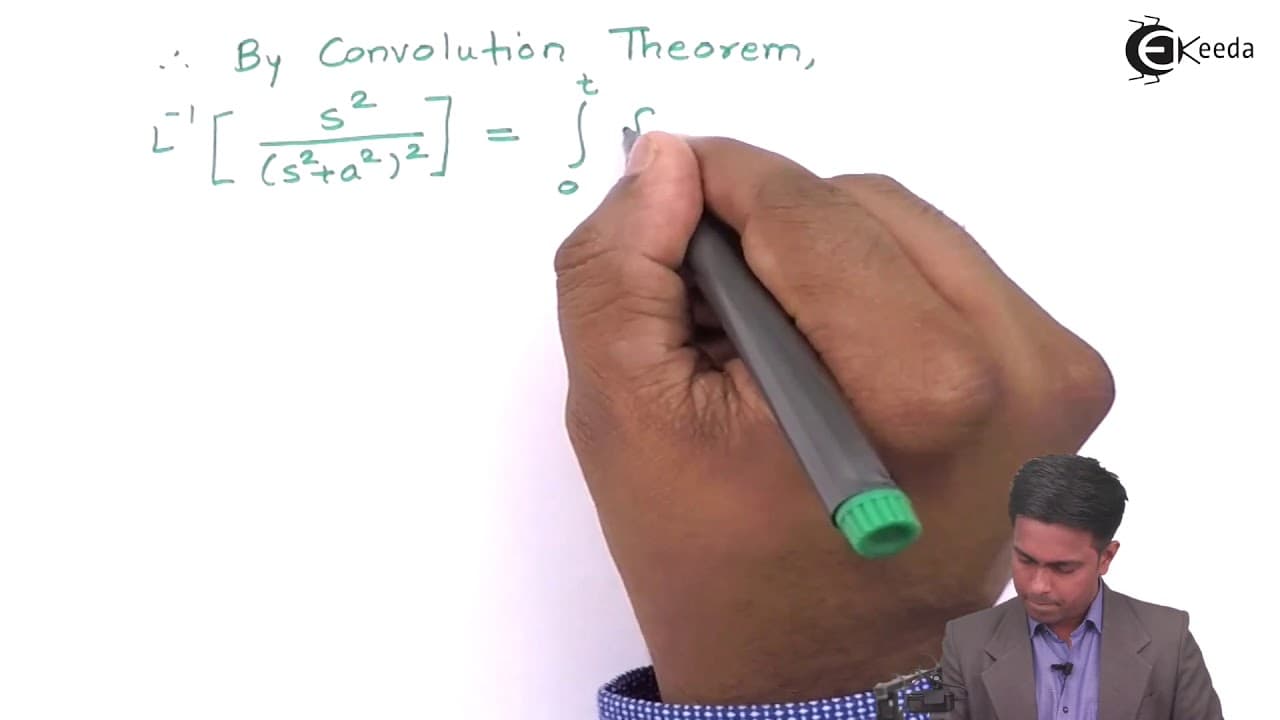
Problem 1 based on Inverse Laplace Transform using Convolution Theorem
TL;DR
This video explains how to find the inverse Laplace transform of a given function using the convolution theorem.
Transcript
hello students so after understanding the convolution theorem now let's start with the numerical which is based on convolution theorem so here i'm gonna give you a function of s and we are gonna find out the inverse laplace transform for that by using convolution theorem so let's start so here we have to find out inverse laplace transform of s squa... Read More
Key Insights
- 🎮 The video explains the steps to find the inverse Laplace transform using the convolution theorem.
- ⛎ The function is divided into phi 1 of s and phi 2 of s for convenience in applying the convolution theorem.
- ⛎ The inverse Laplace transforms of phi 1 of s and phi 2 of s are found separately.
- 😄 The convolution theorem is applied by substituting the values of phi 1 of s, phi 2 of s, f 1 of u, and f 2 of t - u.
Install to Summarize YouTube Videos and Get Transcripts
Explore YouTube Video Summarizer or Get YouTube Transcript Extractor
Questions & Answers
Q: What is the convolution theorem used for in finding the inverse Laplace transform?
The convolution theorem is used to find the inverse Laplace transform of two functions that are multiplying each other.
Q: How do you identify phi 1 of s and phi 2 of s in a given function?
Phi 1 of s is the numerator of the given function, and phi 2 of s is the denominator of the given function.
Q: Can the inverse Laplace transform be found using methods other than the convolution theorem?
Yes, the inverse Laplace transform can be found using other methods, but the video focuses on using the convolution theorem for the specific numerical.
Q: What is the formula for calculating the inverse Laplace transform of s/(s^2 + a^2)?
The inverse Laplace transform of s/(s^2 + a^2) is given by cos(at).
Summary & Key Takeaways
-
The video discusses the steps to find the inverse Laplace transform of a function using the convolution theorem.
-
Step 1: Identify the given function as phi 1 of s and phi 2 of s.
-
Step 2: Find the inverse Laplace transform of phi 1 of s and phi 2 of s, which are denoted as f 1 of t and f 2 of t, respectively.
-
Step 3: Find the value of f 1 of u by replacing t with u in f 1 of t.
-
Step 4: Find the value of f 2 of t - u by replacing t with t - u in f 2 of t.
-
Step 5: Apply the convolution theorem by substituting the values of phi 1 of s, phi 2 of s, f 1 of u, and f 2 of t - u.
Read in Other Languages (beta)
Share This Summary 📚
Summarize YouTube Videos and Get Video Transcripts with 1-Click
Try YouTube Summary with ChatGPT & Claude or YouTube Transcript Generator
Explore More Summaries from Ekeeda 📚




Summarize YouTube Videos and Get Video Transcripts with 1-Click
Try YouTube Summary with ChatGPT & Claude or YouTube Transcript Generator