Adding hundreds, tens, and ones | Addition and subtraction within 100 | Early Math | Khan Academy
TL;DR
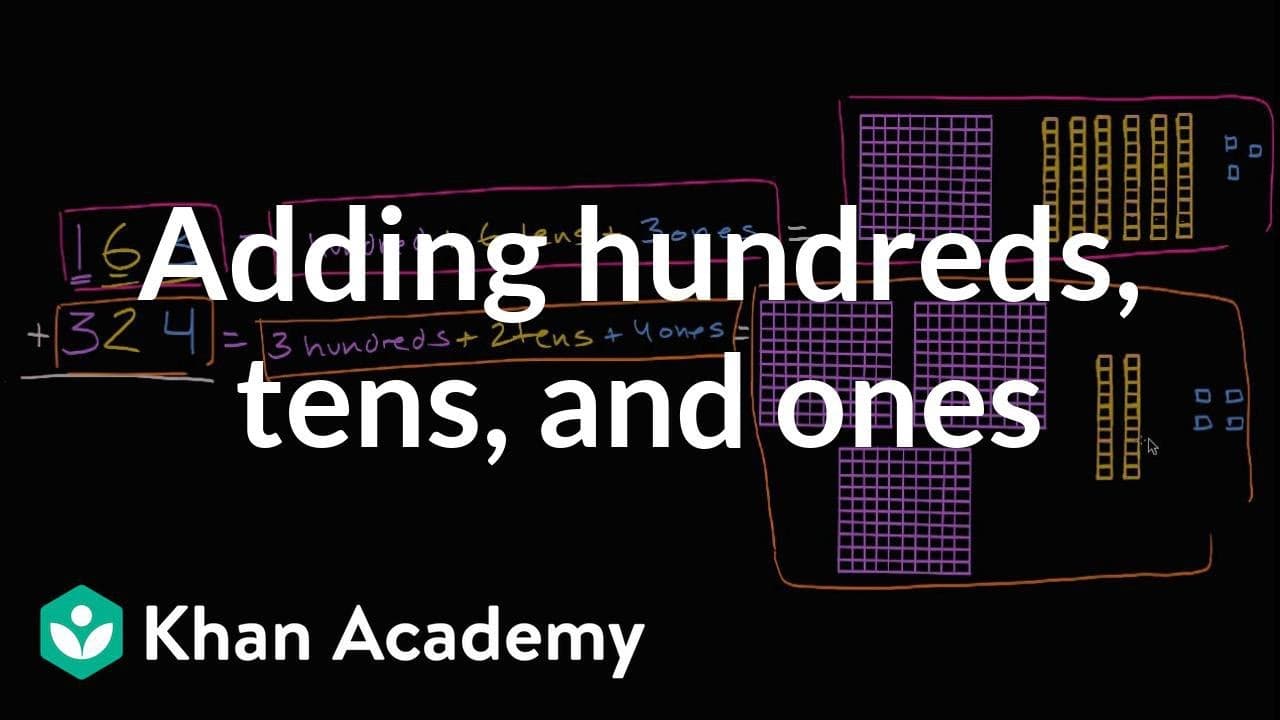
Add two three-digit numbers by breaking them down into hundreds, tens, and ones, and then combining the corresponding squares.
Transcript
- [Voiceover] So I have the number 163 and that is the same as, I have a one in the 100s place, so that's one hundred. Plus six 10s Plus three ones, three in the ones place. Do that in the color blue which I have for the ones place. And I've drawn that out here where I actually draw 163 squares. And you see it as one 100, six 10s. One, two, three, ... Read More
Key Insights
- 🍳 Addition can be visualized by breaking numbers down into their place values and representing them with squares.
- 👥 Grouping the squares by place value helps in adding the corresponding digits together.
- 🛀 The technique shown in the video can be used to add any two three-digit numbers.
- 💄 Representing numbers with squares makes addition more concrete and easier to understand.
- 🥇 Place value is essential in adding multi-digit numbers accurately.
- ❎ The relationship between the number of squares and the value they represent is demonstrated effectively.
- 😒 The addition process can be visually represented and understood through the use of manipulatives like squares.
Install to Summarize YouTube Videos and Get Transcripts
Explore YouTube Video Summarizer or Get YouTube Transcript Extractor
Questions & Answers
Q: How are the numbers 163 and 324 broken down into their place values?
The number 163 is broken down into 100 (hundreds), 6 (tens), and 3 (ones). The number 324 is broken down into 300 (hundreds), 20 (tens), and 4 (ones).
Q: How are the squares used to represent the numbers?
Each place value (hundreds, tens, ones) is represented by a square. For example, the number 163 is illustrated with one square in the hundreds place, six squares in the tens place, and three squares in the ones place.
Q: How are the squares grouped and added together?
The squares of the same place value are grouped together. For example, all the squares in the hundreds place are grouped, all the squares in the tens place are grouped, and all the squares in the ones place are grouped. These groups are then added together to get the final sum.
Q: What is the result of adding 163 and 324?
The result is 487, consisting of 4 hundreds, 8 tens, and 7 ones, as shown by the squares.
Summary & Key Takeaways
-
The video explains how to add two three-digit numbers, using the example of adding 163 and 324.
-
The numbers are broken down into hundreds, tens, and ones, and represented by squares.
-
The squares are grouped based on their place value, and then added together to get the final result of 487.
Read in Other Languages (beta)
Share This Summary 📚
Summarize YouTube Videos and Get Video Transcripts with 1-Click
Try YouTube Summary with ChatGPT & Claude or YouTube Transcript Generator
Explore More Summaries from Khan Academy 📚



Summarize YouTube Videos and Get Video Transcripts with 1-Click
Try YouTube Summary with ChatGPT & Claude or YouTube Transcript Generator