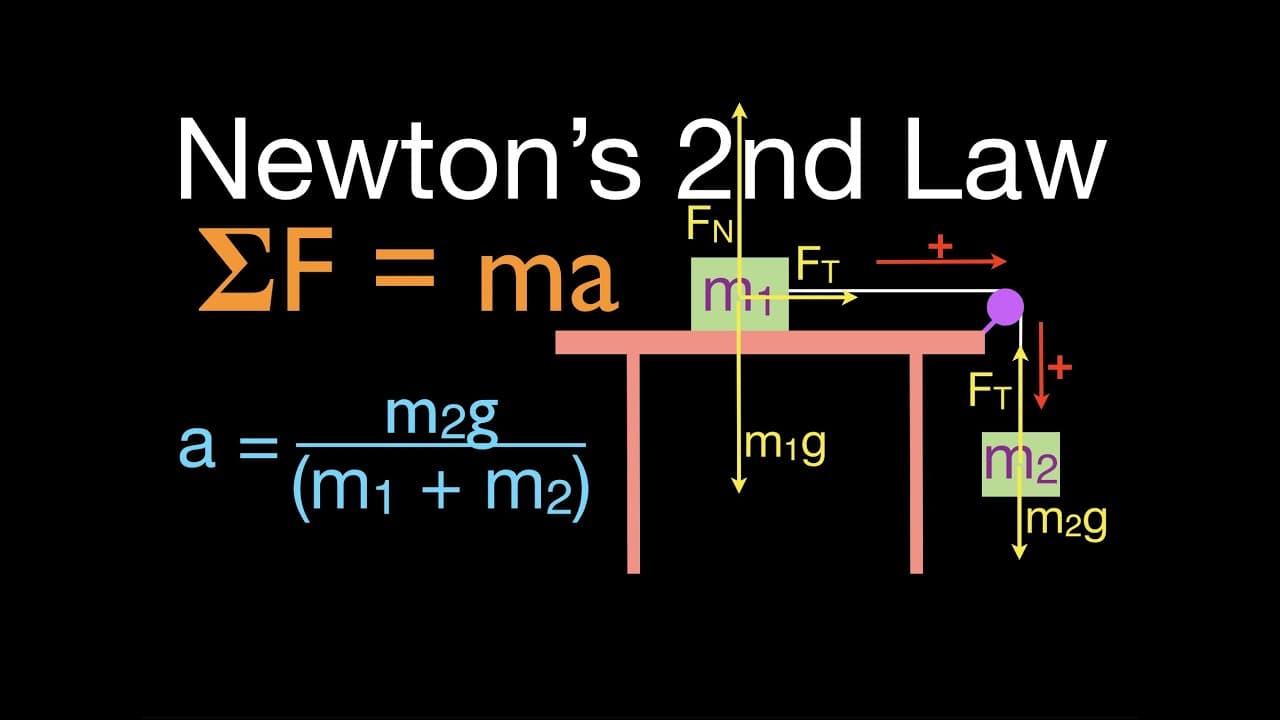
Newton's 2nd Law (11 of 21) Calculating Acceleration with Friction; Table, Pulley, Two Masses
TL;DR
Solving for acceleration and tension in a system with friction using Newton's second law.
Transcript
okay in today's video we're gonna go over another problem involving acceleration with friction and this is the situation we have we had mass m1 which is a mass of seven kilograms is sitting on the table the friction there is a coefficient of friction of 0.25 between m1 and the table so there is friction between m1 and the table and then we have mas... Read More
Key Insights
- ❓ Friction impacts acceleration by opposing motion.
- 👮 Sum of forces and Newton's second law are crucial in solving such problems.
- ⚾ Positive directions are determined based on the motion of the objects.
- 💨 Tension in the string remains constant for masses connected in this way.
- 💆 Calculations involve friction force (μmg), sum of forces, and mass acceleration.
- 🤘 Accurate consideration of positive and negative signs is essential for correct solutions.
- 🟰 Checking results by ensuring tension forces are equal validates calculations.
Install to Summarize YouTube Videos and Get Transcripts
Explore YouTube Video Summarizer or Get YouTube Transcript Extractor
Questions & Answers
Q: How do you determine the positive direction for forces in the system?
Positive direction for M1 is right and for M2 is down due to their motion directions.
Q: What forces are considered when applying Newton's second law to M1 and M2?
Tension force and friction force are considered for M1, while tension force and weight force are considered for M2.
Q: How is the friction force calculated in the system?
Friction force is calculated by multiplying the coefficient of friction (0.25) with the normal force, equal to M1's weight (m1G).
Q: How is the tension force in the string found to be equal for M1 and M2?
By separately applying Newton's second law to each mass and solving for tension, it is shown that the tension force is the same (31.1 N).
Summary & Key Takeaways
-
Masses M1 (7kg) and M2 (4kg) connected by a string over a pulley.
-
Consider friction, sum of forces, and Newton's second law.
-
Calculate acceleration (1.97 m/s^2) and tension force (31.1 N).
Read in Other Languages (beta)
Share This Summary 📚
Summarize YouTube Videos and Get Video Transcripts with 1-Click
Try YouTube Summary with ChatGPT & Claude or YouTube Transcript Generator
Explore More Summaries from Step by Step Science 📚


Summarize YouTube Videos and Get Video Transcripts with 1-Click
Try YouTube Summary with ChatGPT & Claude or YouTube Transcript Generator