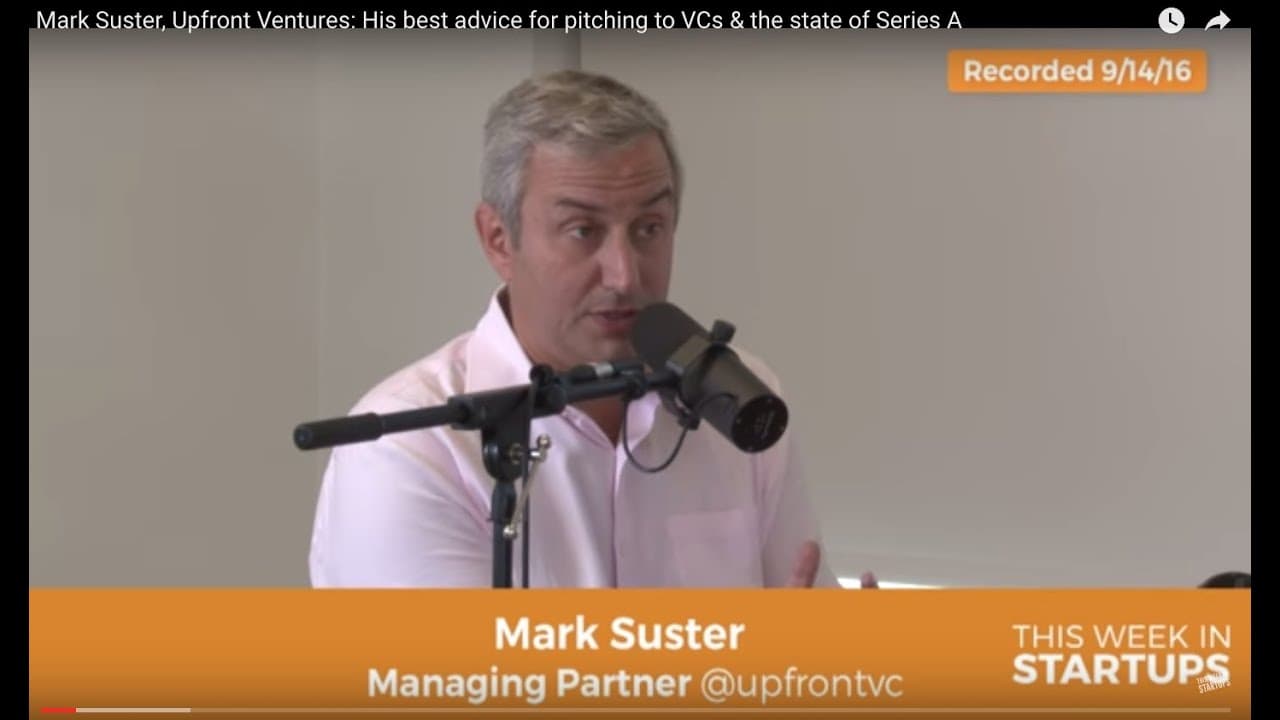
Mark Suster, Upfront Ventures: His best advice for pitching to VCs & the state of Series A
TL;DR
Raising Series A funding can be challenging, but with clear credibility and engaging conversations with investors, it can be achieved successfully.
Transcript
what you want to do is you establish credibility both what is the problem i'm solving what is my solution why am i uniquely positioned to solve this that's my credentials so like product market fit yeah and why we can win and then what you need to do is ask a question ah and you say well here's something we're grappling with ah the cut is the kung ... Read More
Key Insights
- 🥺 Establishing credibility and engaging investors in conversations can lead to successful Series A funding.
- 🤨 The definition of Series A can determine the fundraising difficulty, with $2-3 million being relatively easier to raise compared to $7-10 million.
- 🛀 Risk-taking VCs are still willing to invest in companies with product-market fit but less traction.
Install to Summarize YouTube Videos and Get Transcripts
Explore YouTube Video Summarizer or Get YouTube Transcript Extractor
Questions & Answers
Q: How hard is it to raise Series A funding currently?
Raising Series A funding depends on defining what it means. Raising $2-3 million is relatively easier, but $7-10 million requires more proof of company success. The Series A landscape is affected by a logjam caused by a high number of incoming companies seeking funding.
Q: Are VCs still willing to invest with less traction but strong product-market fit?
Yes, there are still risk-taking VCs willing to invest in companies with product-market fit but limited traction. These VCs are often looking for potential unicorns and believe in the long-term success of the company.
Q: What caused the rise in late-stage round valuations between 2012 and 2015?
The median valuation of late-stage rounds increased by 300% during that period, primarily due to various actors investing more. VCs raised more money, and other sources like hedge funds, corporates, and mutual funds added significant investments.
Q: How did the market conditions affect late-stage investments?
Market conditions played a role in the rise of late-stage investments. Many investors viewed it as an opportunity to place markers on companies that they expected to go public. Factors like FOMO, companies delaying IPOs, and Corporates also contributed to the increased investment.
Summary & Key Takeaways
-
Establishing credibility is crucial when seeking Series A funding, highlighting the problem, solution, and unique positioning. Engage investors with thought-provoking questions and seek their opinions.
-
The series A funding landscape has changed, with a logjam caused by an increasing number of companies seeking funding. It depends on the definition of Series A, as raising $2-3 million is relatively easier compared to raising $7-10 million.
-
Risk-taking VCs still exist, willing to invest in companies with product-market fit but less traction. The substantial increase in late-stage round valuations between 2012 and 2015 was driven by various actors, including corporates and hedge funds.
Read in Other Languages (beta)
Share This Summary 📚
Summarize YouTube Videos and Get Video Transcripts with 1-Click
Try YouTube Summary with ChatGPT & Claude or YouTube Transcript Generator
Explore More Summaries from This Week in Startups 📚






Summarize YouTube Videos and Get Video Transcripts with 1-Click
Try YouTube Summary with ChatGPT & Claude or YouTube Transcript Generator