Basic Operation of Power BJT
TL;DR
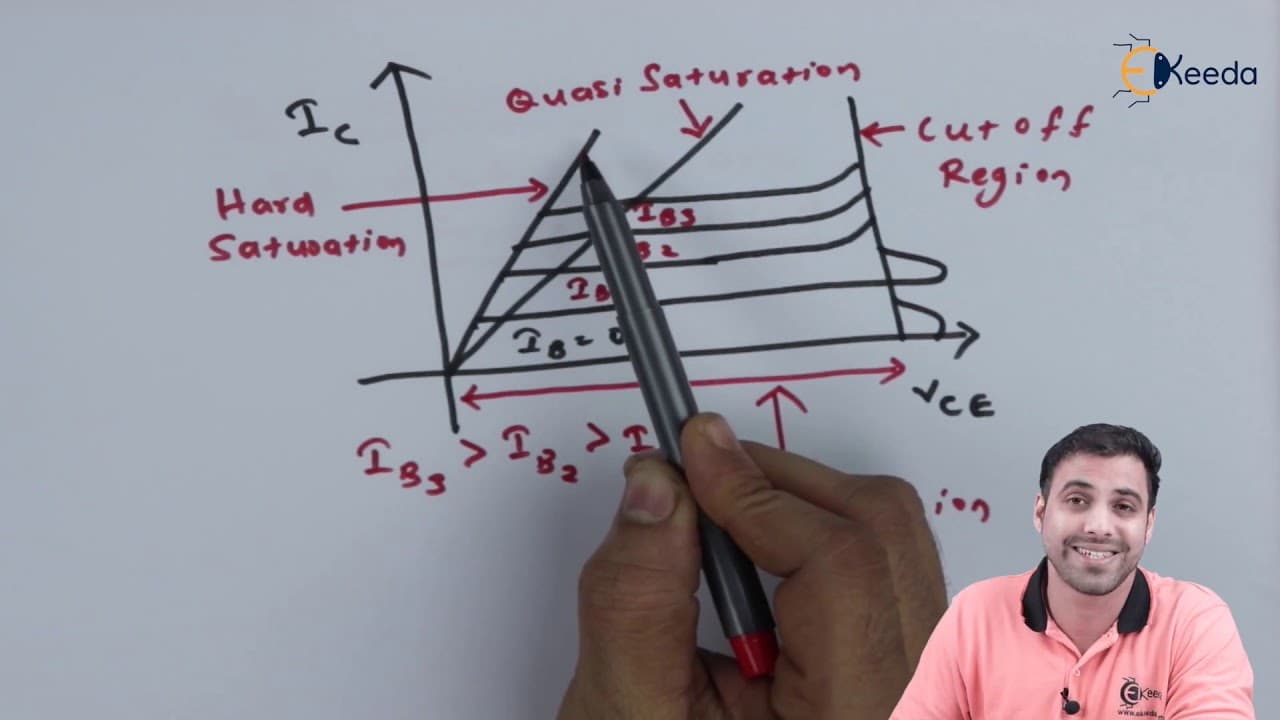
This video discusses the basic operation of a power bipolar junction transistor, including its four operating regions: cutoff, quasi-saturation, hard saturation, and active region.
Transcript
hello friends today we are going to discuss about basic operation of a power bipolar junction transistor friends as we all discuss about the construction of a power bipolar junction transistor and how it is capable of handling a lot of electric current or high value of electric current and high value of electric voltage now let's discuss about how ... Read More
Key Insights
- ✊ Power bipolar junction transistors can operate in four regions: cutoff, quasi-saturation, hard saturation, and active region.
- 👻 In the hard saturation region, both the base-emitter and collector-emitter junctions are forward biased, allowing for a high flow of current.
- 💐 The cutoff region is when both junctions are reverse biased, resulting in no flow of current.
- ☢️ The active region is where the transistor is most commonly operated.
- 💨 Quasi-saturation region is important for high-frequency applications and fast switching operations.
- 👻 Quasi-saturation region allows for the flow of current and keeps both the base and collector forward biased.
- ⚡ The presence of an n minus layer in the quasi-saturation region helps the transistor block high voltage and withstand high currents.
Install to Summarize YouTube Videos and Get Transcripts
Explore YouTube Video Summarizer or Get YouTube Transcript Extractor
Questions & Answers
Q: What are the four operating regions of a power bipolar junction transistor?
The four operating regions are cutoff, quasi-saturation, hard saturation, and active region.
Q: What happens in the hard saturation region?
In the hard saturation region, both the base-emitter and collector-emitter junctions are forward biased, leading to a high flow of current.
Q: Why is the cutoff region important?
The cutoff region is important as it acts as a switch, completely blocking the flow of current through the transistor.
Q: Where is the transistor most commonly operated?
The transistor is most commonly operated in the active region, between quasi-saturation and cutoff.
Summary & Key Takeaways
-
A power bipolar junction transistor can operate in four regions: cutoff, quasi-saturation, hard saturation, and active region.
-
In the hard saturation region, both the base-emitter and collector-emitter junctions are forward biased, allowing for a high flow of current.
-
The cutoff region is where there is no flow of current, as both the base-emitter and collector-emitter junctions are reverse biased.
-
The active region, between quasi-saturation and cutoff, is where the transistor is most commonly operated.
Read in Other Languages (beta)
Share This Summary 📚
Summarize YouTube Videos and Get Video Transcripts with 1-Click
Try YouTube Summary with ChatGPT & Claude or YouTube Transcript Generator
Explore More Summaries from Ekeeda 📚






Summarize YouTube Videos and Get Video Transcripts with 1-Click
Try YouTube Summary with ChatGPT & Claude or YouTube Transcript Generator