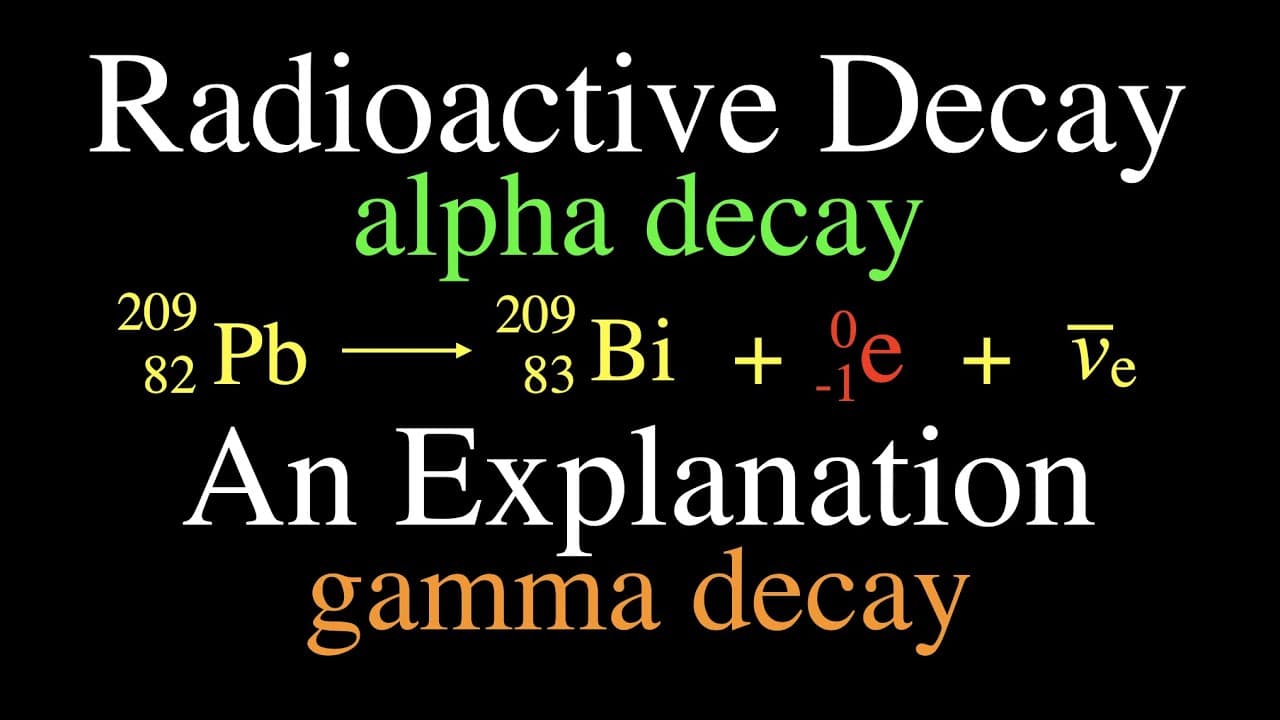
Radioactivity (3 of 16) Three Types of Radioactive Decay, An Explanation
TL;DR
Understanding alpha, beta, and gamma decay in radioactive elements.
Transcript
okay in today's video I'm gonna go over an explanation of radioactive decay and that is of course going to cover alpha beta and gamma decay and before we do that please don't forget down here in the bottom right hand corner click on the subscribe button subscribe to my channel get all my excellent physics chemistry and math videos and also while yo... Read More
Key Insights
- ☢️ Radioactive decay involves alpha, beta, and gamma processes emitting different particles.
- #️⃣ Alpha decay emits helium nuclei and reduces the atomic number by 2 and the mass number by 4.
- 🤑 Beta minus decay occurs in neutron-rich environments, transforming neutrons into protons and emitting an electron.
- 🤑 Beta plus decay happens in proton-rich environments, converting protons into neutrons and releasing a positron.
- ✋ Gamma decay releases high-energy photons without altering the atomic or mass numbers.
- 🥺 Each decay type has different penetrating powers, with alpha stopped by skin, beta by aluminum, and gamma by lead.
- 🫥 The stability line in the chart of nuclides represents nuclei with a balanced proton and neutron ratio.
Install to Summarize YouTube Videos and Get Transcripts
Explore YouTube Video Summarizer or Get YouTube Transcript Extractor
Questions & Answers
Q: What are the three types of radioactive decay?
The three types are alpha, beta, and gamma decay, each involving the emission of different particles.
Q: How does alpha decay change the atomic number and mass number?
Alpha decay reduces the atomic number by 2 and the mass number by 4 due to the emission of a helium nucleus.
Q: Why does beta minus decay occur, and what particles are emitted?
Beta minus decay occurs in neutron-rich environments, transforming a neutron into a proton while emitting an electron and an antineutrino.
Q: What is the significance of the stability line in the chart of nuclides?
The stability line indicates nuclei with the right balance of protons and neutrons, with unstable nuclides tending to undergo decay processes.
Summary & Key Takeaways
-
Radioactive decay involves alpha, beta, and gamma particles emitted from unstable nuclei.
-
Alpha decay emits helium nuclei, beta decay involves neutron-to-proton transformations, and gamma decay releases high-energy photons.
-
The decay processes result in transmutations where atomic and mass numbers change.
Read in Other Languages (beta)
Share This Summary 📚
Summarize YouTube Videos and Get Video Transcripts with 1-Click
Try YouTube Summary with ChatGPT & Claude or YouTube Transcript Generator
Explore More Summaries from Step by Step Science 📚


Summarize YouTube Videos and Get Video Transcripts with 1-Click
Try YouTube Summary with ChatGPT & Claude or YouTube Transcript Generator