Calculus 3 - Vector Projections & Orthogonal Components
TL;DR
Learn how to find the parallel and perpendicular components of a vector with respect to another vector.
Transcript
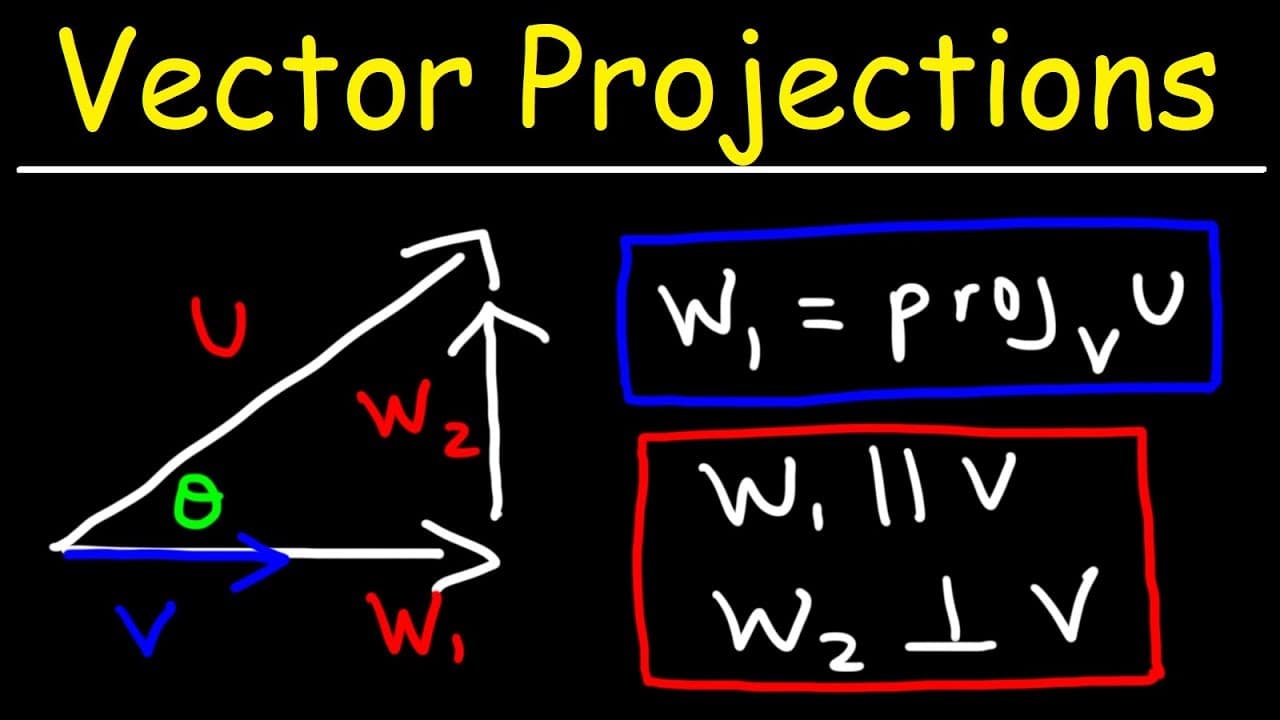
let's say we have two vectors vector u and vector v how can we find two components of vector u one of which is parallel to vector v and the other is perpendicular to vector v so let's draw a picture so let's say this is w1 and this perpendicular to it is w2 how can we find those two components of vector u where w one is parallel to vector v and uh ... Read More
Key Insights
- 🫥 The parallel component of a vector to another vector can be found using the dot product and the magnitude of the parallel vector.
- ❓ The perpendicular component can be obtained by subtracting the parallel component from the original vector.
- ⛔ The components w1 and w2 are not limited to any specific axis and can be found using the provided formulas.
- ❎ The magnitude of vector v is calculated using the square root of the sum of the squares of its components.
- ❓ Practice problems are helpful in understanding and applying these concepts in different scenarios.
- 🤪 The process can be repeated for vectors with x, y, and z components.
- 😄 The magnitude of vector w2 will be the same as vector u, as it represents the component orthogonal or perpendicular to vector v.
Install to Summarize YouTube Videos and Get Transcripts
Explore YouTube Video Summarizer or Get YouTube Transcript Extractor
Questions & Answers
Q: How do you find the parallel component of a vector to another vector?
To find the parallel component (w1), use the formula w1 = (u · v) / ||v||^2 * v, where · represents the dot product and ||v|| represents the magnitude of vector v.
Q: What is the formula to find the perpendicular component of a vector to another vector?
The formula to find the perpendicular component (w2) is w2 = u - w1, where w1 is the parallel component.
Q: Can the components of vector u be along any axis?
Yes, the components w1 and w2 are not necessarily along the x or y axis. They are simply parallel and perpendicular to vector v.
Q: How can the magnitude of vector v be calculated?
The magnitude of vector v, denoted as ||v||, is calculated as the square root of the sum of the squares of its x, y, and z components.
Q: What does w1 represent in relation to vector u and vector v?
w1 is the projection of vector u onto vector v. It represents the component of vector u that travels along vector v.
Q: Is vector v the same length as w1?
No, vector v is not necessarily the same length as w1. It is simply parallel to w1 and perpendicular to w2.
Q: How do you calculate w2?
w2 is calculated by subtracting w1 from vector u. The formula is w2 = u - w1.
Q: Can the formulas for w1 and w2 be used for any vectors?
Yes, the formulas for w1 and w2 can be used for any given vectors u and v.
Summary & Key Takeaways
-
To find the parallel component of vector u to vector v (w1), use the formula w1 = (u · v) / ||v||^2 * v.
-
To find the perpendicular component of vector u to vector v (w2), use the formula w2 = u - w1.
-
Practice problems involve finding w1 and w2 using given vectors.
Read in Other Languages (beta)
Share This Summary 📚
Summarize YouTube Videos and Get Video Transcripts with 1-Click
Try YouTube Summary with ChatGPT & Claude or YouTube Transcript Generator
Explore More Summaries from The Organic Chemistry Tutor 📚


Summarize YouTube Videos and Get Video Transcripts with 1-Click
Try YouTube Summary with ChatGPT & Claude or YouTube Transcript Generator