Self Referential Structure | Structures In C | Data Structure Using C
TL;DR
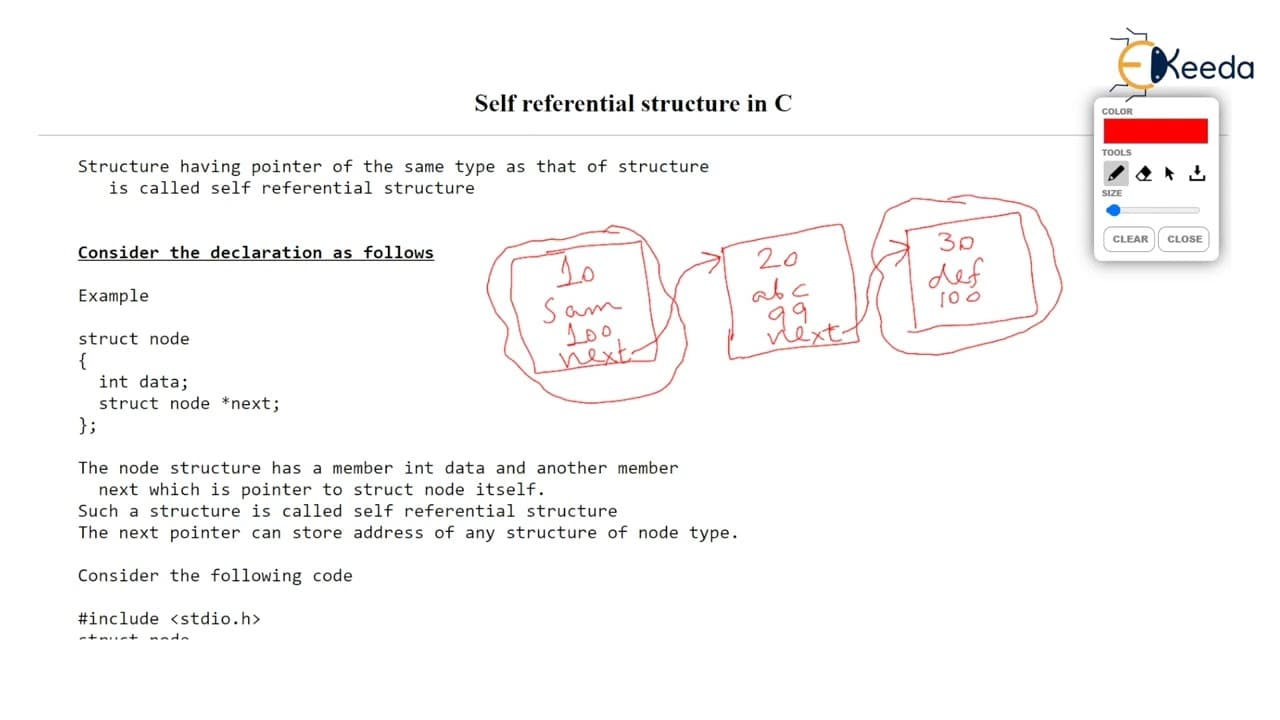
This video introduces the concept of self-referential structures in C programming as a foundation for data structures like linked lists.
Transcript
hello dear students i am samir velankar i welcome all of you to this next video on structures in c we are looking at a topic called self referential structure in c actually i should say that this is just the beginning of data structures in c basically i am going to teach the the topic or the subject programming and data structures and we were learn... Read More
Key Insights
- 🤳 Self-referential structures are a fundamental concept in data structures and are used to create linked lists, stacks, binary trees, and graphs.
- 🤳 Self-referential structures enable the creation of connected data structures where each node contains data and a pointer to the next node.
- 🤳 Self-referential structures provide flexibility in storing different types of data in a structured manner.
- 😀 Memory can be dynamically allocated for self-referential structures using functions like "malloc" in C programming.
- ❤️🩹 Null pointers are commonly used to indicate the end of a linked list or the absence of a connection in a data structure.
- 💘 Self-referential structures can be accessed and manipulated using arrow notation in C programming.
- 👻 Self-referential structures allow for efficient traversal and processing of data in linked lists and other connected data structures.
Install to Summarize YouTube Videos and Get Transcripts
Explore YouTube Video Summarizer or Get YouTube Transcript Extractor
Questions & Answers
Q: What is a self-referential structure in C programming?
A self-referential structure is a structure that contains a pointer of the same type as the structure itself.
Q: How are self-referential structures used in data structures?
Self-referential structures are commonly used in data structures like linked lists, stacks, binary trees, and graphs to store and manipulate data in a connected manner.
Q: What is the purpose of the "next" pointer in a self-referential structure?
The "next" pointer in a self-referential structure is used to point to the next node in a linked list or any other connected data structure.
Q: How is memory allocated for self-referential structures?
Memory can be dynamically allocated for self-referential structures using functions like "malloc" in C programming.
Summary & Key Takeaways
-
The video introduces the concept of self-referential structures in C programming and its relationship to data structures.
-
Self-referential structures are structures that contain a pointer of the same type as the structure itself.
-
The example given demonstrates how self-referential structures can be used to create a linked list.
Read in Other Languages (beta)
Share This Summary 📚
Summarize YouTube Videos and Get Video Transcripts with 1-Click
Try YouTube Summary with ChatGPT & Claude or YouTube Transcript Generator
Explore More Summaries from Ekeeda 📚






Summarize YouTube Videos and Get Video Transcripts with 1-Click
Try YouTube Summary with ChatGPT & Claude or YouTube Transcript Generator