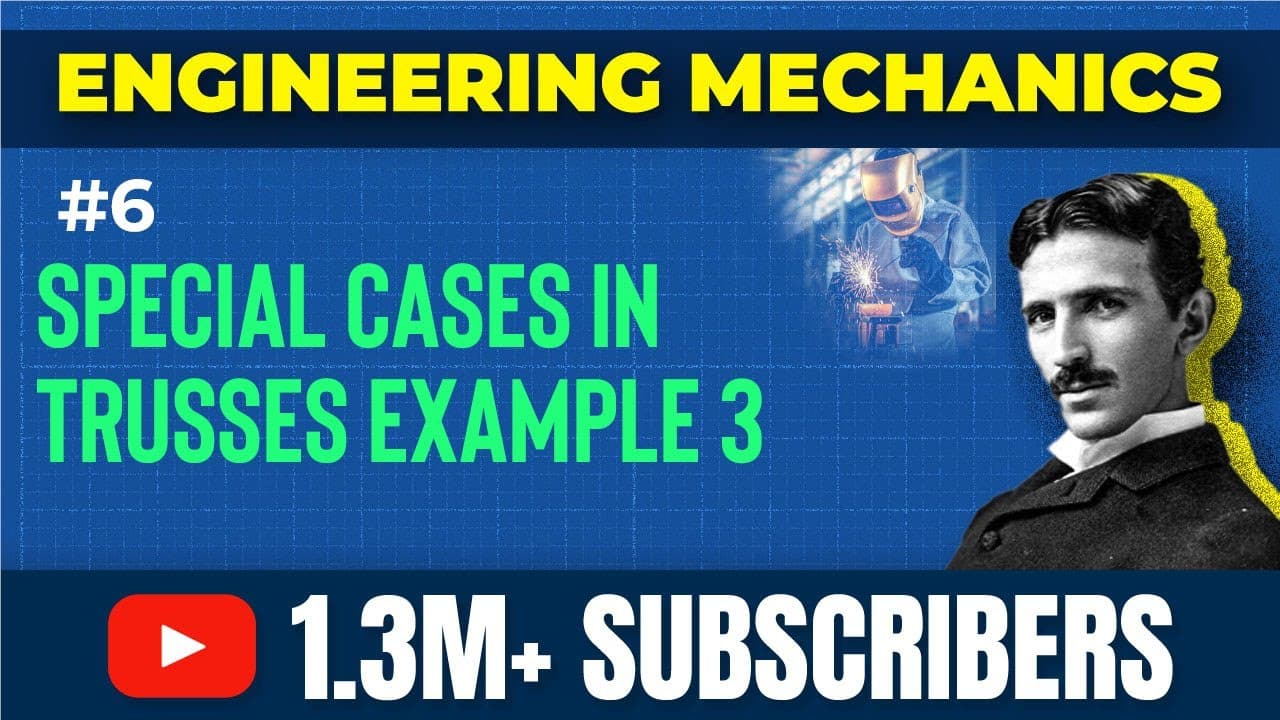
Special Cases in Trusses Example 3 - Truses - Engineering Mechanics
TL;DR
This video explains how to calculate support reactions and member forces in a truss structure.
Transcript
hello students today we will see the next example in special cases we have already solved two examples for special cases today we will see the third example okay students now this is a third example when we are going to apply the special case now the first step that we do as usual that is find out whether the truss is stable after that we will find... Read More
Key Insights
- #️⃣ Stability of a truss can be determined by comparing the number of members and joints.
- 😥 Support reactions are calculated by analyzing the forces at support points.
- 💼 Special cases cannot be applied if there are more than four collinear forces at a joint.
- ⚾ Collinear members can have equal forces based on observation.
- ❓ Member forces can be calculated using the method of joints and equations of equilibrium.
- ❓ Some member forces may be tensile, while others may be compressive.
Install to Summarize YouTube Videos and Get Transcripts
Explore YouTube Video Summarizer or Get YouTube Transcript Extractor
Questions & Answers
Q: How do you determine if a truss structure is stable?
To determine stability, you need to compare the number of members to the number of joints. If they are equal, it is a stable truss.
Q: How many support reactions are there in this example?
There are three support reactions, one horizontal and two vertical, due to the hinge and roller supports.
Q: How are the support reactions calculated?
The support reactions are calculated by summing the horizontal and vertical forces at each support point and resolving them using equations of equilibrium.
Q: Can special cases be applied to determine member forces in this truss?
Special cases cannot be applied to this truss because it has more than four collinear forces at any joint.
Q: How are member forces in collinear members determined?
Forces in collinear members can be assumed to be equal based on observation and can be directly determined from the forces acting on other members in the same line.
Q: What is the next step after calculating support reactions?
The next step is to determine the forces in all the truss members using the method of joints and equations of equilibrium.
Q: Are all member forces compressive in this truss?
No, not all member forces are compressive. Some may be tensile depending on their orientation and the direction of the applied forces.
Q: How do you tabulate the results of member forces?
The member forces are tabulated, indicating whether they are compressive or tensile. Each member force is calculated separately using the method of joints.
Summary & Key Takeaways
-
The video demonstrates the steps to determine support reactions and member forces in a truss structure.
-
The truss structure in the example is stable and can be considered a perfect truss.
-
Support reactions are calculated by analyzing the forces acting on the truss members.
Read in Other Languages (beta)
Share This Summary 📚
Summarize YouTube Videos and Get Video Transcripts with 1-Click
Try YouTube Summary with ChatGPT & Claude or YouTube Transcript Generator
Explore More Summaries from Ekeeda 📚

Summarize YouTube Videos and Get Video Transcripts with 1-Click
Try YouTube Summary with ChatGPT & Claude or YouTube Transcript Generator