Failure with Loss of Non Volatile Storage - Transaction Management - Database Management System
TL;DR
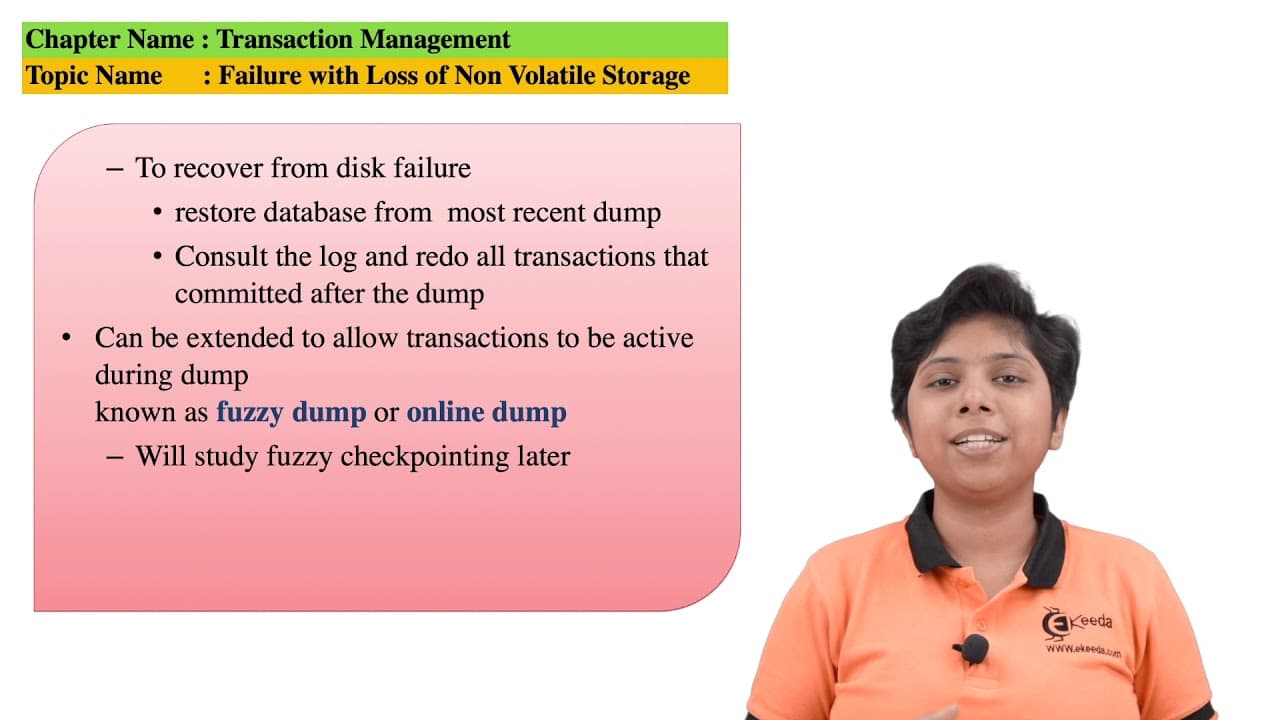
This video discusses the potential failure of non-volatile storage and how to recover the data stored within it.
Transcript
click the Bell icon to get latest videos from akira hello friends today we will talk about the failure that is associated if we lost a non-volatile storage we will see different parts and the way we can achieve the failure and recover from it if the non-volatile storage data will be lost till now we have discussed the failure with only the volatile... Read More
Key Insights
- 💁 Non-volatile storage failure can result in the loss of important data, requiring a recovery process to retrieve the information.
- 🥶 Redundant storage is an effective solution to prevent complete data loss and maintain access to older data values.
- 🥟 Database dumping periodically is crucial for creating backups and facilitating recovery in case of non-volatile storage failure.
- 🧑💻 The recovery management algorithm involves several steps, including updating data, transferring log records, and restoring the database.
- 🚱 Partial failure of non-volatile storage can be resolved by restoring the affected portion using another non-volatile storage device.
- 💨 SQL dumps provide a way to re-execute transactions and perform operations on the database using SQL statements.
- 👻 Fuzzy dumps allow for data dumping while transactions are active, reducing memory requirements and minimizing wasted CPU cycles.
Install to Summarize YouTube Videos and Get Transcripts
Explore YouTube Video Summarizer or Get YouTube Transcript Extractor
Questions & Answers
Q: What are the potential causes of failure in non-volatile storage?
Non-volatile storage can fail due to head crashes, copy errors, or loss of information during data transfer.
Q: What is the purpose of redundant storage?
Redundant storage helps prevent data loss by storing data on multiple devices, such as magnetic disks or flash drives.
Q: How often should database dumping be performed?
The frequency of database dumping depends on the size and vulnerability of the database, with larger databases typically requiring more frequent dumps.
Q: What are the steps involved in recovering from non-volatile storage failure?
The steps include updating data, dumping log records, transferring database contents, and outputting transaction log records to a new disk.
Summary & Key Takeaways
-
The video explores the failure of non-volatile storage and the different causes and types of data loss associated with it.
-
The importance of redundant storage to prevent data loss is highlighted, as well as the concept of dumping data onto multiple storage devices.
-
The recovery process for non-volatile storage failure is discussed, including the steps of updating data, maintaining log records, and restoring the database.
Read in Other Languages (beta)
Share This Summary 📚
Summarize YouTube Videos and Get Video Transcripts with 1-Click
Try YouTube Summary with ChatGPT & Claude or YouTube Transcript Generator
Explore More Summaries from Ekeeda 📚




Summarize YouTube Videos and Get Video Transcripts with 1-Click
Try YouTube Summary with ChatGPT & Claude or YouTube Transcript Generator