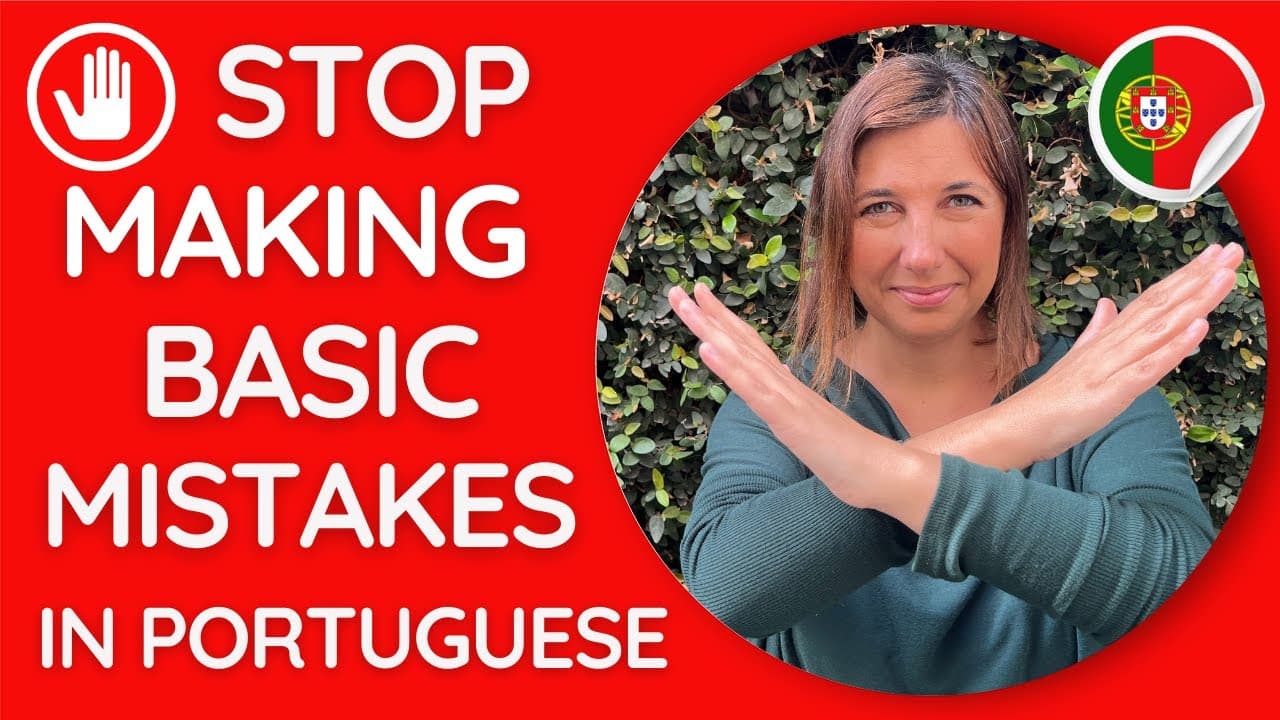
The Ultimate Guide to Overcome Basic Mistakes in Portuguese 🇵🇹
TL;DR
Learn to avoid common beginner mistakes in Portuguese grammar.
Transcript
Every student is different and learns differently. Some students feel that they read better than they write, others that they understand better than they speak, and so on. Each person has their strengths and weaknesses. I have been teaching Portuguese for over 10 years now and this experience has made very clear to me what are the most common m... Read More
Key Insights
- Every student has unique strengths and weaknesses in language learning, impacting their ability to read, write, speak, and understand Portuguese.
- A common mistake among beginners is failing to make nouns and adjectives agree in gender and number, which is crucial for proper sentence structure.
- Definite articles in Portuguese are essential and differ from English, requiring agreement in gender and number with the nouns they accompany.
- In Portuguese, possessive pronouns must agree in gender and number with the nouns they modify, which can be confusing for learners familiar with Brazilian Portuguese or Spanish.
- Certain verbs in Portuguese require specific prepositions that may not translate directly into English, necessitating memorization and practice.
- The video provides a challenge for viewers to test their understanding of the discussed grammar rules by identifying and correcting mistakes.
- Famous or well-known names in Portuguese may omit definite articles, but generally, articles are used in daily conversation.
- The instructor offers additional resources for practice, such as a dedicated video on adjective agreement and a text for error identification.
Install to Summarize YouTube Videos and Get Transcripts
Explore YouTube Video Summarizer or Get YouTube Transcript Extractor
Questions & Answers
Q: What is a common mistake students make with nouns and adjectives in Portuguese?
A common mistake is failing to make nouns and adjectives agree in gender and number. For instance, the adjective must match the noun it describes, like 'a camisa é bonita' for a singular feminine noun and 'os vestidos são bonitos' for plural masculine nouns. This agreement is crucial for grammatical accuracy.
Q: How do definite articles in Portuguese differ from English?
In Portuguese, definite articles must agree with the gender and number of the nouns they accompany. Unlike English, which uses 'the' for all nouns, Portuguese has four articles: 'a' for feminine singular, 'as' for feminine plural, 'o' for masculine singular, and 'os' for masculine plural. This requires careful attention to context.
Q: Why are possessive pronouns challenging for Portuguese learners?
Possessive pronouns in Portuguese must agree in gender and number with the nouns they modify, which can be confusing, especially for students familiar with Brazilian Portuguese or Spanish. Additionally, they often require definite articles, adding another layer of complexity. Understanding these rules is key to mastering possessive pronouns.
Q: What role do prepositions play in Portuguese verb usage?
Prepositions are essential for certain Portuguese verbs, sometimes differing from their English counterparts. For example, 'gostar' requires 'de' when expressing likes, and 'precisar' uses 'de' for needs. These prepositions don't always translate directly, so memorization and practice are necessary to use them correctly in context.
Q: How does the video encourage viewer engagement?
The video invites viewers to engage by offering a challenge to identify and correct grammar mistakes. This interactive element helps reinforce learning and allows students to apply the concepts discussed. Additionally, the instructor provides further resources, such as practice videos and texts, to support ongoing learning.
Q: When can definite articles be omitted in Portuguese?
Definite articles can be omitted when referring to famous or well-known individuals, as their names are universally recognized. However, in everyday Portuguese, articles are typically used, even with people's names, to indicate specificity. This distinction is important for learners to understand the nuances of article usage.
Q: What additional resources does the instructor provide?
The instructor offers a variety of resources, including a dedicated video on adjective agreement and a text for identifying and correcting grammar mistakes. These materials are designed to help students practice and solidify their understanding of the discussed grammar rules, providing valuable support for language learners.
Q: What is the main goal of the video?
The main goal of the video is to highlight and address common beginner mistakes in Portuguese grammar, helping learners improve their language skills. By focusing on gender and number agreement, definite articles, possessive pronouns, and verb-preposition combinations, the video aims to provide practical guidance and encourage active learning.
Summary & Key Takeaways
-
The video addresses common mistakes in Portuguese grammar, emphasizing the importance of gender and number agreement in nouns and adjectives. It highlights the use of definite articles and possessive pronouns, offering examples and tips for learners.
-
Students often struggle with prepositions required by certain Portuguese verbs, which do not always align with English translations. The video encourages memorization and practice of these verb-preposition combinations.
-
Viewers are invited to engage with the content by participating in a challenge to identify and correct grammar mistakes, with additional resources available for further practice and support.
Read in Other Languages (beta)
Share This Summary 📚
Summarize YouTube Videos and Get Video Transcripts with 1-Click
Try YouTube Summary with ChatGPT & Claude or YouTube Transcript Generator
Explore More Summaries from Learn European Portuguese Online 📚



Summarize YouTube Videos and Get Video Transcripts with 1-Click
Try YouTube Summary with ChatGPT & Claude or YouTube Transcript Generator