What Is Gay Lussac's Law and How Does It Work?
TL;DR
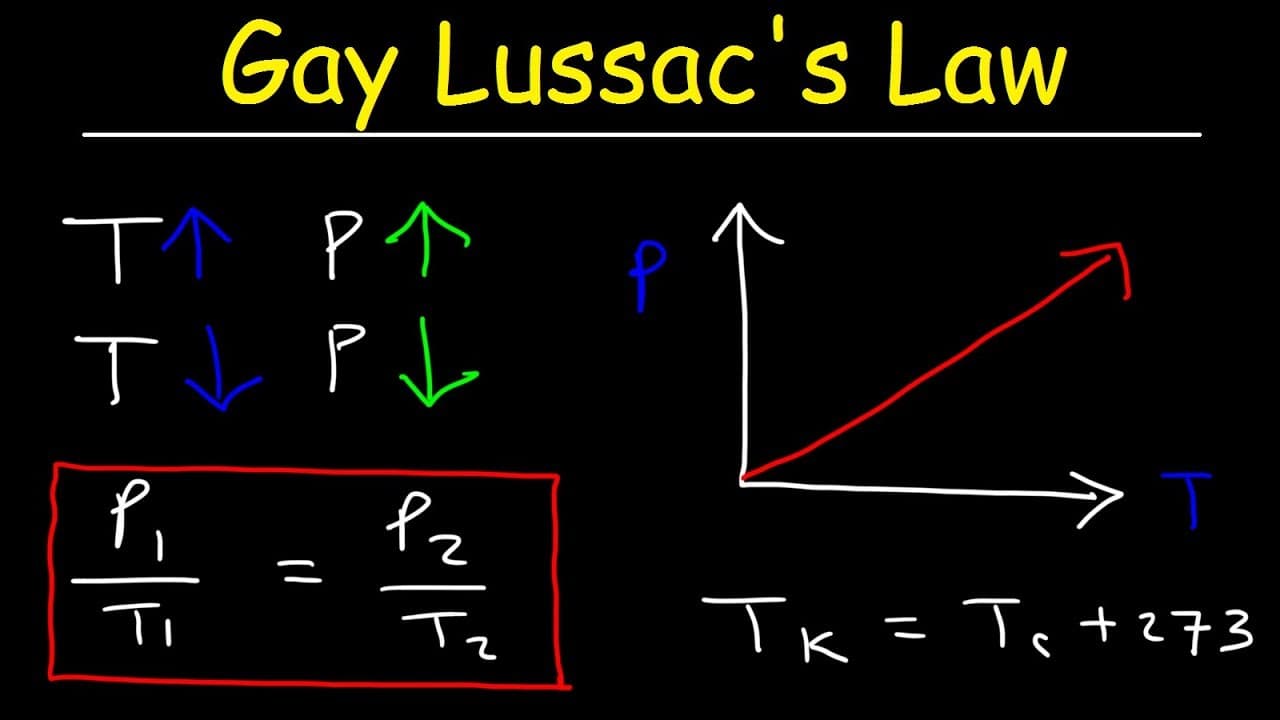
Gay Lussac's Law states that in a fixed volume, increasing temperature increases pressure, while decreasing temperature decreases pressure. This occurs because higher temperatures give gas molecules more kinetic energy, causing more frequent collisions with container walls. The law can be expressed with the equation P1/T1 = P2/T2, where pressures must match units and temperatures are measured in Kelvin.
Transcript
in this tutorial we're gonna talk about gay lussac's law so what's the gist of this law what's the main idea behind it well let me give you an example to illustrate it so let's say if you have a container with some gas particles and this is gonna be your rigid container its volume is fixed what's gonna happen if you add heat to this container what'... Read More
Key Insights
- 🥺 Gay Lussac's Law states that an increase in temperature in a fixed volume container leads to an increase in pressure.
- 🫢 Gas molecules gain kinetic energy and move faster at higher temperatures, resulting in more frequent collisions with the container walls.
- 📈 The relationship between temperature and pressure follows a linear graph.
- ❓ Gay Lussac's Law can be represented mathematically using the equation P1/T1 = P2/T2.
- 🇦🇪 The units for pressure can be different, but they must match within the equation.
- 😑 Temperature must be expressed in Kelvin, not Celsius, when using Gay Lussac's Law.
- 🚰 An increase in temperature can cause gas molecules to vaporize and generate pressure, as seen in the example of a pot with water.
- 😪 Gay Lussac's Law can be applied to real-life situations, such as tire pressure in a car.
Install to Summarize YouTube Videos and Get Transcripts
Explore YouTube Video Summarizer or Get YouTube Transcript Extractor
Questions & Answers
Q: What is the main idea behind Gay Lussac's Law?
Gay Lussac's Law states that an increase in temperature leads to an increase in pressure in a fixed volume container, and vice versa.
Q: How do gas molecules behave when temperature increases according to Gay Lussac's Law?
When temperature increases, gas molecules gain kinetic energy and move faster, resulting in more frequent collisions with the container walls, which increases pressure.
Q: Can the volume of the container change in Gay Lussac's Law?
No, Gay Lussac's Law applies to a fixed volume container, where the volume remains constant throughout temperature changes.
Q: How can Gay Lussac's Law be represented mathematically?
Gay Lussac's Law is represented by the equation P1/T1 = P2/T2, where P1 and P2 are the original and final pressures, and T1 and T2 are the original and final temperatures, respectively.
Summary & Key Takeaways
-
Gay Lussac's Law states that when the volume of a rigid container is held constant, an increase in temperature leads to an increase in pressure.
-
As temperature increases, gas molecules gain kinetic energy and move faster, resulting in more frequent collisions with the container walls, thereby increasing pressure.
-
The relationship between temperature and pressure follows a linear graph, where temperature is plotted on the x-axis and pressure on the y-axis.
Read in Other Languages (beta)
Share This Summary 📚
Summarize YouTube Videos and Get Video Transcripts with 1-Click
Try YouTube Summary with ChatGPT & Claude or YouTube Transcript Generator
Explore More Summaries from The Organic Chemistry Tutor 📚





Summarize YouTube Videos and Get Video Transcripts with 1-Click
Try YouTube Summary with ChatGPT & Claude or YouTube Transcript Generator