Hydration of Cement
TL;DR
Hydration of cement is the chemical reaction that occurs between water and cement, resulting in the formation of CSH gel and the liberation of heat. This process is crucial for the strength gain of cement.
Transcript
hello friends today we are going to start with a new topic of building materials which is hydration of cement till now we have discussed about some basic constituents which are important for the manufacturing purpose and also what are important compounds in aspects of cement but the point came that we have to study how cement works when we had wate... Read More
Key Insights
- 😇 Hydration of cement is a chemical reaction that occurs when water is added, leading to the formation of CSH gel and the liberation of heat.
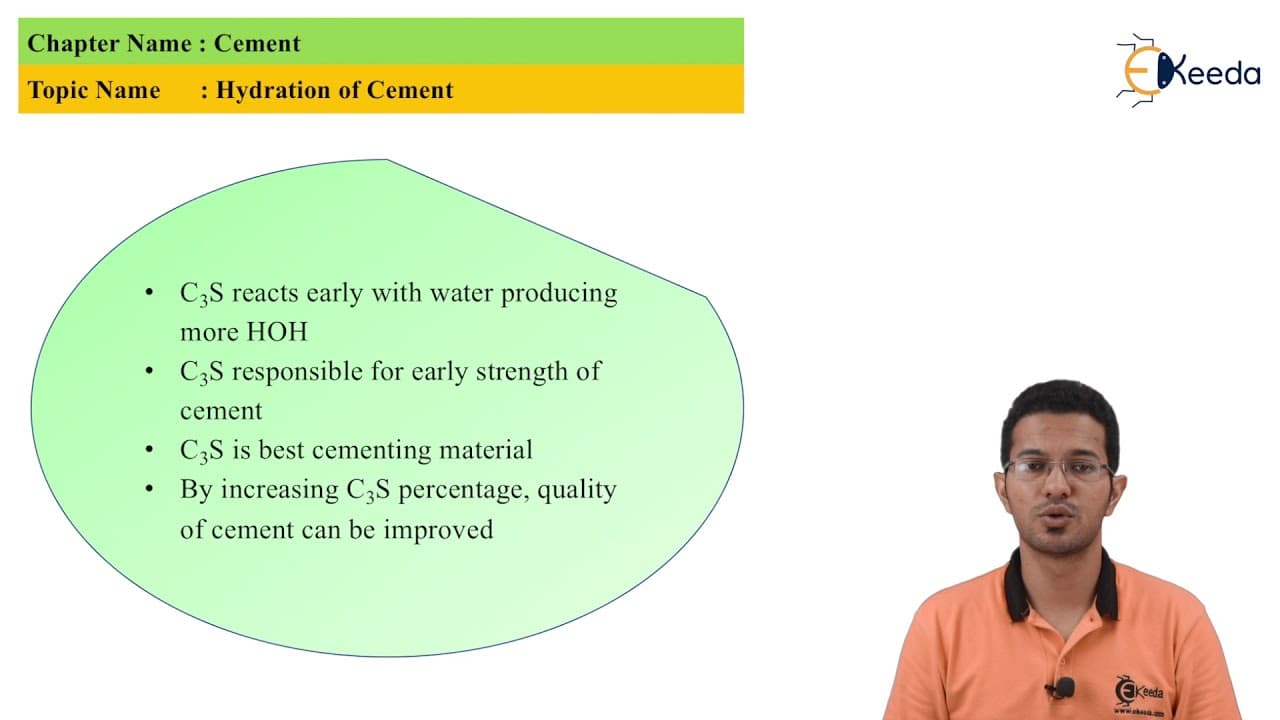
- 📢 The composition of cement compounds, such as C3S and C2S, influences the strength and quality of cement.
- 🥺 Sulfate attack can cause damage to cement structures, leading to cracks and deterioration.
- 🥵 The rate of hydration and heat evolved varies among the different cement compounds, with C3A being the fastest and C2S being the slowest.
- 🥵 The fineness of cement affects the weight of hydration but not the total heat evolved.
Install to Summarize YouTube Videos and Get Transcripts
Explore YouTube Video Summarizer or Get YouTube Transcript Extractor
Questions & Answers
Q: What is hydration of cement?
Hydration of cement is the process that occurs when water is added to cement, leading to chemical reactions and the formation of CSH gel. It is a crucial step for the strength gain of cement.
Q: What happens during the hydration process?
During the hydration process, heat is liberated, and lime is released. The chemical reactions result in the formation of CSH gel, which contributes to the strength of the cement.
Q: Why is sulfate attack a concern in cement structures?
Sulfate attack can cause problems in cement structures as it leads to volume expansion, cracks, and deterioration. This attack occurs when sulfate from soil or water reacts with calcium hydroxide and hydrates, causing damage to the concrete.
Q: How does the composition of cement compounds affect its strength?
The composition of cement compounds, such as C3S and C2S, affects the strength of cement. C3S is responsible for early strength, while C2S contributes to later strength. By adjusting the percentages of these compounds, the quality of cement can be improved.
Summary & Key Takeaways
-
Hydration of cement occurs when water is added to cement, leading to chemical reactions and the formation of CSH gel.
-
Heat is liberated during the hydration process, and lime is also released, which may not be advantageous.
-
The hydration of different cement compounds, such as C3S and C2S, results in the production of varying amounts of calcium silicate hydrates and lime.
Read in Other Languages (beta)
Share This Summary 📚
Summarize YouTube Videos and Get Video Transcripts with 1-Click
Try YouTube Summary with ChatGPT & Claude or YouTube Transcript Generator
Explore More Summaries from Ekeeda 📚





Summarize YouTube Videos and Get Video Transcripts with 1-Click
Try YouTube Summary with ChatGPT & Claude or YouTube Transcript Generator