Why gravity gets so strong near dense objects | Cosmology & Astronomy | Khan Academy
TL;DR
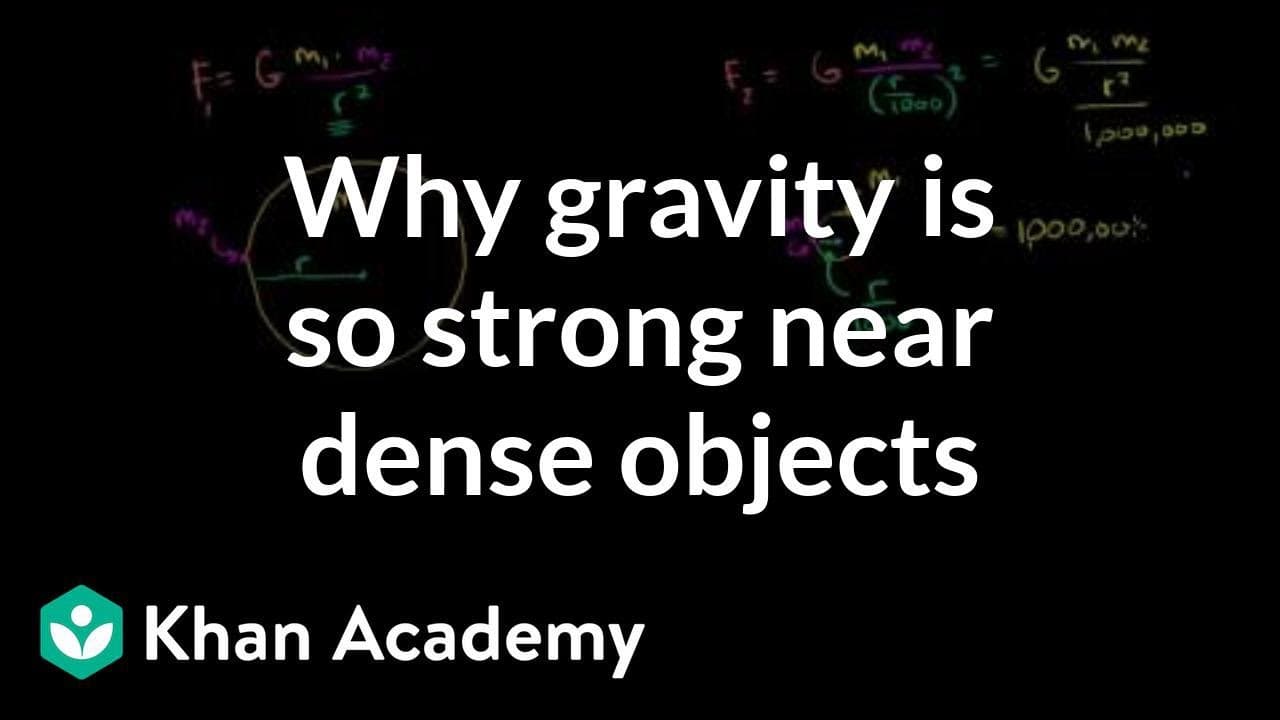
Black holes have stronger gravity than stars of the same mass because their mass is concentrated in a smaller and denser region.
Transcript
In the video on black hole several people asked what is actually a pretty good question, which is if the mass of say a black hole is only two or three solar masses, why is the gravity so strong? Obviously the sun's gravity isn't so strong that it keeps light from escaping, so why would something, or even a star that's two or three solar masses-- it... Read More
Key Insights
- ◾ The concentration of mass in a smaller and denser region allows black holes to exert stronger gravitational forces.
- ❓ The force between two masses is determined by the distance between their center of masses.
- 💪 When objects condense into smaller sizes, their gravitational force becomes significantly stronger.
- 💆 Net gravitational force is zero at the center of a massive object due to the outward pull of the surrounding mass.
Install to Summarize YouTube Videos and Get Transcripts
Explore YouTube Video Summarizer or Get YouTube Transcript Extractor
Questions & Answers
Q: Why does a black hole have stronger gravity than a star of the same mass?
Black holes have stronger gravity because their mass is concentrated in a smaller and denser region, allowing for a stronger gravitational pull.
Q: How does the distance between center of masses affect gravitational force?
The distance between center of masses, rather than the actual physical distance, determines the force between two masses.
Q: Why does the gravitational force exerted by a condensed object become stronger?
When a massive object condenses into a smaller size, the radius decreases, resulting in a much stronger gravitational force due to the concentration of mass.
Q: Why doesn't something closer to the center of mass of a massive object experience the same force as something farther away?
Closer to the center, the net gravitational force becomes zero, as the mass surrounding it pulls in an outward direction, counteracting the inward gravitational force.
Summary & Key Takeaways
-
The gravity of a black hole is stronger than that of a star of the same mass because the mass is concentrated in a smaller and denser region, allowing it to exert a stronger gravitational pull.
-
The distance between the center of masses, rather than the actual physical distance, determines the force between two masses.
-
When a massive object condenses into a smaller size, the gravitational force it exerts becomes much stronger due to the smaller radius.
Read in Other Languages (beta)
Share This Summary 📚
Summarize YouTube Videos and Get Video Transcripts with 1-Click
Try YouTube Summary with ChatGPT & Claude or YouTube Transcript Generator
Explore More Summaries from Khan Academy 📚



Summarize YouTube Videos and Get Video Transcripts with 1-Click
Try YouTube Summary with ChatGPT & Claude or YouTube Transcript Generator