Motion Graphs (5 of 8) Velocity vs. Time Graph Part 2
TL;DR
Analyzing velocity and acceleration trends on a graph to determine speeding up, slowing down, and direction changes.
Transcript
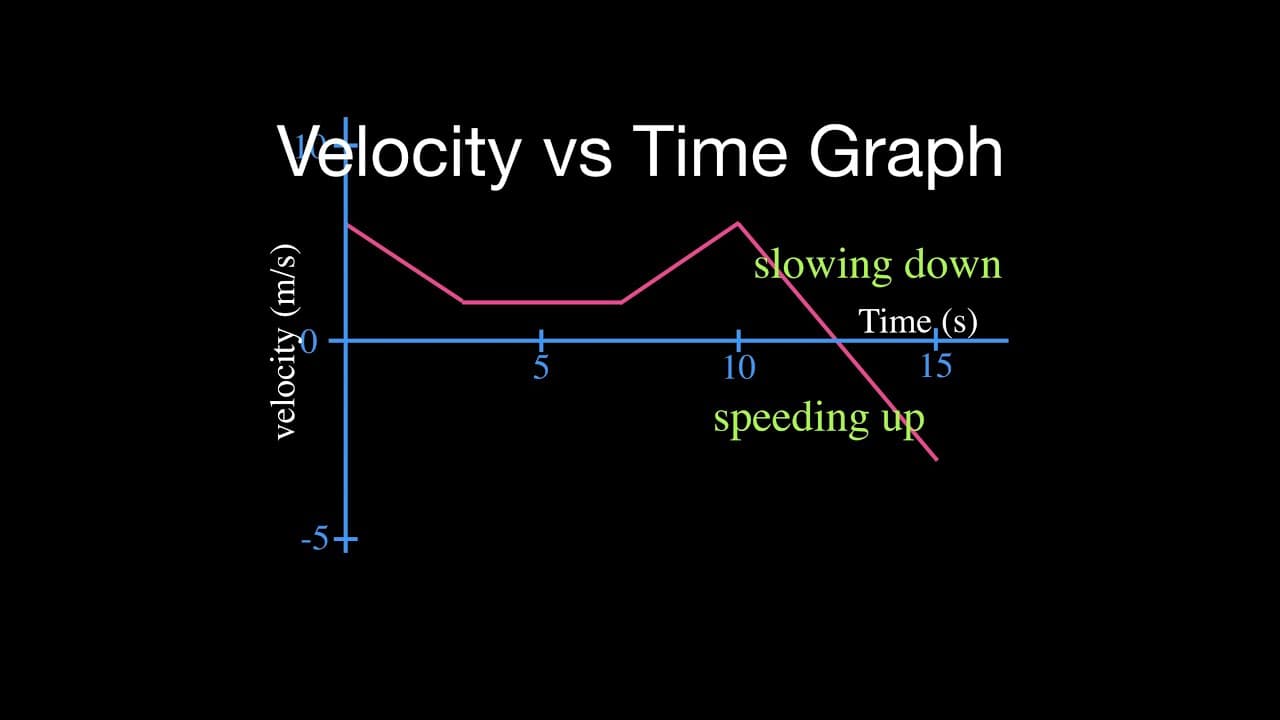
all right this is a part 2 in this series entitled velocity versus time graph and I'm going to go over trying over three things on this graph on this video I want to just look at this this line and see if we can figure out what's going on as far as I've lost in time and then I want to fill in this table and see if we can figure out what's going on ... Read More
Key Insights
- 🐎 Positive and negative slopes on a velocity vs. time graph correspond to speeding up and slowing down, respectively.
- 🤘 Consistent signs of velocity and acceleration indicate motion in the same direction.
- 🐎 Calculating acceleration from the slope of the graph validates the analysis of speeding up, slowing down, and directional changes accurately.
- 🐎 Transitioning from positive to negative velocity signifies a change in direction despite constant speed.
Install to Summarize YouTube Videos and Get Transcripts
Explore YouTube Video Summarizer or Get YouTube Transcript Extractor
Questions & Answers
Q: How can you determine if an object is speeding up or slowing down from a velocity vs. time graph?
By analyzing the slope of the graph, a positive slope indicates speeding up, a negative slope indicates slowing down, and zero slope indicates constant velocity.
Q: What does the direction of acceleration reveal on a velocity vs. time graph?
The sign of acceleration determines whether the object is accelerating in the same direction as its velocity (+) or in the opposite direction (-).
Q: Why is it essential to consider both velocity and acceleration signs when interpreting graphs?
Matching signs of velocity and acceleration indicate speeding up, while opposite signs show slowing down or direction changes.
Q: How does calculating acceleration from a velocity vs. time graph verify graph analysis?
Calculating acceleration using the slope of the graph confirms speeding up, slowing down, and direction changes observed from the graph analysis.
Summary & Key Takeaways
-
The video discusses interpreting velocity vs. time graphs to analyze acceleration and direction changes.
-
It explains how positive and negative slopes indicate speeding up or slowing down in different directions.
-
Calculations based on the graph's slope help determine acceleration accurately.
Read in Other Languages (beta)
Share This Summary 📚
Summarize YouTube Videos and Get Video Transcripts with 1-Click
Try YouTube Summary with ChatGPT & Claude or YouTube Transcript Generator
Explore More Summaries from Step by Step Science 📚



Summarize YouTube Videos and Get Video Transcripts with 1-Click
Try YouTube Summary with ChatGPT & Claude or YouTube Transcript Generator