The German Potato Masher Explained
TL;DR
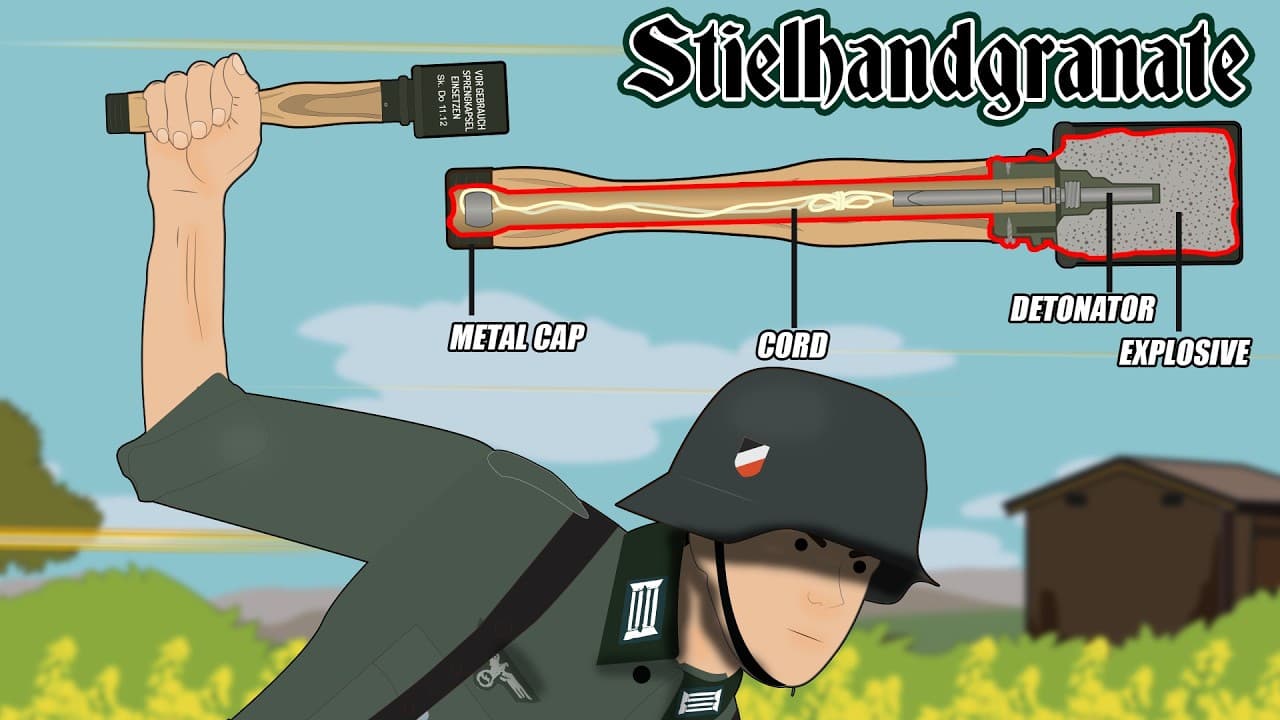
The M24 stick grenade was an iconic German weapon in WWII, known for its design and use on the battlefield.
Transcript
grenades have been used for centuries and would become a standard part of a modern soldier's gear in the 20th century out of all the pieces of equipment that the German military used during the second World War perhaps the most easily recognizable would be the Shel Granada M24 a stick grenade that has become an iconic image of the conflict the orig... Read More
Key Insights
- 💋 The M24 stick grenade originated from experiments in WWI, symbolizing decades of military innovation in explosive devices.
- 👾 Its design was optimized for soldier usability in confined spaces, providing tactical advantages during urban combat situations.
- 🥔 The nickname "potato masher" reflects soldiers' perspectives and humor in wartime, adding a cultural dimension to military history.
- 🎖️ Despite its iconic status, the M24 was part of a broader arsenal, illustrating the various types of grenades deployed by the German military.
- ❓ Technical limitations, including complexity and visibility on the battlefield, contributed to its eventual replacement by more sophisticated explosives.
- 🥺 The evolution of grenade design reveals how military needs influence equipment development, often leading to radical changes in technology.
- 🈂️ The bundling technique to create concentrated charges underscores the creative tactics soldiers employed to enhance firepower during engagements.
Install to Summarize YouTube Videos and Get Transcripts
Explore YouTube Video Summarizer or Get YouTube Transcript Extractor
Questions & Answers
Q: What were the key features of the M24 stick grenade?
The M24 weighed approximately 1.3 lb and was about 14 inches long. It had a cylindrical steel body filled with TNT, and its wooden handle aided in throwing. The grenade relied on explosive force rather than shrapnel, making it effective for concussive blasts in confined spaces.
Q: How did the design of the M24 evolve over time?
The M24’s design was refined from earlier models, notably eliminating the belt clip for easier carrying. It transitioned from a more complex mechanism in earlier grenades to a simpler one with its successor models, allowing for faster access but also introducing safety concerns that were addressed in later versions.
Q: Why was the M24 stick grenade nicknamed "potato masher"?
British soldiers coined the term “potato masher” during WWI due to the grenade's resemblance to a kitchen tool. The nickname became synonymous with all stick grenades, reflecting the common visual characteristic rather than specific performance.
Q: What were the main advantages and disadvantages of the M24 compared to other grenades?
The M24 allowed for a longer throw due to its handle and could be bundled for enhanced explosive power. However, its bulk made it less portable, more visible, and slower to use, requiring assembly steps that could be critical in chaotic combat situations.
Q: How did the M24 differ in use and functionality from conventional grenades?
Unlike conventional grenades that detonated upon pulling a safety pin, the M24 required unscrewing a metal cap and pulling a lanyard to ignite the fuse. Its design was more cumbersome, potentially affecting the user’s readiness in battle.
Q: Were there any special variations of the M24 grenade?
Yes, variations, including the M43 smoke hand grenade and different training models, were developed to adapt to various combat scenarios. There were also special fragmentation sleeves and adaptations for cold conditions, showcasing the flexibility in response to battlefield needs.
Q: What was the significance of the M24 stick grenade at the end of WWII?
By the end of WWII, advancements in grenade technology rendered the M24 and stick grenades in general largely obsolete. The end of the conflict marked a decisive shift away from its design, highlighting its historical significance rather than continued operational relevance.
Summary & Key Takeaways
-
The M24 stick grenade became a notable weapon during WWII, evolving from earlier designs. It was distinguished by its wooden handle and explosive charge, making it effective in enclosed spaces.
-
Although the M24 was popular, it was not the only grenade used by German forces; alternatives like the M39 egg grenade and later models offered different functionalities in combat.
-
The design and usage of grenades like the M24 illustrate the evolution of military technology, with advantages and disadvantages emerging based on battlefield conditions and combat needs.
Read in Other Languages (beta)
Share This Summary 📚
Summarize YouTube Videos and Get Video Transcripts with 1-Click
Try YouTube Summary with ChatGPT & Claude or YouTube Transcript Generator
Explore More Summaries from Simple History 📚



Summarize YouTube Videos and Get Video Transcripts with 1-Click
Try YouTube Summary with ChatGPT & Claude or YouTube Transcript Generator