IIT JEE circle hyperbola common tangent part 3 | Conic sections | Algebra II | Khan Academy
TL;DR
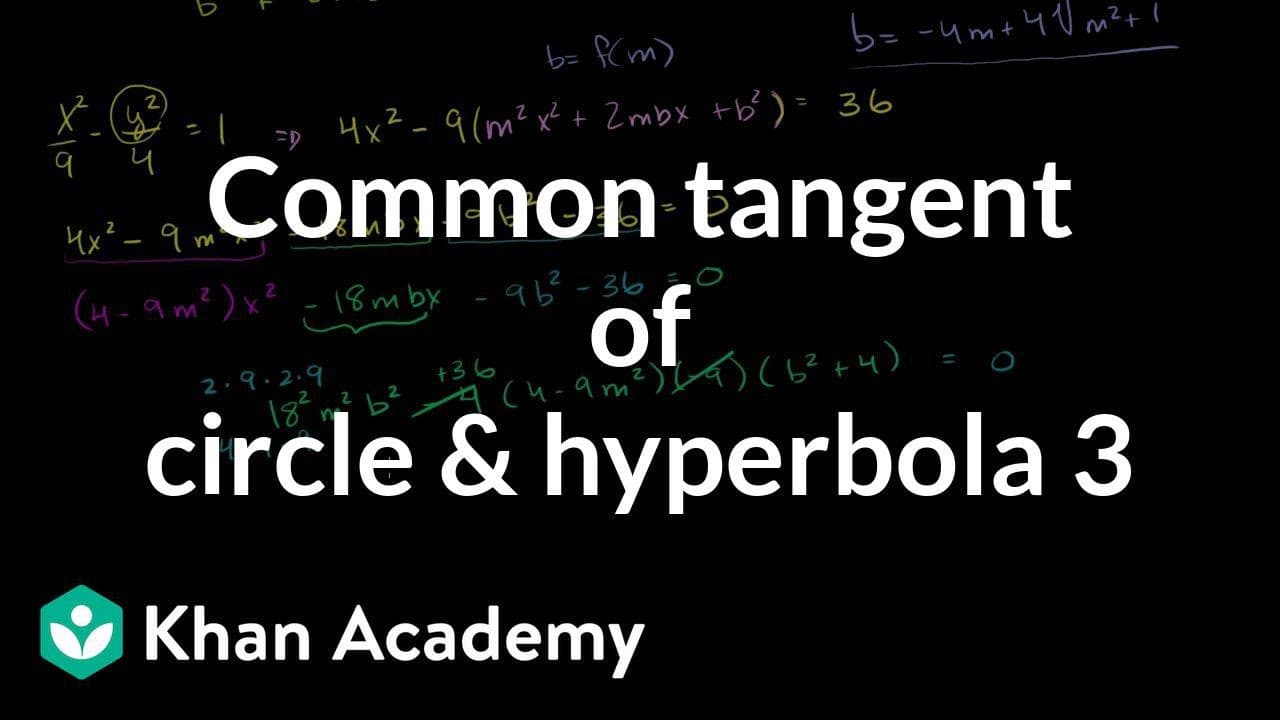
This video explains how to find constraints on the y-intercept for the tangent line of a hyperbola using the equation of the hyperbola and the equation of the tangent line.
Transcript
In this video we're going to do with the hyperbola the exact same thing we did with the circle. We're going to find constraints on the y-intercept for the tangent line in terms of m. But this time we're going to use the hyperbola. And then we can set them equal to each other, and solve for the m. So let's remind ourselves what the equation of the h... Read More
Key Insights
- 🫥 The process of finding constraints on the tangent line of a hyperbola is similar to that of finding constraints for a circle but uses the equation of a hyperbola instead.
- 🥘 Substituting the equation of the tangent line into the equation of the hyperbola allows for the determination of constraints on the y-intercept.
- 🫥 Setting the discriminant of the quadratic formula to zero ensures that the tangent line intersects the hyperbola at only one point, making it tangent.
- 🙃 Multiplying both sides of the equation by the least common multiple of the denominators eliminates fractions and simplifies the equation.
Install to Summarize YouTube Videos and Get Transcripts
Explore YouTube Video Summarizer or Get YouTube Transcript Extractor
Questions & Answers
Q: How does the process of finding constraints on the y-intercept for the tangent line of a hyperbola compare to finding constraints for a circle?
The process is similar to finding constraints for a circle, but instead of using the equation of a circle, the equation of a hyperbola is used. The substitution of the equation of the tangent line into the equation of the hyperbola allows for the determination of constraints on the y-intercept of the tangent line.
Q: Why is it necessary to set the discriminant of the quadratic formula to zero?
Setting the discriminant to zero ensures that the quadratic equation has only one solution, meaning the tangent line intersects the hyperbola at only one point. This guarantees that the tangent line is indeed tangent to the hyperbola.
Q: What is the purpose of multiplying both sides of the equation by 36?
Multiplying both sides by 36 eliminates the fractions in the equation, making it easier to simplify and solve. This is possible because 36 is the least common multiple of 9 and 4, which are the denominators of the fractions in the original equation.
Q: Can the values of m and b that satisfy the constraints be determined directly without using the quadratic formula?
Yes, once the equation is simplified by combining like terms, the constraints on m and b can be determined by setting the simplified equation equal to zero. This eliminates the need to use the quadratic formula directly.
Summary & Key Takeaways
-
The video demonstrates how to substitute the equation of the tangent line (y=mx+b) into the equation of the hyperbola to find constraints on the y-intercept.
-
By simplifying the equation, it becomes a quadratic in terms of x, which allows for finding constraints on the slope (m) and y-intercept (b) of the tangent line.
-
Using the quadratic formula, the discriminant is set to zero to find the values of m and b that make the tangent line intersect the hyperbola at only one point.
Read in Other Languages (beta)
Share This Summary 📚
Summarize YouTube Videos and Get Video Transcripts with 1-Click
Try YouTube Summary with ChatGPT & Claude or YouTube Transcript Generator
Explore More Summaries from Khan Academy 📚



Summarize YouTube Videos and Get Video Transcripts with 1-Click
Try YouTube Summary with ChatGPT & Claude or YouTube Transcript Generator