Function Overloading and Recursion ekeeda
TL;DR
Explaining the concept of function overloading, recursion, and default arguments in programming.
Transcript
click the bell icon to get latest videos from equator hello friends in this video we will discuss a more about a function that is we will discuss a topic called as function overloading then we'll see what is recursion and what are default arguments before going to a function overloading first we will discuss a small topic called as default argument... Read More
Key Insights
- 👻 Default arguments in functions allow for more flexible and convenient function calls, avoiding the need to pass values for all parameters.
- 😒 Function overloading allows programmers to use the same function name for different variations of the same task, as long as they have different parameter lists.
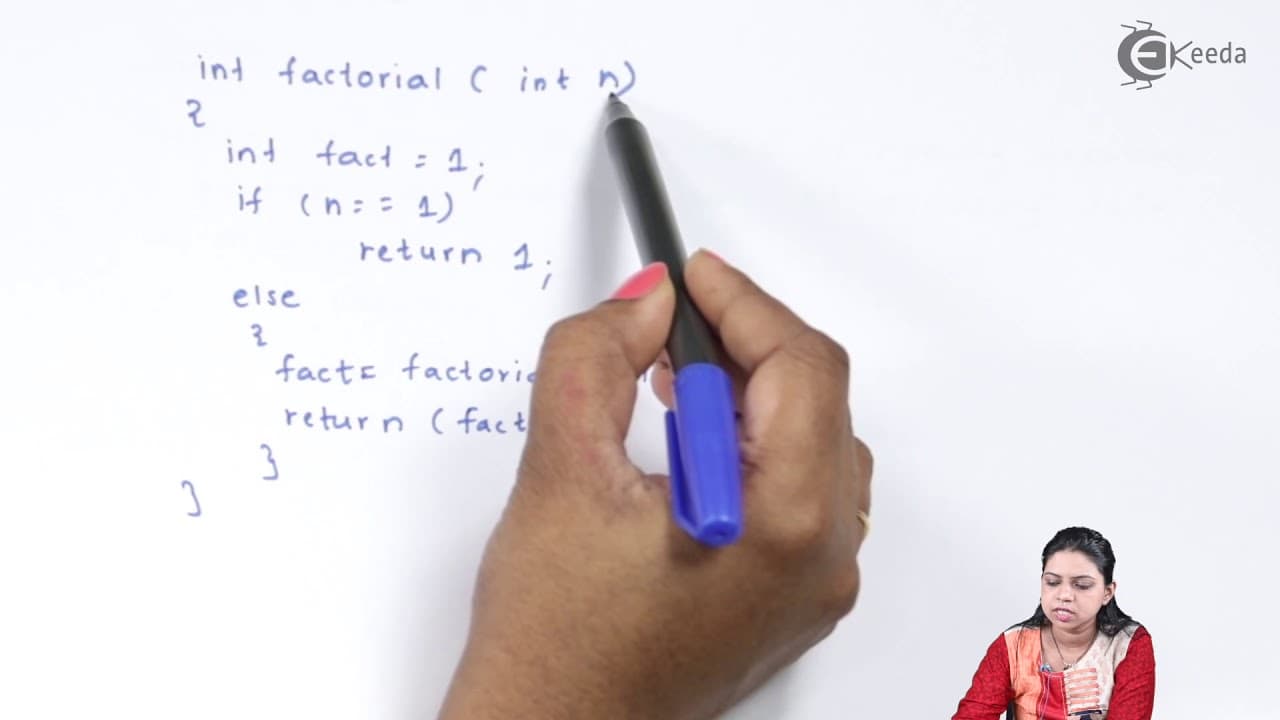
- 👻 Recursion is an important concept in programming that allows for the solution of certain problems by breaking them down into simpler, repetitive tasks.
- 🙈 Recursion can be seen as a form of circular function or circular definition, as the function calls itself within its own body.
- ⚾ Parameter matching is crucial in function overloading, as the compiler needs to identify the correct function to invoke based on the number of parameters.
- ❓ The concept of recursion can be better understood with examples such as calculating factorials.
- 👻 Recursion allows for the implementation of complex algorithms and logic by dividing problems into smaller, manageable components.
Install to Summarize YouTube Videos and Get Transcripts
Explore YouTube Video Summarizer or Get YouTube Transcript Extractor
Questions & Answers
Q: What is the purpose of default arguments in functions?
Default arguments are used when values for arguments are not specified, allowing the function to take pre-initialized default values. This helps in cases where some arguments may not be passed in function calls.
Q: How does function overloading work?
Function overloading occurs when a function is declared multiple times with the same name but different parameters. The compiler matches the parameters of the function call to the corresponding function declaration, based on the number of parameters.
Q: How can recursion be defined in programming?
Recursion is the process of a function calling itself within its body. It allows for repetitive tasks to be performed by breaking them down into smaller, more manageable steps.
Q: Can you provide an example of recursion in programming?
Sure! One example of recursion is calculating the factorial of a number. In this case, the function will call itself to multiply the number with its previous value until it reaches a base case (e.g., multiplying 54321).
Summary & Key Takeaways
-
The content discusses the concept of default arguments in functions, where values are already initialized, and how they are used in function calls.
-
It explains function overloading, which occurs when a function is declared multiple times in a program with the same name but different parameters.
-
The video also introduces recursion, where a function calls itself within its body to perform repetitive tasks.
Read in Other Languages (beta)
Share This Summary 📚
Summarize YouTube Videos and Get Video Transcripts with 1-Click
Try YouTube Summary with ChatGPT & Claude or YouTube Transcript Generator
Explore More Summaries from Ekeeda 📚

Summarize YouTube Videos and Get Video Transcripts with 1-Click
Try YouTube Summary with ChatGPT & Claude or YouTube Transcript Generator