2015 AP Chemistry free response 5a: Finding order of reaction | Chemistry | Khan Academy
TL;DR
The analysis determines that the reaction is first order based on the constant half-life and the linear relationship between ln concentration and time.
Transcript
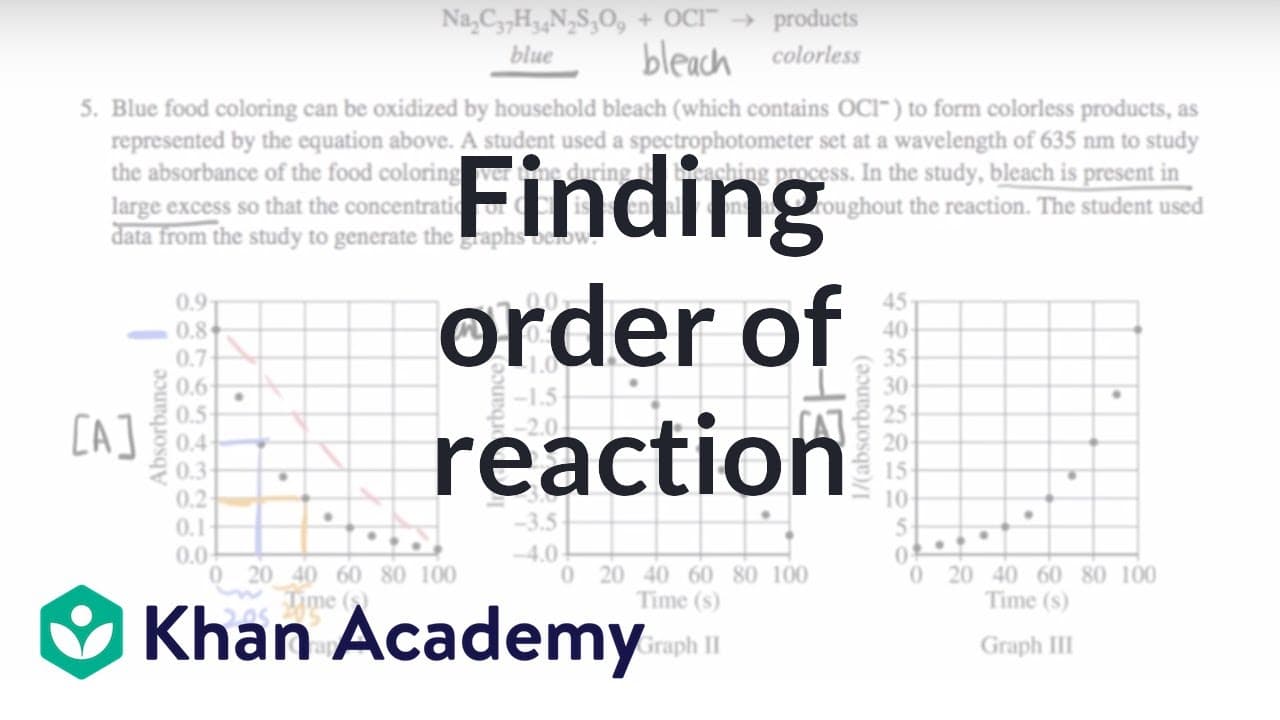
- [Voiceover] Blue food coloring can be oxidized by household bleach, which contains hypochlorite ion, or OCI-, to form colorless products, as represented by the equation above. So we have this equation where we have blue food coloring, which has this chemical formula, and it's reacting with bleach, or hypochlorite, and it's making colorless produc... Read More
Key Insights
- ❓ Spectrophotometry data can provide valuable insights into the reaction kinetics.
- ⌛ The concentration over time graph helps determine the reaction order.
- 🛟 The constant half-life observed in the graph indicates that the reaction is first order.
- ⌛ The linear relationship between ln concentration and time confirms the first order reaction.
- 🌥️ Bleach is used in large excess to maintain a constant concentration of the reactive species.
- 🪈 The reaction order can be determined without analyzing all the provided graphs.
- 🪈 Knowledge of first order reactions and their characteristics is essential for analysis.
Install to Summarize YouTube Videos and Get Transcripts
Explore YouTube Video Summarizer or Get YouTube Transcript Extractor
Questions & Answers
Q: How is the reaction order determined based on the spectrophotometry data?
The reaction order is determined by analyzing the concentration over time graph. Since the graph is not linear, it can be concluded that the reaction is not zero order. Additionally, the constant half-life observed in the graph indicates that the reaction is first order.
Q: What is the significance of the constant half-life in determining the reaction order?
The constant half-life is a key characteristic of first order reactions. It means that the time taken for the concentration to decrease by half is the same regardless of the initial concentration or the stage of the reaction. This observation supports the conclusion that the reaction is first order.
Q: How does the relationship between ln concentration and time help determine the reaction order?
For a first order reaction, plotting ln concentration against time will result in a straight line. In the second graph, a clear linear relationship is observed, indicating that the reaction is first order with respect to the blue food coloring.
Q: Why is the bleaching process conducted with bleach in large excess?
The bleach is present in large excess to ensure that the concentration of hypochlorite ion (the reactive species) remains constant throughout the reaction. This allows for a more accurate study of the reaction kinetics.
Summary & Key Takeaways
-
The study examines the bleaching process of blue food coloring using household bleach.
-
Spectrophotometry data is collected and three graphs are generated: concentration over time, ln concentration over time, and 1/concentration over time.
-
By analyzing the first graph, it is observed that the reaction is not zero order. The constant half-life and linear relationship between ln concentration and time in the second graph indicate that the reaction is first order.
Read in Other Languages (beta)
Share This Summary 📚
Summarize YouTube Videos and Get Video Transcripts with 1-Click
Try YouTube Summary with ChatGPT & Claude or YouTube Transcript Generator
Explore More Summaries from Khan Academy 📚



Summarize YouTube Videos and Get Video Transcripts with 1-Click
Try YouTube Summary with ChatGPT & Claude or YouTube Transcript Generator