Hash function | Cryptography and System Security
TL;DR
This video discusses the concept of hash functions in cryptography, their properties, and their applications in data security.
Transcript
hello and welcome back to the course of cryptography and system security uh now begin with the third chapter that is hash massage digest and the digital certificates so in this uh chapter we are going to have the cryptography and hash function so as far as the hash function is concerned it is one of the important hash function in the cryptography s... Read More
Key Insights
- #️⃣ Hash functions encrypt fixed-size blocks of plain text to produce fixed-size hash values, ensuring data confidentiality and integrity.
- 🥶 Cryptographic hash functions have properties like data integration, computational invisibility, one-way property, and collision-free property.
- #️⃣ Hash functions are widely used for authentication purposes, validating the identity of the sender and ensuring data integrity.
- 🚱 Digital signatures, generated using hash functions, provide authentication, integrity, and non-repudiation in digital communications.
- #️⃣ In addition to authentication and integrity, hash functions can be used for confidentiality, intrusion detection, virus detection, password file creation, and random number generation.
- #️⃣ Hash functions are based on symmetric key processes and can be further secured using public key and private key combinations.
- 😒 The use of hash functions in cryptography and system security ensures that encrypted data remains undisclosed and unidentifiable to attackers.
Install to Summarize YouTube Videos and Get Transcripts
Explore YouTube Video Summarizer or Get YouTube Transcript Extractor
Questions & Answers
Q: What is the role of hash functions in data encryption?
Hash functions convert variable-length blocks of plain text into fixed-size hash values, providing confidentiality and integrity to the encrypted data.
Q: What are the properties of cryptographic hash functions?
Cryptographic hash functions have properties like data integration, where applying the function to a large set of inputs produces evenly distributed and apparently random outputs. They also have one-way and collision-free properties.
Q: How are hash functions used for authentication?
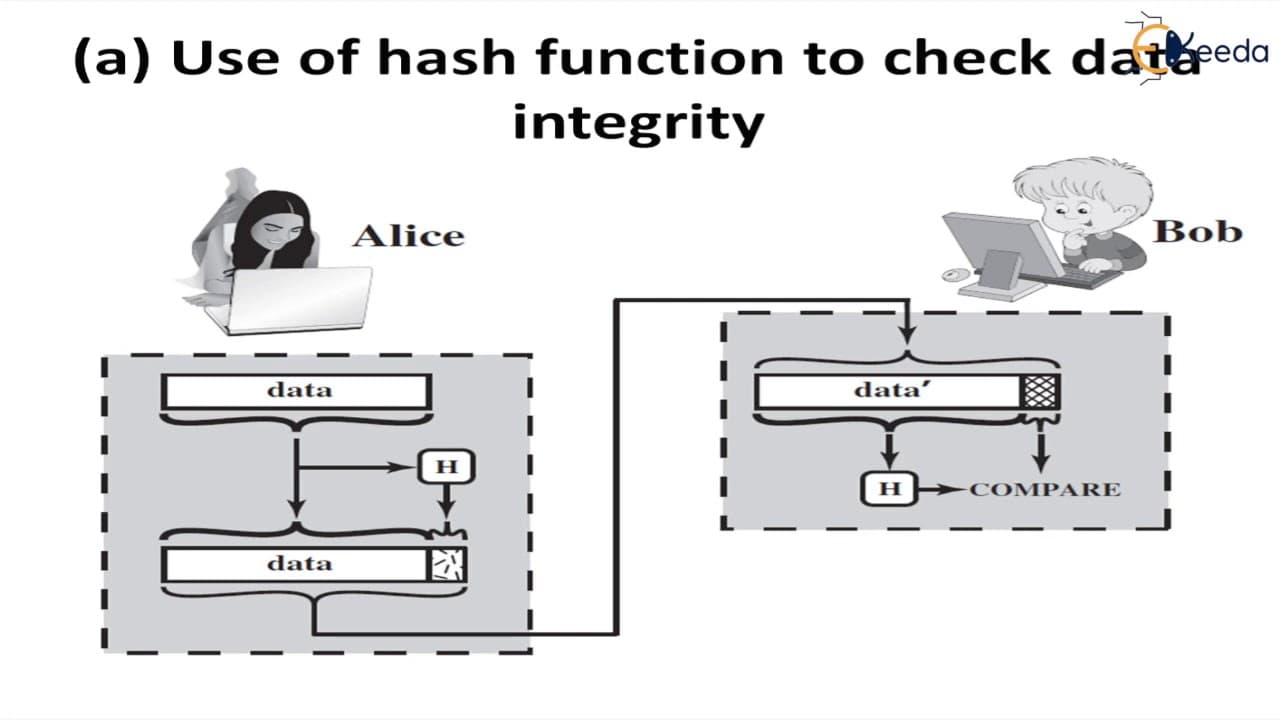
Hash functions are used to validate the identity of the sender by computing a hash value of the message bits. The sender transmits both the hash value and the message, and the receiver performs the same hash calculation to compare and verify the integrity of the message.
Q: What is the purpose of digital signatures in cryptography?
Digital signatures, generated using hash functions and encryption algorithms, provide authentication and integrity to digital messages. Only the sender, with their private key, can produce the encrypted hash code, ensuring the integrity and non-repudiation of the message.
Summary & Key Takeaways
-
Hash functions are essential in cryptography systems as they encrypt fixed-size blocks of plain text to produce fixed-size hash values, ensuring data confidentiality and integrity.
-
Cryptographic hash functions have properties like data integration, making it computationally infeasible for attackers to modify or replace encrypted data.
-
Hash functions are widely used for authentication purposes, ensuring the integrity of messages and detecting any alterations or tampering.
-
Digital signatures, generated using hash functions and encryption algorithms, provide authentication, integrity, and non-repudiation in digital communications.
Read in Other Languages (beta)
Share This Summary 📚
Summarize YouTube Videos and Get Video Transcripts with 1-Click
Try YouTube Summary with ChatGPT & Claude or YouTube Transcript Generator
Explore More Summaries from Ekeeda 📚






Summarize YouTube Videos and Get Video Transcripts with 1-Click
Try YouTube Summary with ChatGPT & Claude or YouTube Transcript Generator