Ionic Bonding Part 3
TL;DR
Electrons move from atoms with low electronegativity to atoms with high electronegativity in ionic bonding, leading to the formation of lattice structures in compounds like sodium chloride.
Transcript
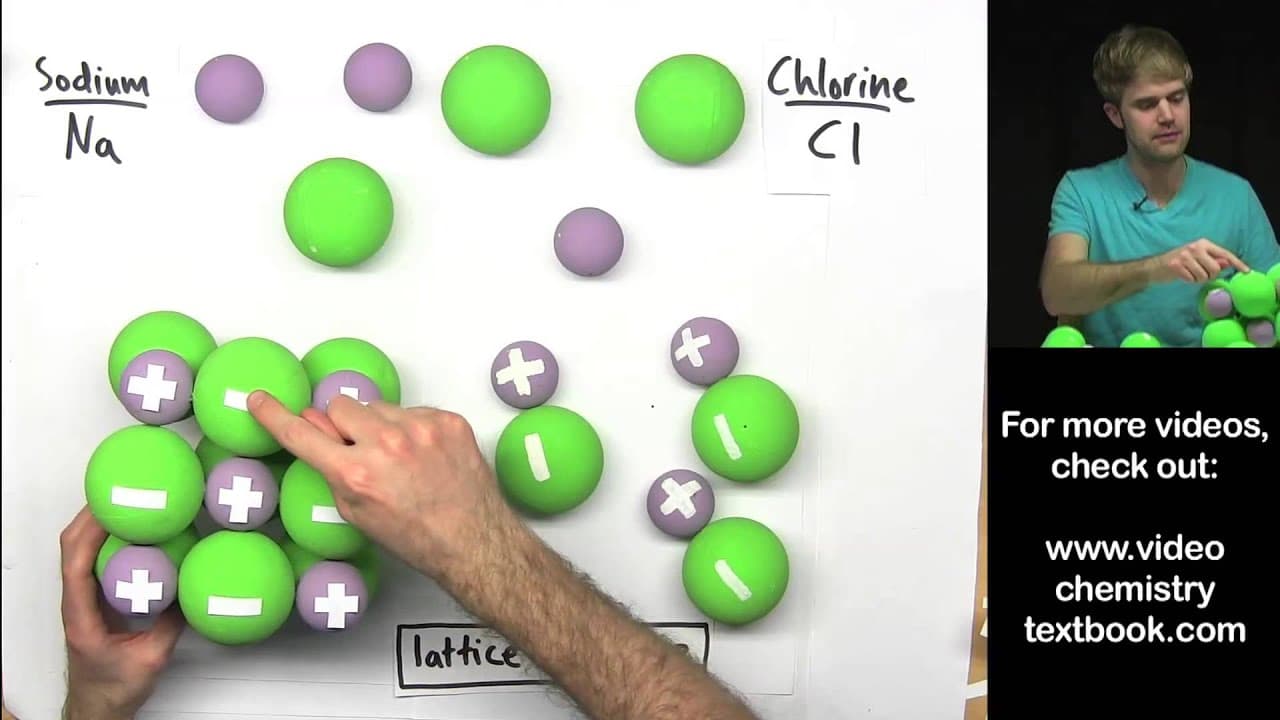
okay let's keep learning about ionic bonding the first thing I want to talk about is why electrons move from sodium to chlorine and not from chlorine to sodium okay so in the first step of ionic bonding this one electron from sodium moves over here chlorine to fill this one space but people often ask why couldn't these seven electrons from chlorine... Read More
Key Insights
- 🫀 Electrons in ionic bonding move from atoms with low electronegativity to atoms with high electronegativity.
- 🧑🏭 Nonmetals have higher electronegativity and act as electron takers, while metals have lower electronegativity and act as electron givers.
- 💁 In compounds with more than two atoms, lattice structures are formed due to the attraction between positively and negatively charged ions.
Install to Summarize YouTube Videos and Get Transcripts
Explore YouTube Video Summarizer or Get YouTube Transcript Extractor
Questions & Answers
Q: Why do electrons move from sodium to chlorine in ionic bonding and not the other way around?
Electrons move from sodium to chlorine because chlorine has a higher electronegativity and is more greedy for electrons. Sodium, being a metal, has low electronegativity and is willing to give up its electrons.
Q: What determines whether an atom is an electron giver or taker in ionic bonding?
An atom's electronegativity determines whether it is an electron giver or taker. Nonmetals like chlorine, with high electronegativity, are electron takers, while metals like sodium, with low electronegativity, are electron givers.
Q: How do atoms form a lattice structure in ionic compounds?
In compounds with more than two atoms, the positive and negative ions are attracted to each other due to opposite charges. This attraction leads to the formation of a lattice structure, where ions are arranged in a repeating pattern.
Q: Why is the chemical formula for sodium chloride written as NaCl without the plus and minus symbols?
The chemical formula for sodium chloride is written as NaCl without the plus and minus symbols because the positive and negative charges of sodium and chloride ions cancel out in the compound. The compound as a whole is neutral.
Summary & Key Takeaways
-
Electrons in ionic bonding move from atoms with low electronegativity to atoms with high electronegativity.
-
Nonmetals like chlorine have high electronegativity and act as electron takers, while metals like sodium have low electronegativity and act as electron givers.
-
In compounds with more than two atoms, the positively and negatively charged ions are attracted to each other, forming lattice structures.
Read in Other Languages (beta)
Share This Summary 📚
Summarize YouTube Videos and Get Video Transcripts with 1-Click
Try YouTube Summary with ChatGPT & Claude or YouTube Transcript Generator
Explore More Summaries from Tyler DeWitt 📚





Summarize YouTube Videos and Get Video Transcripts with 1-Click
Try YouTube Summary with ChatGPT & Claude or YouTube Transcript Generator