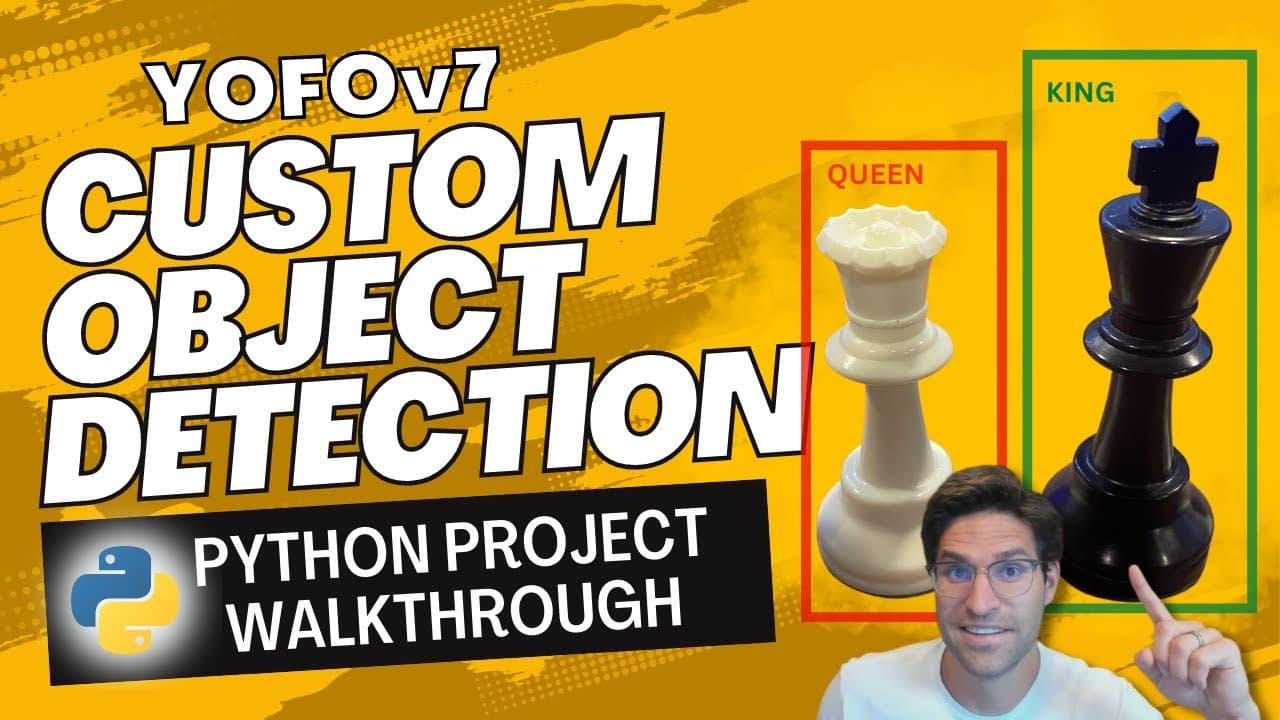
Yolov7 Custom Object Detection in Python Tutorial - Chess Piece Detection
TL;DR
This video tutorial demonstrates how to train a custom object detection model using YOLO V5, including setup, model selection, and evaluation.
Transcript
hey YouTube my name is Rob and I make videos about machine learning and data science right next to me I have a chess board set up the reason why I have that is because today we are going to be training our very own object detection model to detect the different pieces on a chessboard now in this video you're going to learn a ton of stuff we're goin... Read More
Key Insights
- 🐎 YOLO is a popular object detection algorithm known for its speed and accuracy.
- ❓ Different versions of YOLO, such as V5 and V7, have different implementations and performance characteristics.
- 🚂 Training a custom object detection model requires preparing a suitable dataset and selecting appropriate pre-trained weights.
- 🚂 Evaluation metrics like MAP are important for assessing the accuracy of the trained model.
Install to Summarize YouTube Videos and Get Transcripts
Explore YouTube Video Summarizer or Get YouTube Transcript Extractor
Questions & Answers
Q: What is YOLO, and how does it differ from other object detection algorithms?
YOLO is an object detection algorithm known for its speed and accuracy. Unlike other algorithms, YOLO performs object detection in one pass, making it faster but sometimes less accurate.
Q: How does YOLO V5 and V7 differ from each other?
YOLO V5 is a smaller version (15MB) compared to YOLO V7 (270MB). The size affects inference time, with the larger model generally being more accurate. However, YOLO V7 implementation in the video showed some issues with webcam frame rate.
Q: What is MAP (Mean Average Precision), and why is it important in object detection?
MAP is a metric used to assess the accuracy of object detection models. It considers factors such as precision, recall, and intersection over union (IOU) to determine how well the predicted bounding boxes align with the ground truth. Higher MAP values indicate better performance.
Q: How can the model's performance be further improved for object detection on a chessboard?
To improve the model's performance, it is recommended to augment the dataset with diverse training examples, including different angles, lighting conditions, and board types. This helps the model generalize better and accurately detect objects in various scenarios.
Key Insights:
- YOLO is a popular object detection algorithm known for its speed and accuracy.
- Different versions of YOLO, such as V5 and V7, have different implementations and performance characteristics.
- Training a custom object detection model requires preparing a suitable dataset and selecting appropriate pre-trained weights.
- Evaluation metrics like MAP are important for assessing the accuracy of the trained model.
- Augmenting the dataset with diverse examples improves the model's ability to generalize and detect objects accurately.
Summary & Key Takeaways
-
The video introduces YOLO (You Only Look Once), an object detection algorithm that has multiple versions (V1 to V7) developed by different contributors.
-
The presenter demonstrates setting up YOLO V5 and V7, selecting pre-trained weights, and running object detection on a Chessboard using webcams.
-
The video shows the process of training a custom object detection model using a pre-existing chessboard dataset, explaining the importance of evaluation metrics and considerations for improving model performance.
Read in Other Languages (beta)
Share This Summary 📚
Summarize YouTube Videos and Get Video Transcripts with 1-Click
Try YouTube Summary with ChatGPT & Claude or YouTube Transcript Generator
Explore More Summaries from Rob Mulla 📚
Summarize YouTube Videos and Get Video Transcripts with 1-Click
Try YouTube Summary with ChatGPT & Claude or YouTube Transcript Generator