What Makes a Programming Language Turing Complete?
TL;DR
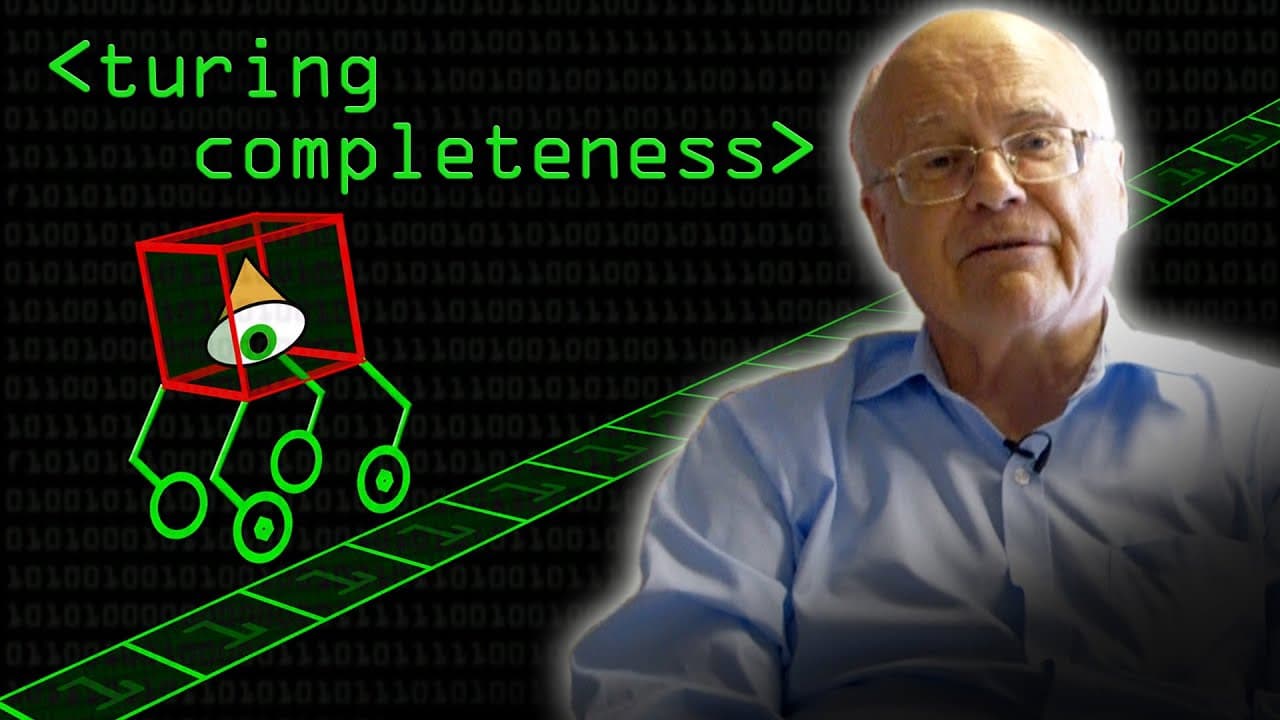
A programming language is Turing complete if it can perform any computation that a Turing machine can, requiring conditional branching, arbitrary memory, and the potential for infinite loops. This concept, which also involves the influential ideas of Charles Babbage, is fundamental in determining the computational power and expressiveness of programming languages.
Transcript
there's one thing that we keep coming back to and this idea of turing complete what does it mean and why do we need to worry about it yeah what does it mean to say it's a language it's usually in this context a programming language is or is not during complete well obvious first example is that every programming language you're familiar with um i m... Read More
Key Insights
- 🤟 Turing completeness is a fundamental concept in computer science, determining the computational power of programming languages and systems.
- 🤩 The ability to perform conditional branching, have arbitrary memory, and potentially handle infinite loops are the key factors in achieving Turing completeness.
- 💦 Charles Babbage's work was instrumental in recognizing the importance of conditional branching for powerful computation.
- 🤟 While modern computers are not Turing machines due to their limited memory capacity, they can simulate Turing machines and perform Turing-complete computations.
- 🗯️ Understanding Turing completeness is crucial for choosing the right programming language for specific computational tasks.
- 🤟 Turing machines, with their infinite memory and computational capabilities, provide a theoretical framework for exploring the limits of computation.
- 🤟 Turing completeness serves as a foundation for analyzing the computational complexity and expressiveness of programming languages.
Install to Summarize YouTube Videos and Get Transcripts
Explore YouTube Video Summarizer or Get YouTube Transcript Extractor
Questions & Answers
Q: What is Turing completeness and why is it relevant to programming languages?
Turing completeness refers to the ability of a programming language or system to perform any computation that a Turing machine can. It is important in programming languages as it determines the scope of computations that can be performed using the language.
Q: What are the fundamental requirements for a system to be deemed Turing complete?
The fundamental requirements for Turing completeness are the ability to perform conditional branching, arbitrary memory allocation, and the potential for infinite loops. These capabilities allow for the execution of any computation that can be done on a Turing machine.
Q: Why is conditional branching crucial for Turing completeness?
Conditional branching allows for decision-making based on the state of the data being processed. It enables the system to choose different actions based on specific conditions, which is vital for complex computations that depend on varying data inputs.
Q: Can modern computers be considered Turing machines?
No, modern computers cannot be considered Turing machines because they have finite memory. Turing machines, on the other hand, have unlimited memory capacity, and computations on them can potentially continue indefinitely.
Summary & Key Takeaways
-
Turing completeness means that a programming language or system has the capability to perform any computation that a Turing machine can.
-
The fundamental requirements for Turing completeness include conditional branching, arbitrary memory, and the potential for infinite loops.
-
Charles Babbage's work was influential in developing the concept of Turing completeness, as he recognized the importance of conditional branching for powerful computation.
Read in Other Languages (beta)
Share This Summary 📚
Summarize YouTube Videos and Get Video Transcripts with 1-Click
Try YouTube Summary with ChatGPT & Claude or YouTube Transcript Generator
Explore More Summaries from Computerphile 📚

Summarize YouTube Videos and Get Video Transcripts with 1-Click
Try YouTube Summary with ChatGPT & Claude or YouTube Transcript Generator