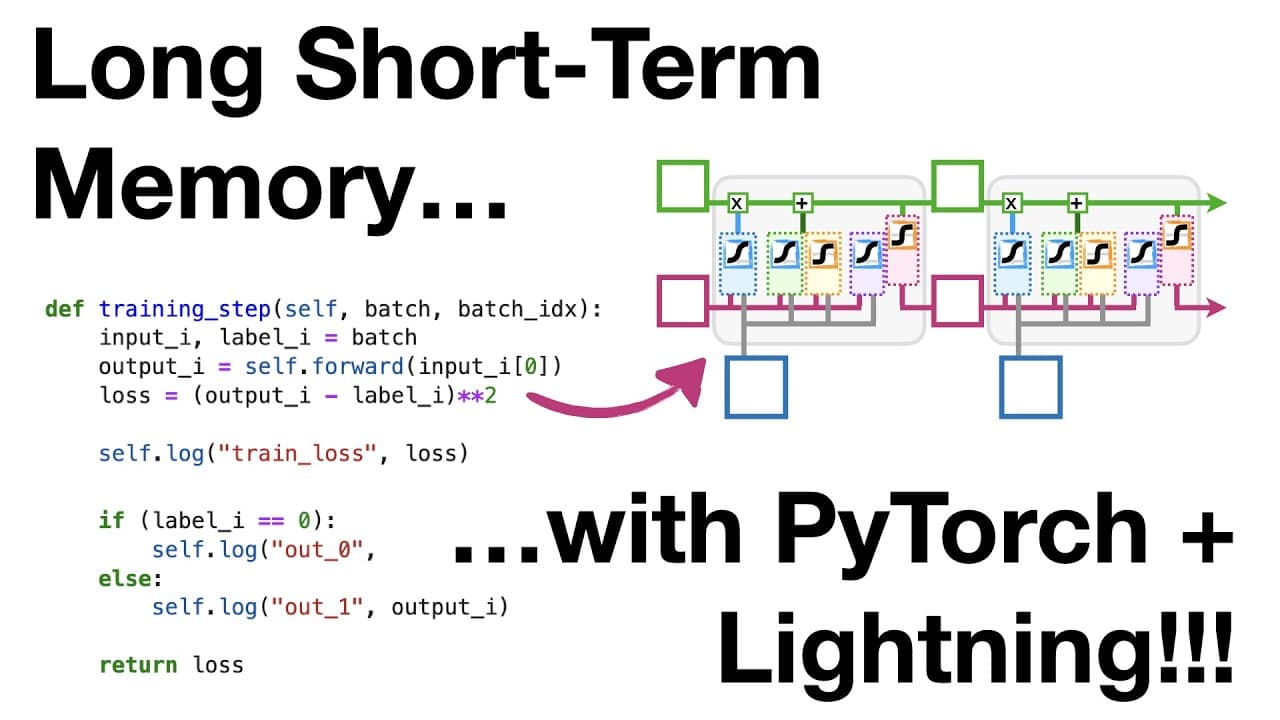
Long Short-Term Memory with PyTorch + Lightning
TL;DR
Discover how to create and train an LSTM model from scratch using PyTorch and Lightning in this comprehensive tutorial.
Transcript
long short term memory with pie torch plus lightning is cool stat Quest hello I'm Josh starmer and welcome to statquest today we're going to talk about long short-term memory with pi torch plus lightning raise yourself for awesomeness and everything being just a little bit easier Lighting in yeah this stack quiz is also brought to you by the letter... Read More
Key Insights
- 🍝 LSTM enables remembering past context in sequential data for accurate predictions.
- 👨💻 Coding LSTM from scratch involves parameter initialization, math operations, and training steps.
- 🧑💻 Lightning module simplifies training neural networks by handling optimizations and logging progress.
- 😀 Transitioning to nn.LSTM function in PyTorch offers a more efficient way of creating and training LSTM models.
Install to Summarize YouTube Videos and Get Transcripts
Explore YouTube Video Summarizer or Get YouTube Transcript Extractor
Questions & Answers
Q: What is the key concept behind using Long Short-Term Memory (LSTM) in predicting sequential data?
The key concept is for LSTM to remember vital information from the past sequence data to predict future outcomes accurately.
Q: How does coding an LSTM from scratch in PyTorch involve parameter initialization and the math behind LSTM?
This involves setting weights and biases, calculating what to remember in long and short-term memory stages, and updating memory states based on input data.
Q: What are the benefits of using Lightning module in training an LSTM model?
Lightning simplifies the training process by handling optimizations, logging training progress, and providing easy-to-use methods for training neural networks efficiently.
Q: How does the tutorial demonstrate the transition from coding LSTM manually to using nn.LSTM function in PyTorch?
The tutorial showcases the ease of using nn.LSTM function for creating LSTM models, optimizing weights and biases, and training neural networks effectively with minimal code complexity.
Summary & Key Takeaways
-
Explanation of Long Short-Term Memory (LSTM) concept in predicting sequential data with a detailed example.
-
Step-by-step guide to coding LSTM from scratch in PyTorch, including initializing parameters, math behind LSTM, and training.
-
Comparison of training LSTM from scratch vs. using nn.LSTM function for ease and effectiveness.
Read in Other Languages (beta)
Share This Summary 📚
Summarize YouTube Videos and Get Video Transcripts with 1-Click
Try YouTube Summary with ChatGPT & Claude or YouTube Transcript Generator
Explore More Summaries from StatQuest with Josh Starmer 📚


Summarize YouTube Videos and Get Video Transcripts with 1-Click
Try YouTube Summary with ChatGPT & Claude or YouTube Transcript Generator