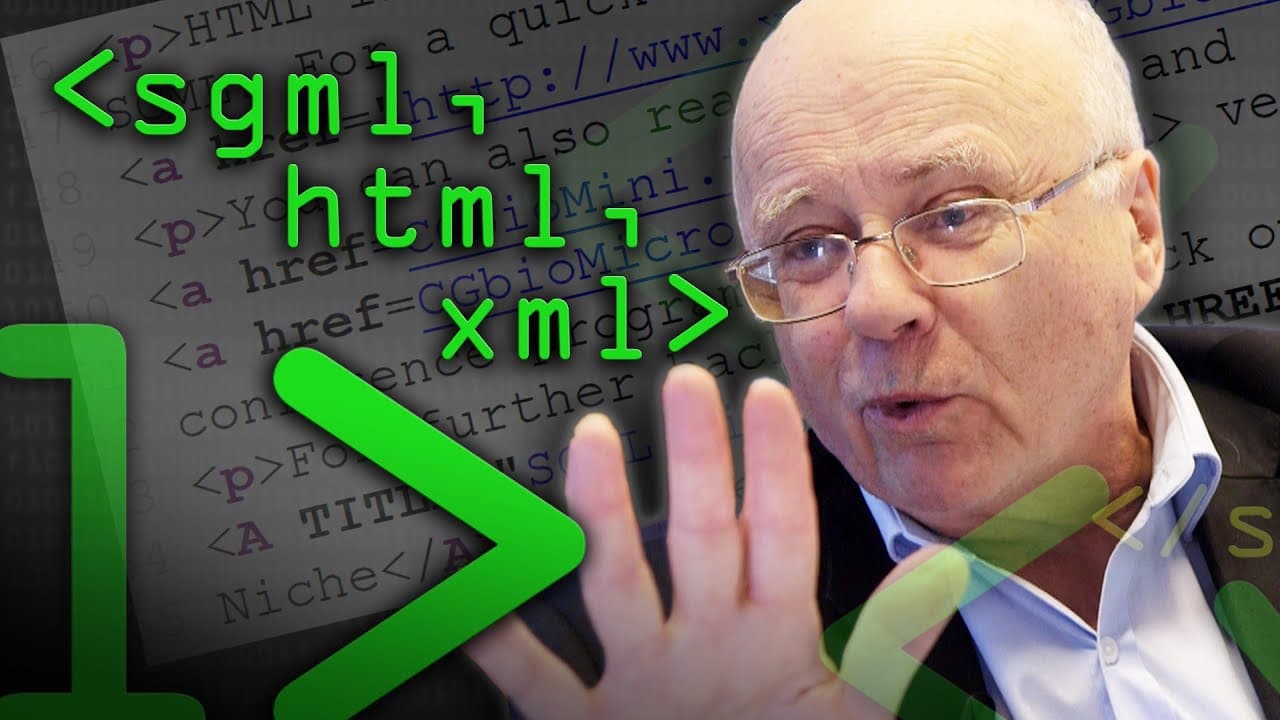
SGML HTML XML What's the Difference? (Part 1) - Computerphile
TL;DR
This content explains the history, purpose, and key differences between SGML, HTML, and XML.
Transcript
the people defining what was called a standard generalized markup language sgml they took over the pointy bracket notation and actually used it within documents themselves it leads back into computer science principles in so many many ways and there has been so much confusion suppose you could say what this episode is about is sgml html xml what's ... Read More
Key Insights
- 😫 SGML was developed to provide a tag set notation for structured document organization and access.
- 📜 Organizations like the Department of Defense and the Text Encoding Initiative were early adopters of SGML for enhanced document structuring and searchability.
- 🥺 HTML, although widely popular, had weaknesses in terms of document structure, leading to the need for XML.
- 📜 XML was developed as a cleaner, more structured version of HTML, addressing the shortcomings of HTML's document structure and definition.
- 😫 The pointy bracket notation used in HTML and XML is derived from SGML's tag set notation.
- 💾 SGML allowed for optional omission of end tags to save disk space, but this practice could lead to ambiguity if not carefully managed.
- 🥺 HTML's weaknesses became evident in the early years of its adoption, leading to discussions on how to improve the language.
Install to Summarize YouTube Videos and Get Transcripts
Explore YouTube Video Summarizer or Get YouTube Transcript Extractor
Questions & Answers
Q: What is SGML, and why was it developed?
SGML, or Standard Generalized Markup Language, was developed by Charles Goldfarb and his team at IBM in the late 1970s. It provided a tag set notation for structuring and organizing documents, making it easier to access and locate specific information within large collections of documents.
Q: How did organizations like the Department of Defense and the Text Encoding Initiative use SGML?
The Department of Defense and the Text Encoding Initiative were early users of SGML. They aimed to tag up various types of documents with a suitable tag set to enhance accessibility and searchability within their databases. For example, the Department of Defense used SGML to structure specifications of defense equipment.
Q: What is the difference between SGML, HTML, and XML?
SGML is the overarching technology, providing a tag set notation. HTML, developed by Tim Berners-Lee, is a specific application of SGML and uses its pointy bracket notation. XML, on the other hand, was developed as a cleaner, more structured version of HTML, addressing the weaknesses in HTML's lack of document structure and definition.
Q: Why did HTML have weaknesses in terms of document structure and definition?
HTML lacked a document type definition to specify what tags were optionally admissible or what wasn't. This led to issues like improperly closed tags or inconsistent document structure. For example, HTML did not strictly require closing tags for paragraphs, leading to potential rendering issues.
Summary & Key Takeaways
-
In the late 1970s, Charles Goldfarb and his team at IBM developed SGML, a tag set notation that allowed for structured document organization and access.
-
SGML was utilized by organizations like the Department of Defense and the Text Encoding Initiative to tag and structure large collections of documents.
-
HTML, developed by Tim Berners-Lee, adopted the pointy bracket notation of SGML but had weaknesses in terms of document structure and definition, leading to the need for XML.
Read in Other Languages (beta)
Share This Summary 📚
Summarize YouTube Videos and Get Video Transcripts with 1-Click
Try YouTube Summary with ChatGPT & Claude or YouTube Transcript Generator
Explore More Summaries from Computerphile 📚





Summarize YouTube Videos and Get Video Transcripts with 1-Click
Try YouTube Summary with ChatGPT & Claude or YouTube Transcript Generator