Products
Features
YouTube Video Summarizer
Summarize YouTube videos
Web & PDF Highlighter
Highlight web pages & PDFs
Chat with PDF
Ask any PDF questions with AI
Ask AI Clone
Chat with your highlights & memories
Audio Transcriber
Transcribe audio files to text
Glasp Reader
Read and highlight articles
Kindle Highlight Export
Export your Kindle highlights
Idea Hatch
Hatch ideas from your highlights
Integrations
Obsidian Plugin
Notion Integration
Pocket Integration
Instapaper Integration
Medium Integration
Readwise Integration
Snipd Integration
Hypothesis Integration
Apps & Extensions
Chrome Extension
Safari Extension
Edge Add-ons
Firefox Add-ons
iOS App
Android App
Discover
Discover
Ideas
Discover new ideas and insights
Articles
Curated articles and insights
Books
Book recommendations by great minds
Posts
Essays and notes from readers
Quotes
Inspiring quotes collection
Videos
Curated videos and summaries
Explore Glasp
Glasp Story
How we grew from 0 to 3 million users
Glasp Newsletter
Weekly insights and updates
Glasp Talk
Interview series with great minds
Glasp Blog
Latest news and articles
Glasp Use Cases
Learn how others use Glasp
Build & Support
Glasp API
Access Glasp's API for developers
MCP Connector
Connect Glasp to Claude & ChatGPT
Community
Glasp Reddit Community
Students
Student discount and benefits
FAQs
Frequently Asked Questions
AboutPricing
DashboardLog inSign up

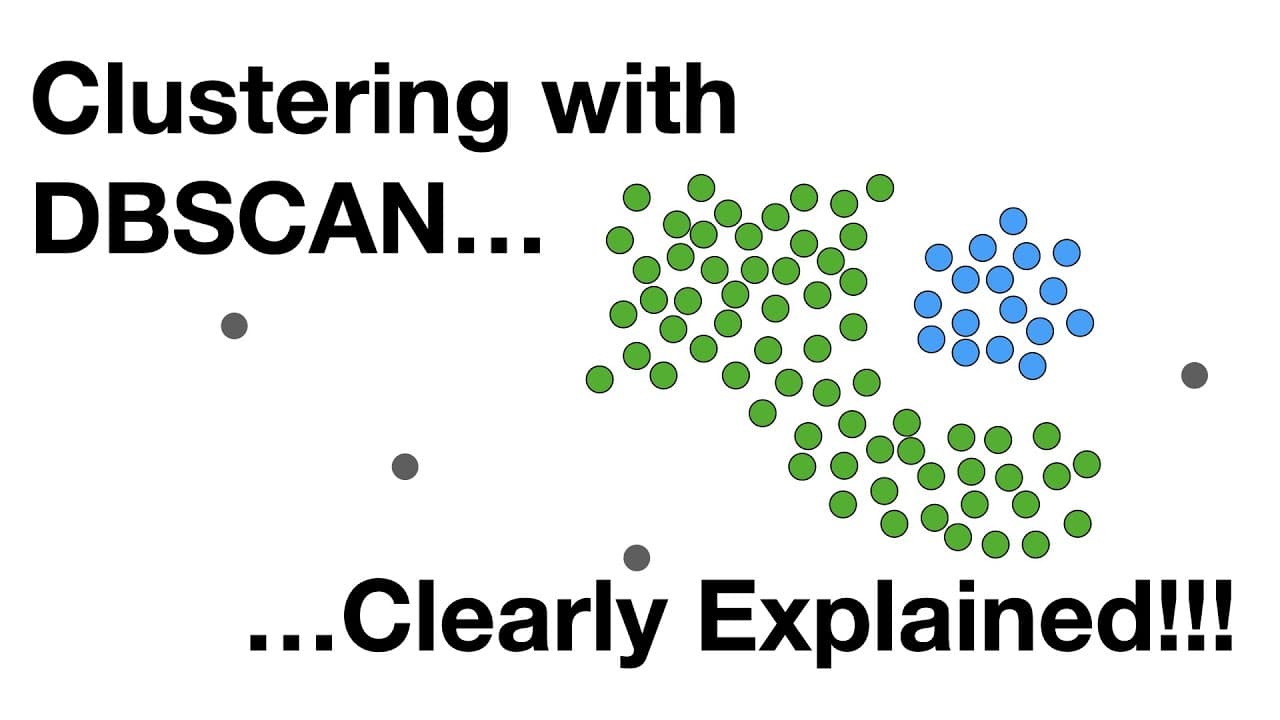
What Is DBSCAN and How Does It Identify Clusters?
260.0K views
•
January 10, 2022
by
StatQuest with Josh Starmer
YouTube video player
What Is DBSCAN and How Does It Identify Clusters?

TL;DR

DBSCAN is a clustering algorithm that identifies clusters based on point densities rather than traditional methods like k-means. It categorizes points into core and non-core points, where core points can initiate and expand clusters, while non-core points can only join existing clusters. DBSCAN effectively handles nested clusters and is suitable for high-dimensional data.

Transcript

dp scan clusters just like a person can statquest hello i'm josh starmer and welcome to statquest today we're going to talk about clustering with db scan and it's going to be clearly explained now imagine we collected weight and height measurements from a bunch of people and we plotted the people on a two-dimensional graph like this where we have w... Read More

Key Insights

  • 🪹 DBSCAN excels at identifying nested clusters traditional methods fail to recognize.
  • 💯 Core points in DBSCAN play a crucial role in initiating and extending clusters.
  • 💯 Non-core points in DBSCAN can only join clusters but not extend them further.
  • 😒 DBSCAN uses point densities to determine cluster boundaries effectively.
  • 😥 Outliers in DBSCAN are points not assigned to any cluster.
  • ✋ DBSCAN is suitable for high-dimensional data where visualizing clusters is challenging.
  • 😥 DBSCAN clusters are formed sequentially, preventing overlap of points in multiple clusters.

Install to Summarize YouTube Videos and Get Transcripts

Explore YouTube Video Summarizer or Get YouTube Transcript Extractor

Questions & Answers

Q: What are some limitations of traditional clustering methods like k-means in identifying nested clusters?

Traditional methods like k-means struggle with nested clusters, assigning points to incorrect clusters due to the nesting, unlike DBSCAN which handles this effectively.

Q: How does DBSCAN distinguish between core and non-core points in cluster formation?

DBSCAN defines core points as those close to a set number of points, using point densities to identify clusters, while non-core points can only join clusters without extending them further.

Q: Explain the process of cluster formation in DBSCAN algorithm.

DBSCAN starts by selecting a core point to initiate a cluster, extending by adding neighboring core points, and including non-core points close to the core points to form clusters step by step.

Q: How does the DBSCAN algorithm handle outliers in cluster formation?

DBSCAN classifies points not assigned to any cluster as outliers, ensuring only relevant core and non-core points contribute to cluster formation.

Summary & Key Takeaways

  • Traditional clustering methods like k-means fail with nested clusters.

  • DBSCAN identifies clusters by point densities, distinguishing core and non-core points.

  • Core points initiate clusters, growing to include neighboring core points and relevant non-core points.


Read in Other Languages (beta)

English

Share This Summary 📚

Summarize YouTube Videos and Get Video Transcripts with 1-Click

Download browser extensions on:

Try YouTube Summary with ChatGPT & Claude or YouTube Transcript Generator

Explore More Summaries from StatQuest with Josh Starmer 📚
CatBoost Part 2: Building and Using Trees thumbnail
CatBoost Part 2: Building and Using Trees
StatQuest with Josh Starmer
What Are ROC Curves and AUC in Classification? thumbnail
What Are ROC Curves and AUC in Classification?
StatQuest with Josh Starmer
Alternative Hypotheses: Main Ideas!!! thumbnail
Alternative Hypotheses: Main Ideas!!!
StatQuest with Josh Starmer
How to Calculate Maximum Likelihood for Binomial Distribution thumbnail
How to Calculate Maximum Likelihood for Binomial Distribution
StatQuest with Josh Starmer
What Are One-Hot, Label, and Target Encoding Techniques? thumbnail
What Are One-Hot, Label, and Target Encoding Techniques?
StatQuest with Josh Starmer
How Does Gradient Boosting Work for Regression? thumbnail
How Does Gradient Boosting Work for Regression?
StatQuest with Josh Starmer

Summarize YouTube Videos and Get Video Transcripts with 1-Click

Download browser extensions on:

Try YouTube Summary with ChatGPT & Claude or YouTube Transcript Generator

Apps & Extensions

  • Chrome Extension
  • Safari Extension
  • Edge Add-ons
  • Firefox Add-ons
  • iOS App
  • Android App

Key Features

  • YouTube Video Summarizer
  • Web & PDF Summarizer
  • Web & PDF Highlighter
  • Chat with PDF
  • Ask AI Clone
  • Audio Transcriber
  • Glasp Reader
  • Kindle Highlight Export
  • Idea Hatch

Integrations

  • Obsidian Plugin
  • Notion Integration
  • Pocket Integration
  • Instapaper Integration
  • Medium Integration
  • Readwise Integration
  • Snipd Integration
  • Hypothesis Integration

More Features

  • APIs
  • MCP Connector
  • Blog & Post
  • Embed Links
  • Image Highlight
  • Personality Test
  • Quote Shots
  • Open Graph Checker

Company

  • About us
  • Our Story
  • Blog
  • Community
  • FAQs
  • Job Board
  • Newsletter
  • Pricing
Terms

•

Privacy

•

Guidelines

© 2026 Glasp Inc. All rights reserved.