Relativistic Addition of Velocity | Special Relativity Ch. 6
TL;DR
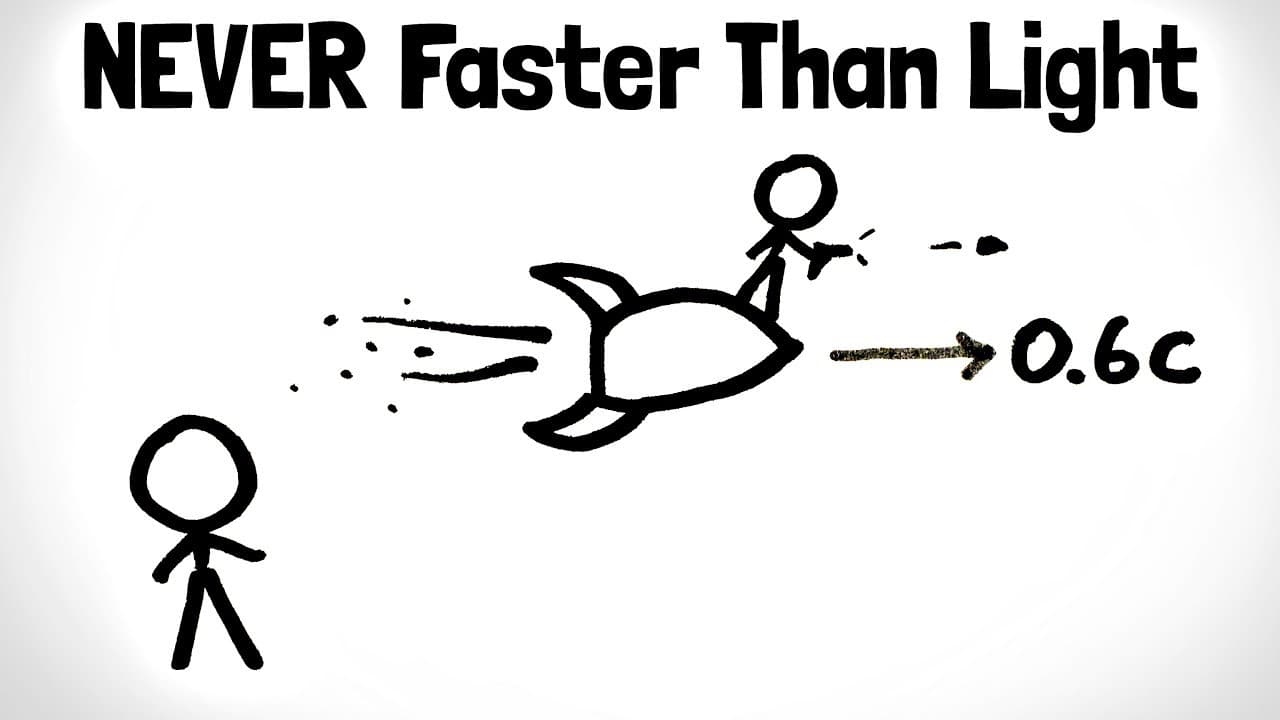
The Lorentz transformation in our universe represents a squeeze-stretch rotation of spacetime when changing perspectives, keeping the speed of light constant. Velocities in our universe don't simply add up and cannot exceed the speed of light.
Transcript
In our universe, when you change from a non-moving perspective to a moving one, or vice versa, that change of perspective is represented by a what's called Lorentz transformation, which is a kind of squeeze-stretch rotation of spacetime that I've mechanically implemented with this spacetime globe. Lorentz transformations keep the speed of light the... Read More
Key Insights
- 💱 Changing perspectives in our universe is represented by Lorentz transformations, a squeeze-stretch rotation of spacetime.
- 🙂 The speed of light remains constant for all perspectives, as experimentally verified.
- 🐎 Velocities in our universe do not simply add up when changing perspectives, and relative speeds cannot exceed the speed of light.
Install to Summarize YouTube Videos and Get Transcripts
Explore YouTube Video Summarizer or Get YouTube Transcript Extractor
Questions & Answers
Q: How does the Lorentz transformation represent a change in perspective?
The Lorentz transformation mechanically implements a squeeze-stretch rotation of spacetime when shifting from a non-moving perspective to a moving one or vice versa. It is a mathematical representation of how our universe behaves when changing perspectives.
Q: Why does the speed of light remain constant for all perspectives?
The constancy of the speed of light is an experimentally verified fact in our universe. Lorentz transformations ensure that the speed of light remains the same for all perspectives, as represented by the 45° line on a spacetime diagram.
Q: Do velocities add up when changing perspectives?
Velocities do not simply add up when changing perspectives in our universe. While they may approximately add up for speeds much slower than light, in general, relative velocities cannot exceed the speed of light.
Q: How does the equation describe relativistic velocities?
The equation v frommyperspective = v fromthemovingperspective + u / (1 + v fromthemovingperspective * u / c^2) describes the precise speed of an object from a different perspective. It shows that velocities never add up to a speed faster than light, aligning with the constant speed of light and the inability to accelerate to light speed.
Summary & Key Takeaways
-
Lorentz transformations represent a change in perspective and maintain the constant speed of light in our universe.
-
Velocities don't simply add up when changing perspectives, but almost do for slower speeds than light.
-
Relative speeds can never exceed the speed of light due to the way spacetime is perceived and how velocities combine.
Read in Other Languages (beta)
Share This Summary 📚
Summarize YouTube Videos and Get Video Transcripts with 1-Click
Try YouTube Summary with ChatGPT & Claude or YouTube Transcript Generator
Explore More Summaries from minutephysics 📚



Summarize YouTube Videos and Get Video Transcripts with 1-Click
Try YouTube Summary with ChatGPT & Claude or YouTube Transcript Generator