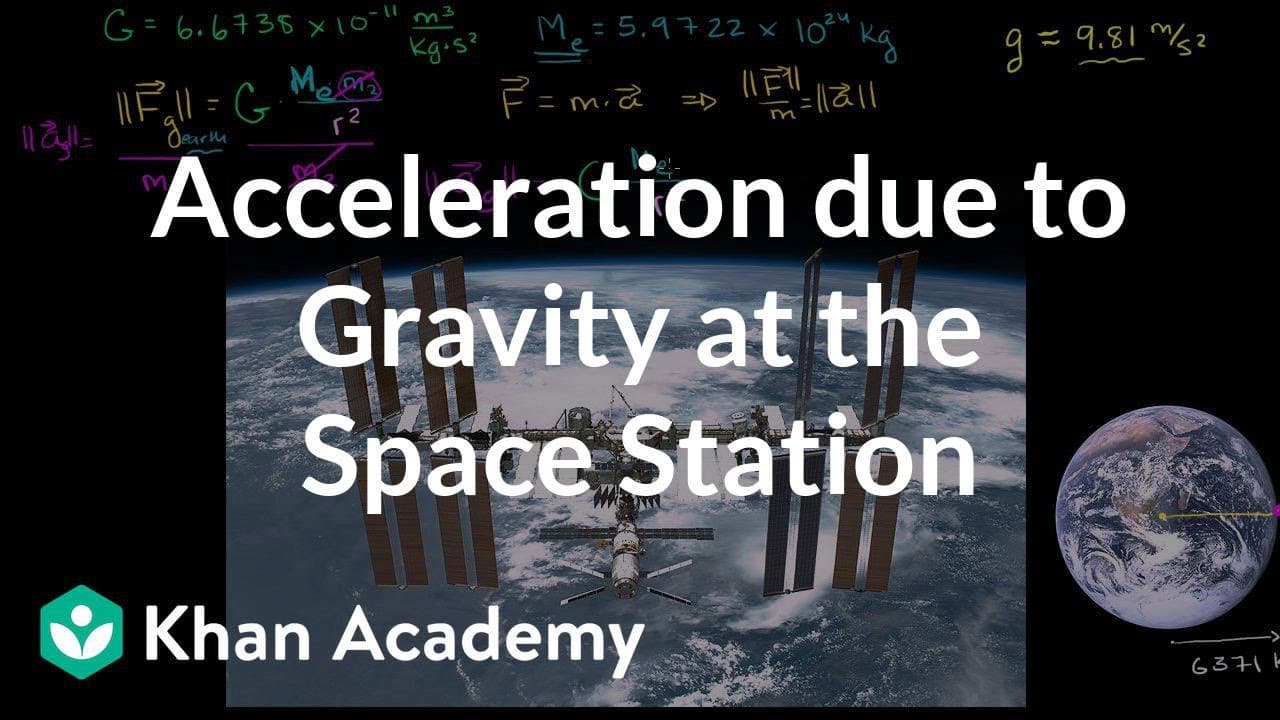
Acceleration due to gravity at the space station | Physics | Khan Academy
TL;DR
This video explains how to calculate the acceleration due to gravity using Newton's law of universal gravitation.
Transcript
Most physics books will tell you that the acceleration due to gravity near the surface of the Earth is 9.81 meters per second squared. And this is an approximation. And what I want to do in this video is figure out if this is the value we get when we actually use Newton's law of universal gravitation. And that tells us that the force of gravity bet... Read More
Key Insights
- 🟨 The accepted approximation of 9.81 meters per second squared for acceleration due to gravity near the Earth's surface is slightly lower than the value calculated using Newton's law of universal gravitation.
- 👱 Differences in Earth's shape, varied density, and minor effects such as air buoyancy contribute to the deviation between theoretical calculations and experimental measurements.
- ❓ The acceleration due to gravity decreases as the distance between an object and the Earth's center increases.
Install to Summarize YouTube Videos and Get Transcripts
Explore YouTube Video Summarizer or Get YouTube Transcript Extractor
Questions & Answers
Q: Why is the acceleration due to gravity near the Earth's surface usually approximated as 9.81 meters per second squared?
The common approximation of 9.81 meters per second squared is based on average measurements, which take into account Earth's shape and density irregularities. While it is not exact, it provides a close estimate for practical purposes.
Q: How does Newton's law of universal gravitation allow us to calculate the acceleration due to gravity?
By using the relationship between force, mass, and acceleration, we can divide the magnitude of the force of gravity by the mass being accelerated to determine the magnitude of the acceleration due to gravity.
Q: Why does the acceleration due to gravity decrease as we move further away from the Earth's surface?
The acceleration due to gravity decreases as we move further away from the Earth's surface because the distance between the object and the center of the Earth increases, which results in a weaker gravitational force.
Q: Why does the acceleration due to gravity change when we go to an altitude of 400 kilometers?
The acceleration due to gravity changes at an altitude of 400 kilometers because the radius used in the calculation is now the sum of the Earth's radius and the distance above the surface of the Earth. This leads to a decrease in acceleration compared to the surface value.
Summary & Key Takeaways
-
In this video, the speaker explores whether the commonly accepted value of 9.81 meters per second squared for acceleration due to gravity near the surface of the Earth is accurate.
-
Newton's law of universal gravitation states that the force of gravity between two objects is equal to the universal gravitational constant times the product of their masses, divided by the square of the distance between their centers of mass.
-
By applying this law to the Earth, the speaker calculates that the acceleration due to gravity at the surface should be 9.82 meters per second squared, which is slightly higher than the widely accepted value.
Read in Other Languages (beta)
Share This Summary 📚
Summarize YouTube Videos and Get Video Transcripts with 1-Click
Try YouTube Summary with ChatGPT & Claude or YouTube Transcript Generator
Explore More Summaries from Khan Academy 📚



Summarize YouTube Videos and Get Video Transcripts with 1-Click
Try YouTube Summary with ChatGPT & Claude or YouTube Transcript Generator